Dispensing Needle: Preparation, Placement and Process Control
A dispensing needle is the last few millimetres of the solder paste path, and it is where most dispensing problems start. The paste has to pass through a bore that is only a few hundred micrometres across, and the behaviour of that passage depends on the powder in the paste as much as on the air pressure behind it.
Dispensing is used for odd form parts, for rework, for small batches and for boards where a stencil is not economic. In all of those cases the deposit is judged by eye, which makes a repeatable needle setup the difference between a tidy joint and a pad covered in smeared paste.

Why the Bore Matters More Than the Gauge
A dispensing needle is sold by gauge, and the gauge number tells you the outer size rather than the passage. Two needles of the same gauge from different suppliers can have different internal diameters, and it is the internal diameter that decides whether paste flows or blocks.
The working rule is that the bore should be at least five times the largest particle in the paste, and closer to ten times where the paste contains a wide particle distribution. A type 3 paste with particles near the top of its range needs a noticeably larger bore than a type 5 paste used for the same dot.
Matching the Dispensing Needle to the Powder Type
The powder type is the starting point for a dispensing needle. A fine powder can pass a small dispensing needle and produce small dots, while a coarse powder in the same needle blocks, dispenses unevenly and leaves a tail on the pad. Where a fine powder is used, the bore can be reduced until the dot size is right rather than until the flow stops.
It is worth remembering that a smaller bore does not simply produce a smaller dot. It also raises the pressure needed for a given flow, increases the shear on the paste and warms it, which changes the viscosity of the paste that reaches the board. That is why a needle change should always be followed by a check of the deposit. The paste volume target applies to a dispensed dot as much as to a printed deposit.
Pressure, Time and Standoff Settings
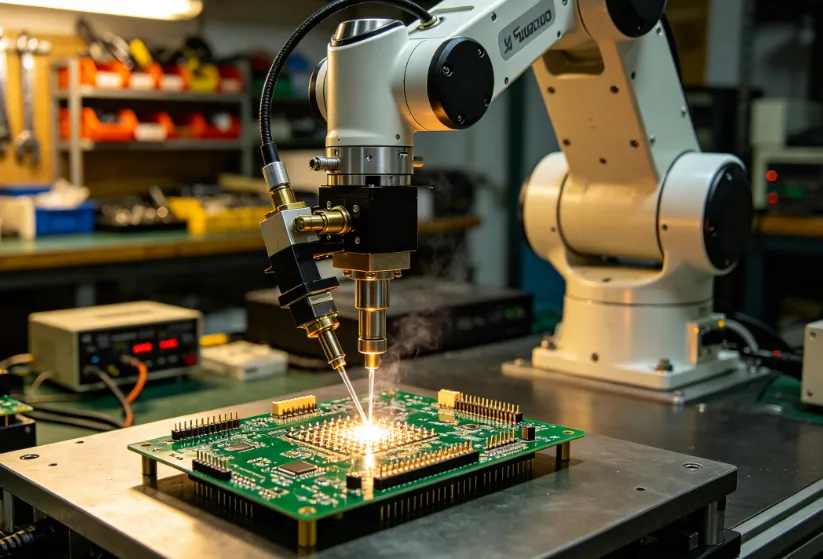
Three settings shape a dispensed dot: the air pressure, the valve open time and the gap between the needle tip and the pad. The pressure drives the paste, the open time decides how long it flows and the standoff decides how the dot breaks away from the tip.
Too much pressure or too long an open time leaves a dot with a tail and a halo of paste around it. Too little of either leaves a partial dot with a hollow centre. The standoff should be small enough that the dot touches the pad before the needle lifts, and large enough that the tip never presses into the pad or drags across a previous dot.
Temperature and Paste Condition
Paste viscosity follows temperature, so a syringe that is colder than the room dispenses less for the same settings. That is the usual reason a morning run produces small dots and an afternoon run produces large ones.
The cure is to bring the syringe to room temperature before use and to keep the bench at a stable temperature. A frozen syringe must be thawed in its sealed pack and never warmed with heat, because heat separates the flux from the powder and the paste that comes out first is not the paste that was specified. The paste working life clock starts when the syringe is opened, not when it is first dispensed.
Clogging and the Dispensing Needle Purge Routine
Paste dries in the dispensing needle within minutes when the valve is idle. The dried plug is harder than the incoming paste, so the next dot is small or absent, and the operator increases the pressure to compensate, which then produces an oversized dot once the plug breaks free.
A purge at the start of the shift and after every pause restores the flow, and a wipe of the tip removes the paste that collects on the outside. The needle itself is a consumable: a bent tip, a scored seat or a tip that has been cleared with a wire should be replaced rather than reused. Never ream a needle, because the bore and the seat are the two features that make the dot repeatable.
Checking the Dot
The check on a dispensing needle should be a measurement rather than an opinion. Dispense a row of dots onto a clean coupon, view them under low magnification and confirm the diameter, the shape and the absence of tails. Weighing a hundred dots gives an average volume that can be compared with the target.
The paste inspection system can be used for the same purpose where the coupon is a real panel, and it gives a volume figure that can be trended over a shift. A dot that is right at the start of the day and light at the end is telling you about temperature, drying or both.
Rework and Odd Form Cases
Rework is where dispensing earns its place. A single connector, a shielded part or a component that cannot see a stencil is soldered after a dot is placed by hand, and the deposit has to be consistent enough that the joint forms the same way every time.
For these cases the dispensing needle should be chosen for the largest pad in the work, not for the smallest. A needle that produces a small dot on a large pad forces the operator to deposit two or three times, and the result is a deposit with air trapped between the layers. The jetting and dispensing comparison explains when a valve is a better choice than a needle.
Consumables, Storage and Records
Needles, syringes and adapters are consumables and should be stocked as such. Keeping the same part number in use means that the settings published for a product still apply, and it removes a variable that is easy to overlook when a batch of dots looks wrong.
The record should show the needle gauge, the pressure, the open time and the standoff for each product, together with the paste type. Paste specifications follow the IPC standards for the material, and the dispensing settings are the shop side of the same specification.
FAQ
Can one dispensing needle be used for every paste on the line? In practice no, because the bore has to suit the powder type in the paste. A needle that is right for a type 5 paste will block with a type 3 paste, and a needle that suits the coarse paste will deposit too much of the fine one.
Why does a dispensed dot have a tail? A tail comes from paste that is still connected to the tip when the needle lifts, which is usually caused by too long an open time, too high a pressure or a standoff that is too large. Reducing one of those three at a time will show which one it is.
Is a longer needle better for reaching into a recess? It reaches further, but it adds dead volume and makes the pressure response slower, so the dot becomes harder to control. Where a recess has to be reached, a shorter needle on an angled adapter is usually the better answer.