High-Temperature PCB for Oil Exploration Instruments: Design, Materials, and Manufacturing
Oil and gas exploration increasingly relies on electronic instruments that must operate reliably in demanding downhole environments. During drilling, logging, measurement, and formation evaluation, electronic assemblies can be exposed to elevated temperatures, high pressure, mechanical vibration, shock, and chemically aggressive conditions.
In these applications, a conventional PCB may not provide sufficient thermal and mechanical reliability. Material selection, multilayer construction, copper adhesion, interconnect reliability, solder joints, component temperature ratings, and manufacturing controls all become critical.
A high-temperature PCB for oil exploration instruments is therefore not simply a standard circuit board made with a higher-temperature laminate. It is part of a complete electronics system engineered around the expected operating environment.
For downhole applications, PCB design and manufacturing must consider the entire reliability chain—from laminate selection and stackup design to fabrication, assembly, testing, and traceability.
What Is a High-Temperature PCB for Oil Exploration?
A high-temperature PCB is a circuit board designed to maintain its electrical, mechanical, and dimensional performance when exposed to temperatures significantly above those encountered by typical consumer electronics.
Oilfield and downhole electronics may require specialized PCB constructions depending on the application’s temperature range, pressure, vibration profile, operating duration, and chemical environment.
Potential requirements include:
- High glass-transition temperature (Tg)
- Appropriate decomposition temperature (Td)
- Low moisture absorption
- Stable dielectric properties
- Strong copper-to-laminate adhesion
- Low Z-axis expansion
- High interlaminar reliability
- Reliable plated through-holes
- Stable insulation resistance
- Robust solder and component interfaces
The appropriate material should be selected according to the complete temperature and reliability requirements rather than simply choosing the PCB laminate with the highest advertised temperature rating.
Why Oil Exploration Electronics Need High-Temperature PCBs
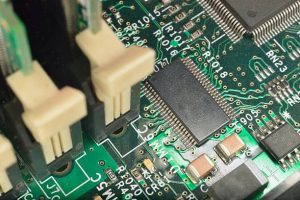
Downhole measurement and logging equipment can operate under conditions very different from conventional industrial electronics.
Elevated Temperature
As drilling depth increases, surrounding formation temperature can rise considerably. Long exposure to elevated temperatures accelerates material degradation and can affect dielectric properties, copper adhesion, solder joints, and component reliability.
High Pressure
Downhole tools can experience substantial pressure. Although PCB laminate itself is only one part of pressure resistance, internal materials, vias, solder joints, component packages, and mechanical encapsulation must all be compatible with the system’s pressure environment.
Mechanical Shock and Vibration
Drilling equipment is exposed to continuous vibration as well as mechanical shock. Repeated mechanical stress can contribute to:
- Plated-through-hole fatigue
- Solder-joint cracking
- Component displacement
- Copper trace damage
- Lamination defects becoming reliability failures
Chemical and Environmental Exposure
Depending on the application, electronic assemblies may encounter drilling fluids, hydrocarbons, moisture, corrosive substances, or other aggressive environments.
Consequently, the PCB material, surface finish, protective coatings, and overall assembly structure must be selected according to the actual exposure conditions.
Key Material Requirements for High-Temperature Downhole PCBs
Material selection is one of the most important decisions in high-temperature PCB engineering.
High-Tg and Thermally Stable Laminates
High-Tg materials can provide improved dimensional and mechanical stability at elevated temperatures compared with conventional low-Tg materials.
However, Tg should not be treated as the maximum continuous operating temperature. Other parameters—including Td, Z-axis CTE, dielectric stability, moisture behavior, and long-term thermal aging—also need to be considered.
For demanding oilfield electronics, material selection should therefore be based on the complete reliability profile rather than a single specification.
Low Z-Axis CTE
The coefficient of thermal expansion in the Z direction is particularly important for multilayer PCB reliability.
During repeated heating and cooling, excessive Z-axis expansion can place mechanical stress on plated through-hole copper. Proper laminate selection and controlled fabrication processes can reduce the risk of interconnect fatigue.
Moisture Resistance
Moisture can influence insulation resistance, dielectric performance, delamination risk, and processing reliability.
Material handling and PCB fabrication should therefore include appropriate moisture-control procedures, particularly for materials with greater sensitivity to environmental exposure.
High-Temperature PCB Stackup Design
The PCB stackup should be engineered before detailed routing begins.
For multilayer downhole electronics, stackup planning should consider:
- Number of signal layers
- Ground and power planes
- Dielectric thickness
- Copper thickness
- Controlled impedance requirements
- Thermal expansion
- Signal integrity
- Power distribution
- Via structure
- Mechanical constraints
A balanced multilayer construction can improve dimensional stability and help manage thermal and mechanical stresses.
For complex oilfield electronics, a professional multilayer PCB manufacturing process is particularly important because layer registration, lamination, drilling, plating, and dielectric thickness all influence long-term reliability.
PCB Fabrication Process for High-Temperature Applications
The manufacturing process must be adapted to the selected laminate and final reliability requirements.
1. Engineering and DFM Review
Before fabrication, manufacturing engineers should review the PCB data, stackup, material specification, drill structure, copper requirements, tolerances, and surface finish.
A DFM review can identify potential manufacturing risks before production begins.
Typical review items include:
- Minimum trace and spacing
- Hole size and aspect ratio
- Copper thickness
- Annular ring
- Layer registration
- Board thickness
- Via structure
- Solder mask requirements
- Surface finish
- Impedance requirements
2. Laminate Preparation
High-performance laminate materials should be stored and handled according to the material supplier’s requirements.
Improper storage or moisture exposure can affect subsequent lamination and reliability.
3. Inner-Layer Circuit Formation
For multilayer PCBs, inner-layer circuits are formed through imaging, development, etching, and inspection.
Fine-line requirements should be matched to the selected material and manufacturing process.
Automated optical inspection (AOI) can be used to identify circuit defects before lamination.
4. Lamination
Lamination is a critical stage for high-temperature multilayer PCBs.
Temperature, pressure, heating rate, resin flow, and curing conditions must be controlled according to the laminate system.
Insufficient or excessive resin flow can affect dielectric thickness and interlayer bonding. Poor process control may increase the risk of voids, delamination, or dimensional instability.
5. Drilling and Hole Metallization
Reliable vias are essential for multilayer downhole electronics.
Drilling parameters must be compatible with the selected material system. After drilling, desmear and copper metallization processes establish the conductive connection between layers.
For high-reliability applications, plated through-hole integrity is especially important because repeated thermal cycling can place stress on the copper barrel.
6. Outer-Layer Circuit Formation
Outer-layer copper is formed through imaging, plating, etching, and inspection.
Copper thickness and geometry should be controlled according to current-carrying requirements, signal-integrity requirements, and the design specification.
7. Solder Mask and Surface Finish
The solder mask provides electrical insulation and environmental protection, while the surface finish protects exposed copper and supports component assembly.
Possible surface finishes include ENIG, ENEPIG, OSP, HASL, and other application-specific options.
The correct choice depends on assembly technology, storage conditions, contact requirements, temperature exposure, and reliability objectives.
Why Copper and Interconnect Reliability Matter
In high-temperature PCB applications, the reliability of copper structures is just as important as the laminate itself.
Potential failure mechanisms include:
- Plated-through-hole fatigue
- Copper cracking
- Pad lifting
- Interfacial separation
- Via failure
- Trace resistance changes
- Delamination
Thermal cycling creates repeated expansion and contraction. Differences between the PCB material and copper can generate mechanical stress within the interconnect structure.
For this reason, high-temperature PCB manufacturing should include appropriate process controls for drilling, desmear, plating thickness, lamination, and thermal processing.
High-Temperature PCB Assembly Considerations
The PCB is only one part of a downhole electronic assembly.
Even if the laminate is capable of withstanding the target temperature, the components, solder materials, connectors, coatings, adhesives, and other construction materials must also be compatible with the operating environment.
Important assembly considerations include:
Component Temperature Ratings
Components should have appropriate operating and storage temperature ratings for the intended application.
A high-temperature PCB cannot compensate for components that are unsuitable for the operating environment.
Solder Joint Reliability
Thermal cycling and vibration can accelerate solder fatigue. Package selection, pad design, solder alloy, reflow profile, and mechanical support should therefore be considered together.
Protective Coatings and Encapsulation
Depending on the system architecture, conformal coating, potting, or other protective methods may be used.
The coating or encapsulation material must itself be compatible with the expected temperature, pressure, moisture, and chemical environment.
Mechanical Support
Large or heavy components may require additional mechanical reinforcement in high-vibration environments.
PCB mounting, connector retention, component placement, and enclosure design can all influence system reliability.
Testing High-Temperature PCBs
High-temperature PCB quality cannot be verified through visual inspection alone.
A comprehensive quality program can include:
- AOI inspection
- Electrical continuity and isolation testing
- X-ray inspection where appropriate
- Plated-hole inspection
- Dimensional inspection
- Solderability testing
- Thermal cycling
- High-temperature aging
- Insulation resistance testing
- Microsection analysis
- Environmental testing
The exact test program should be defined according to the product’s qualification requirements.
Thermal Cycling
Thermal cycling evaluates the PCB’s ability to withstand repeated temperature changes.
It can help reveal weaknesses in:
- Plated through-holes
- Vias
- Lamination
- Copper interfaces
- Solder joints
High-Temperature Aging
High-temperature aging can provide useful information about material and assembly stability over extended exposure.
However, accelerated testing should be designed carefully so that the test conditions remain representative of the actual failure mechanisms.
Vibration Testing
Because drilling tools experience mechanical vibration, vibration testing may be required at the assembly or system level.
PCB construction, component attachment, solder joints, and mechanical mounting should all be evaluated.
PCB Design Optimization for Downhole Electronics
In addition to material selection, PCB layout has a significant influence on reliability.
Designers should consider:
Thermal Distribution
High-power components should be positioned to control localized heat concentration.
Copper planes and thermal vias can help spread heat when compatible with the mechanical and manufacturing requirements.
Signal Integrity
Measurement and logging instruments may process low-level sensor signals alongside power and high-speed digital circuits.
Sensitive analog circuits should be separated from high-noise switching circuits where practical.
Controlled impedance may be required for high-speed interfaces.
For demanding applications, PCB design and layout engineering can help optimize stackup, routing, thermal paths, and manufacturability before fabrication.
PCB Design and Layout Engineering
Grounding and Shielding
A carefully designed ground structure can reduce unwanted coupling between analog, digital, and power circuits.
Shielding may also be required depending on the tool architecture and electromagnetic environment.
Prototype Testing Before Production
Oil exploration electronics can involve expensive mechanical assemblies, long development cycles, and difficult field-service conditions.
Building PCB prototypes before mass production provides an opportunity to verify:
- Material selection
- Stackup construction
- Component placement
- Thermal performance
- Signal integrity
- Mechanical compatibility
- Assembly reliability
- Environmental performance
Prototype testing can identify design weaknesses before they become production-scale problems.
A supplier with dedicated rapid PCB prototyping capability can help engineering teams shorten the design-validation cycle.
Applications of High-Temperature Oilfield PCBs
High-temperature PCB technology can support a wide range of oil and gas exploration electronics, including:
- Measurement-while-drilling (MWD) systems
- Logging-while-drilling (LWD) equipment
- Downhole logging tools
- Formation evaluation instruments
- Pressure and temperature measurement systems
- Downhole telemetry
- Geophysical measurement equipment
- Drilling instrumentation
- Well-monitoring electronics
The actual PCB construction depends on the target temperature, pressure, vibration, operating duration, electrical architecture, and mechanical packaging.
How to Choose a High-Temperature PCB Manufacturer
Choosing the right manufacturing partner is critical for demanding downhole electronics.
A suitable high-temperature PCB manufacturer should be able to demonstrate capabilities in:
Advanced Material Processing
The manufacturer should understand high-Tg and specialized laminate systems and be able to control their processing parameters.
Multilayer Manufacturing
Complex downhole electronics may require multilayer structures, controlled impedance, dense routing, or specialized via structures.
High-Reliability Plating
Reliable copper plating is essential for maintaining interlayer electrical connections during thermal and mechanical stress.
Process Traceability
Material batches, fabrication parameters, inspection results, and testing data should be traceable when required by the customer’s quality system.
Prototype-to-Production Support
A strong supplier should be capable of supporting the project from prototype fabrication through stable production.
For projects requiring both fabrication and assembly, integrated PCB assembly services can simplify supplier coordination and quality management.
Why DFM Matters for High-Temperature PCB Manufacturing
Design-for-manufacturing should be performed before production rather than after fabrication problems appear.
A DFM review can help identify:
- Excessive aspect ratios
- Difficult drill structures
- Insufficient annular rings
- Unbalanced copper distribution
- Lamination risks
- Fine-line manufacturing limitations
- Insufficient spacing
- Surface-finish constraints
- Assembly-related problems
For high-reliability electronics, DFM is not simply a cost-reduction exercise. It is an important part of preventing manufacturing variation from becoming a field reliability issue.
From Prototype to Volume Production
The transition from prototype to production should preserve the validated material system and manufacturing process wherever possible.
Important production controls include:
- Approved material specifications
- Controlled PCB stackup
- Standardized fabrication parameters
- Documented inspection procedures
- Electrical testing
- Process traceability
- Lot identification
- Change-control procedures
- Final quality inspection
For demanding oilfield electronics, consistency between prototype and production is especially important because field replacement or repair can be difficult and expensive.
Conclusion
High-temperature PCBs are an important enabling technology for oil exploration instruments operating in demanding downhole environments.
The key challenge is not simply selecting a PCB laminate with a high temperature rating. Reliable performance requires a coordinated approach covering material selection, stackup design, thermal management, plated-hole reliability, PCB fabrication, component selection, assembly, mechanical support, environmental protection, and qualification testing.
For oil exploration applications, PCB manufacturers should work closely with the engineering team to understand the actual temperature, pressure, vibration, chemical exposure, operating duration, and electrical requirements before recommending a manufacturing solution.
With controlled materials, optimized PCB manufacturing, rigorous inspection, and application-specific validation, high-temperature PCB assemblies can provide the electrical and mechanical reliability required by advanced downhole measurement, logging, and drilling systems.