Your PCBA is ready for shipment, but you suddenly discover that several components are missing RoHS compliance documentation. To avoid a material shortage, you approve alternative parts—only to find that their compliance status cannot be verified. Then your customer requests complete material declarations and production traceability records before the product can enter the target market.
These problems rarely begin at the end of the manufacturing process. In many cases, they originate much earlier—during BOM review, component sourcing, and PCB assembly supplier selection.
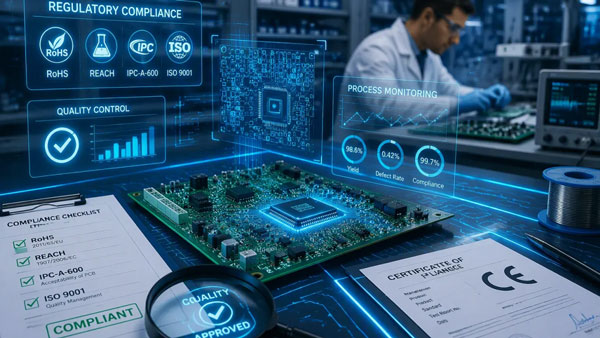
For companies developing electronic products for export, certification, or long-term production, choosing a RoHS compliant PCB assembly service means much more than using lead-free solder or receiving a RoHS certificate from a supplier.
A reliable PCBA partner should control RoHS-related risks throughout the manufacturing process—from BOM review and component sourcing to PCB fabrication, SMT Assembly and Through Hole Assembly, inspection, and production traceability.
What Does RoHS Compliant PCB Assembly Mean?
RoHS stands for Restriction of Hazardous Substances. The RoHS standard restricts certain hazardous substances in electrical and electronic products.
For PCBA manufacturing, RoHS compliance is not limited to the soldering process. A typical PCB assembly may contain dozens or even hundreds of components and materials, including:
- ICs, MCUs, MPUs, and MOSFETs
- Resistors, capacitors, and inductors
- Connectors, switches, and other electromechanical components
- PCB substrates and surface finishes
- Solder paste and solder materials
- Other manufacturing materials
This creates an important point:
A lead-free assembly process does not automatically mean that the entire PCBA meets the requirements for a RoHS compliant PCB assembly.
Even if the PCB itself meets the required specifications, the finished PCBA may still have compliance risks if certain components or materials cannot provide adequate documentation.
For this reason, effective RoHS compliance should be managed across the entire PCBA supply chain—not treated as a final inspection item.
5 Things to Check When Choosing a RoHS PCB Assembly Service
1. Can the Supplier Verify RoHS Compliance at the BOM Stage?
The BOM is one of the first places where potential compliance problems can be identified.
Many companies assume that an approved BOM automatically guarantees compliance. However, the actual component purchased may depend on the manufacturer, production batch, authorized distributor, and available supply channel.
A typical problem can look like this:
Approved BOM → Original component becomes unavailable → Supplier finds a substitute → Production continues → RoHS documentation is missing before shipment
At that point, resolving the issue may require new sourcing, customer approval, rework, or even rebuilding the affected batch.
A professional RoHS PCB assembly service should therefore review potential material risks before production begins.
When evaluating a supplier, ask whether they can:
- Review the BOM before purchasing
- Verify manufacturer and Part Number information
- Identify obsolete or hard-to-source components
- Check component compliance documentation
- Flag potential material risks
- Obtain customer approval before introducing substitutes
Early BOM review can prevent a compliance problem from becoming a production problem.
2. How Does the Supplier Manage Component Substitutions?
Component shortages are common in electronics manufacturing.
When an IC, MOSFET, connector, or other component becomes unavailable, finding an alternative may seem like a simple purchasing decision.
For a RoHS-controlled PCBA, however, the replacement part needs to meet more than just the availability requirement.
The supplier should consider:
- Electrical specifications
- Package and footprint compatibility
- Manufacturer information
- Lifecycle status
- Material compliance
- Availability of supporting documentation
- Customer approval requirements
A better substitution process is:
Shortage identified → Alternative screened → Technical parameters verified → RoHS status checked → Customer approval → Purchasing → Production
This approach helps prevent a common situation where a supplier solves a shortage but introduces a new quality or compliance risk.
For long-term production programs, proper substitute management is particularly important because an unverified replacement can affect multiple future production batches.
3. Does Lead-Free PCB Assembly Mean the PCBA Is RoHS Compliant?
Not necessarily.
Some suppliers promote their manufacturing capability by stating:“We provide lead-free PCB assembly.”
Lead-free soldering is an important part of many RoHS-compliant manufacturing processes. However, lead-free production alone does not prove that every material used in the PCBA meets the required compliance requirements.
RoHS-related control may involve:
BOM Review → Component Sourcing → Incoming Inspection → Lead-Free SMT/DIP → Process Inspection → Final Inspection → Traceability
This is why companies should look beyond the question:
“Can you provide lead-free PCB assembly?”
A better question is:
“How do you control RoHS compliance throughout the PCBA manufacturing process?”
The supplier’s answer can reveal much more about its actual manufacturing capabilities.
4. Can the Supplier Provide Complete Material and Production Traceability?
Another important consideration is traceability.
A PCBA supply chain may involve several independent suppliers:
PCB Manufacturer → Component Suppliers → SMT Factory → Testing Provider
This model can work, but it can become difficult to manage when a product requires strict material control and long-term traceability.
Imagine that a customer discovers a potential material issue in one PCBA batch.
You may need to determine:
- Which PCB batch was used?
- Where did the components come from?
- Which supplier provided the affected component?
- What was the component lot number?
- Was a substitute used?
- When was the substitute introduced?
- Which PCBA batches contain the affected material?
- Which inspection and production records are available?
If this information is distributed across multiple suppliers, identifying the affected products can take significantly longer.
A one-stop PCB assembly service can reduce these information gaps by integrating PCB manufacturing, component sourcing, assembly, testing, and production records within a more unified process.
5. Is a RoHS Certificate from the Supplier Enough?
A supplier’s RoHS declaration or certificate can be useful during supplier qualification, but it should not be the only factor used to evaluate RoHS compliance.
The more important question is:
How does the supplier maintain compliance from one production batch to the next?
Consider asking:
- How are components sourced?
- Are suppliers qualified and controlled?
- Are incoming materials inspected?
- How are BOM changes managed?
- How are alternative components approved?
- Can material batches be traced?
- Are appropriate lead-free SMT/DIP processes used?
- What inspection equipment is available?
- How long are production and quality records retained?
These questions help distinguish a supplier with a genuine compliance management process from one that simply provides a certificate.
How to Evaluate a RoHS-Compliant PCB Assembly Supplier
If you are sourcing PCBA for industrial control systems, medical electronics, energy products, communications equipment, IoT devices, or other electronic products, consider the following criteria:
| Evaluation Area | What to Check |
|---|---|
| RoHS Compliance | Can materials be managed according to project and market requirements? |
| BOM Review | Can potential component and compliance risks be identified before production? |
| Component Sourcing | Does the supplier have reliable and traceable sourcing channels? |
| Alternative Parts | Are substitutions technically reviewed and customer-approved? |
| PCB Manufacturing | Do PCB materials and surface finishes meet project specifications? |
| Lead-Free Assembly | Does the supplier have established lead-free SMT/DIP processes? |
| Quality Inspection | Are SPI, AOI, X-ray, ICT, and/or FCT available? |
| Traceability | Can materials, batches, and production records be traced? |
| Engineering Support | Can the supplier support BOM review, DFM, and manufacturing engineering? |
| One-Stop Manufacturing | Can PCB, sourcing, assembly, testing, and related processes be managed through one supplier? |
Why Choose a One-Stop PCB Assembly Service for RoHS-Controlled Products?
For many electronics companies, the biggest manufacturing challenge is not SMT placement itself. It is managing the gaps between PCB manufacturing, component sourcing, assembly, testing, and quality control.
When each process is handled by a different supplier, a small component or material change may require coordination across multiple companies.
A one-stop PCBA manufacturing model can integrate:
PCB Manufacturing → BOM Review → Component Sourcing → SMT Assembly → DIP Assembly → PCBA Testing → Final Inspection → Production Traceability
This provides better visibility across the manufacturing process and makes it easier to identify material and compliance risks before they affect mass production.
For R&D teams with limited manufacturing resources, working with an integrated PCBA supplier can also reduce supplier coordination and allow engineers to focus more on product development.
What Should You Look for in a RoHS-Compliant PCBA Manufacturer?
When evaluating a potential supplier, do not focus only on assembly price, placement speed, or the number of SMT lines.
A stronger PCBA partner should be able to support your project across multiple stages:
Before Production
- BOM review
- Component sourcing
- Compliance documentation review
- Alternative component evaluation
- DFM and manufacturing engineering support
During Production
- Controlled material handling
- Lead-free SMT/DIP assembly
- SPI inspection
- AOI inspection
- X-ray inspection where required
- ICT/FCT testing where applicable
After Production
- Final quality inspection
- Material and production traceability
- Batch-level production records
- Support for customer documentation and audits
This broader approach helps turn RoHS compliance from a last-minute documentation issue into a controlled part of the manufacturing process.
How Kingda Supports RoHS-Compliant PCB Assembly
Kingda provides one-stop PCB assembly services covering PCB manufacturing, component sourcing, SMT Assembly, DIP Assembly, PCBA testing, and additional PCBA manufacturing processes.
For projects that require RoHS compliance, our approach starts before production.
We can review BOM requirements, manage component sourcing, identify potential material risks, and evaluate alternative components when original parts become unavailable.
During production, Kingda uses SPI, AOI, X-ray, ICT/FCT, and other inspection methods according to project requirements. Material and production information can also be managed for better batch traceability.
Our goal is not simply to answer:
“Can you assemble this PCB?”
We also need to answer:
“Are the materials properly controlled?”
“Have alternative components been verified?”
“Is the manufacturing process under control?”
“Can the relevant production information be traced if a problem occurs?”
For industrial control, medical electronics, energy, communications, IoT, and other electronic products, this approach helps reduce material, quality, and supply-chain risks throughout the PCBA manufacturing process.
Final Thoughts: Choose RoHS Compliance Before Production Starts
For electronic products intended for export, certification, or long-term mass production, RoHS compliance should not be checked only before shipment.
The most effective approach is to identify potential risks early:
BOM Review → Material Verification → Component Sourcing → Approved Substitution → Controlled Manufacturing → Quality Inspection → Production Traceability
When these processes are properly managed, many potential compliance and supply-chain problems can be resolved before they affect production or shipment.
So when choosing a RoHS-compliant PCB assembly service, do not compare suppliers based only on price or SMT capacity.
Look for a manufacturing partner with:
- Strong BOM and material review capabilities
- Reliable component sourcing
- Controlled alternative-part management
- Mature lead-free manufacturing processes
- Comprehensive quality inspection
- Production and material traceability
- Engineering support throughout the project
A professional PCBA manufacturer should do more than assemble your PCB.
It should help you reduce material, quality, compliance, and supply-chain risks from the BOM stage through mass production.