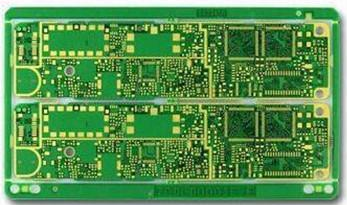
How to Choose Fast-Turn PCB Prototyping Services for Urgent Projects
When an electronics project is running on a tight schedule, every day can affect product development, testing, and market launch plans. A reliable Fast-Turn PCB Prototyping service can significantly shorten the time between PCB design completion and physical prototype validation.
However, choosing a fast PCB supplier should not be based on delivery time alone. A supplier may promise extremely short lead times but still create problems through inconsistent quality, poor communication, material shortages, or inadequate logistics.
For urgent projects, the ideal PCB supplier should provide a balance of speed, quality, manufacturing capability, communication, and delivery reliability.
1. Verify the Supplier’s Actual Fast-Turn Production Capability
The first step is to determine whether a supplier can genuinely support urgent PCB prototype orders rather than simply promising an aggressive delivery date.
Some PCB manufacturers advertise very short lead times but lack sufficient production capacity to handle rush orders consistently. Capacity constraints, equipment bottlenecks, material shortages, or inefficient production scheduling can quickly turn a promised fast delivery into a delayed shipment.
Before placing an urgent order, ask several important questions:
- Does the manufacturer have dedicated capacity for rush PCB orders?
- Can urgent prototypes be prioritized within the production schedule?
- What is the typical lead time for similar PCB specifications?
- When does the quoted lead time officially begin?
- Does the lead time end when the PCB is completed or when it is shipped?
- How does the manufacturer handle unexpected production problems?
It is also important to define the production timeline clearly. For example, the actual lead time may begin after Gerber files, specifications, payment, and engineering confirmation have all been completed.
A clear definition of the starting and ending points helps prevent misunderstandings and makes the delivery commitment easier to evaluate.
For customers who need both manufacturing and assembly, integrating PCB fabrication with assembly can further reduce project delays. You can learn more about Prototype PCB Assembly and how prototype boards can move efficiently from fabrication to assembly.
Evaluate Contingency Planning
Urgent production requires more than normal manufacturing capacity. Ask how the supplier responds to unexpected issues such as:
- Component or raw-material shortages
- Equipment downtime
- Engineering problems
- Manufacturing defects
- Last-minute design changes
- Logistics delays
A supplier with effective contingency procedures is more likely to maintain predictable delivery performance when unexpected problems occur.
2. Make Sure Fast Delivery Does Not Mean Lower PCB Quality
Speed should never come at the expense of PCB reliability.
A poorly manufactured prototype can create additional delays because engineers may need to repeat testing, modify the design, or order another batch. In some cases, the time lost through rework can be much greater than the time saved by choosing an unreliable rush service.
A professional PCB Prototype supplier should maintain essential quality-control procedures even when an order is expedited.
Important quality-control areas may include:
- Incoming material inspection
- Engineering review
- Layer alignment verification
- Drilling inspection
- Plating and copper thickness control
- Solder mask inspection
- Surface finish inspection
- Electrical testing
- Visual inspection
The exact inspection requirements should depend on the PCB design, application, materials, and customer specifications.
Check Special Manufacturing Requirements in Advance
Urgent projects sometimes involve special requirements such as:
- Controlled impedance
- Blind or buried vias
- Half-hole structures
- Heavy copper
- Fine-pitch designs
- High-frequency materials
- Special surface finishes
- Flexible or rigid-flex construction
Not every fast-turn manufacturing process is suitable for every PCB specification.
Before confirming an urgent order, ask the supplier to review the design and verify whether the required materials and manufacturing processes can be completed within the requested schedule.
For complex boards, professional PCB Manufacturing capabilities are particularly important because manufacturing limitations identified early can prevent costly delays later in the project.
3. Choose a Supplier With Efficient Engineering Communication
Communication becomes even more important when a project is urgent.
During normal production, there may be enough time to resolve questions gradually. In a rush project, however, a delayed engineering response can stop production completely.
Ideally, the supplier should provide a dedicated contact or engineering support team capable of quickly handling:
- Gerber file questions
- Stack-up confirmation
- Material selection
- Manufacturing feasibility
- Dimensional requirements
- Impedance requirements
- Surface finish specifications
- Design changes
- Production status updates
The contact person should also have enough technical knowledge to understand PCB manufacturing requirements.
For example, if a customer requests a specific via structure or unusual copper thickness, the supplier should be able to determine whether the requirement is manufacturable and explain any limitations rather than simply forwarding the request to another department.
Keep Production Status Transparent
For an urgent project, customers should not have to repeatedly ask where their boards are in the production process.
A useful production update may indicate whether the boards are:
- Under engineering review
- In material preparation
- In fabrication
- In drilling
- In plating
- In surface finishing
- Under electrical inspection
- Ready for shipment
Transparent progress updates allow engineering teams to coordinate downstream activities such as component procurement, PCB assembly, testing, and system integration.
4. Evaluate Logistics and Final Delivery Options
PCB production is only one part of the total project timeline.
Even if the boards are manufactured quickly, inefficient shipping can reduce or eliminate the benefit of fast production.
When selecting a Quick Turn PCB supplier, consider the available logistics options and whether the supplier can coordinate shipping according to your project schedule.
Potential options may include:
- Express delivery
- Air freight
- Standard international shipping
- Local courier services
- Consolidated shipments
- Partial or split shipments
Consider Partial Delivery
If a project requires a larger quantity of prototypes, partial shipment can sometimes shorten the overall development cycle.
For example, if some boards are completed earlier than others, the first completed batch can be shipped immediately for testing while the remaining boards continue through production.
This approach may allow engineers to begin validation earlier rather than waiting for the entire order to be completed.
Before choosing this option, confirm the additional shipping cost and whether partial delivery is practical for the project.
5. Assess Emergency After-Sales Support
Fast production is valuable only if the supplier can respond quickly when something goes wrong.
Urgent projects are particularly sensitive to issues such as:
- Electrical test failures
- Dimensional problems
- Cosmetic defects
- Incorrect specifications
- Manufacturing deviations
- Quantity discrepancies
- Last-minute design changes
Before placing an order, ask how the supplier handles quality complaints and urgent rework.
A strong supplier should have a clearly defined process for:
- Receiving the customer’s issue report
- Reviewing the technical evidence
- Identifying the root cause
- Determining responsibility
- Proposing a corrective action
- Organizing replacement or rework when appropriate
The supplier should also be able to evaluate whether a late-stage design change can be incorporated without unnecessarily disrupting the production schedule.
6. Compare Fast-Turn PCB Suppliers Using the Right Criteria
When evaluating several suppliers, delivery time should be only one factor.
A practical comparison can include the following:
| Evaluation Factor | What to Check |
|---|---|
| Production Capacity | Ability to handle urgent prototype orders |
| Lead Time | Clearly defined and realistic delivery schedule |
| Quality Control | Inspection and testing procedures |
| Engineering Support | Technical response speed and expertise |
| Material Availability | Ability to secure required PCB materials |
| Manufacturing Capability | Ability to handle your PCB specifications |
| Logistics | Flexible and reliable shipping options |
| Progress Tracking | Visibility into production status |
| After-Sales Support | Response to defects and urgent problems |
| Cost | Total cost including rush and shipping charges |
This approach is more reliable than simply selecting the supplier advertising the shortest lead time.
7. How to Reduce Risk When Ordering Rapid PCB Prototypes
Customers can also take several steps to make urgent PCB production more efficient.
Prepare Complete Manufacturing Files
Provide complete and accurate manufacturing documentation, including:
- Gerber files
- Drill files
- PCB specifications
- Layer count
- Board thickness
- Copper thickness
- Surface finish
- Solder mask requirements
- Special process requirements
- Quantity
- Required delivery date
Incomplete information can cause engineering questions and delay production.
Minimize Unnecessary Design Changes
Frequent changes after production begins can significantly affect the schedule.
Whenever possible, complete design verification before submitting the final manufacturing package.
Confirm the Deadline Before Production Starts
Do not assume that an advertised lead time automatically applies to your specific PCB.
Instead, ask the manufacturer to confirm the production schedule based on your actual:
- Board size
- Layer count
- Quantity
- Material
- Surface finish
- Manufacturing complexity
- Testing requirements
This produces a much more realistic expectation.
8. Why Fast-Turn PCB Prototyping Is Important for Product Development
Rapid prototyping is particularly valuable during the early stages of electronics development.
A physical PCB prototype allows engineers to verify:
- Circuit functionality
- Component placement
- Mechanical fit
- Signal performance
- Thermal behavior
- Assembly feasibility
- Manufacturing issues
Identifying problems at the prototype stage is generally much less costly than discovering them after mass production begins.
For projects requiring only a limited number of boards, Low-Volume PCB Assembly can also help teams move from prototype validation to small-scale production without immediately committing to large quantities.
9. Fast Does Not Mean Cutting Corners
The most important principle when choosing a Rapid PCB Prototyping service is that speed and quality should work together.
A reliable supplier should be able to shorten unnecessary waiting time through efficient engineering review, production scheduling, material management, inspection, and logistics—not by eliminating essential manufacturing and quality-control procedures.
The best fast-turn PCB service therefore combines:
- Realistic and controllable lead times
- Stable manufacturing quality
- Strong engineering support
- Transparent production updates
- Flexible logistics
- Responsive after-sales service
Conclusion
Choosing a fast PCB prototyping supplier for an urgent project requires more than comparing advertised delivery times. The real question is whether the supplier can consistently deliver the required boards quickly, correctly, and reliably.
Before placing an urgent order, evaluate the supplier’s actual production capacity, quality-control procedures, engineering communication, logistics capabilities, and emergency support.
A well-managed Fast-Turn PCB Prototyping process can help engineers validate designs earlier, reduce development delays, and move products toward testing and production more efficiently.
For projects that require both PCB fabrication and assembly, an integrated manufacturing and assembly workflow can provide additional time savings and simplify supplier coordination.