What Is an LED PCB?
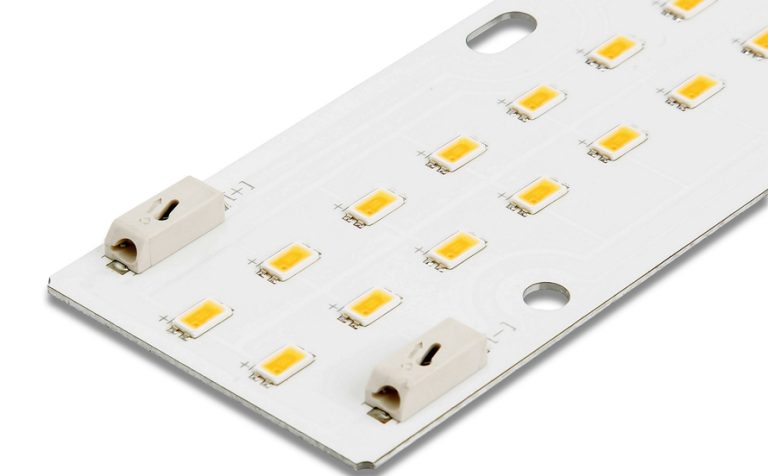
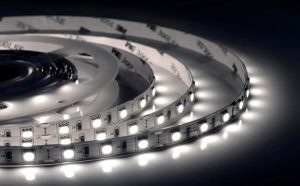
An LED PCB, also known as an LED printed circuit board, is a circuit board specifically designed to support, connect, control, and dissipate heat from light-emitting diodes (LEDs). Compared with conventional circuit boards, LED PCBs are often designed with greater emphasis on thermal management, electrical distribution, mechanical stability, and optical performance.
Before discussing LED PCBs, it is useful to understand how an LED works.
A light-emitting diode is a semiconductor device that emits light when current flows through it in the forward direction. An LED is formed by a p-type semiconductor and an n-type semiconductor that create a p-n junction. When the device is forward-biased, electrons and holes recombine in the junction region and release energy in the form of photons, producing visible or infrared light depending on the semiconductor material and device structure.
An LED Circuit Board provides the electrical and mechanical foundation for LED components. It can be designed for individual LEDs, LED arrays, high-power LEDs, or complex lighting modules.
Because LEDs convert a large proportion of electrical energy into light but still generate heat, effective heat dissipation is particularly important. For high-power LED applications, the PCB substrate and copper structure must efficiently transfer heat away from the LED junction and into a heat sink or other cooling structure.
LED PCBs are therefore widely used in lighting, displays, automotive electronics, architectural illumination, signage, consumer electronics, industrial equipment, and horticultural lighting.
Applications of LED PCBs
LED technology has transformed modern lighting and display systems because of its efficiency, compact size, long operating life, and design flexibility.
Common applications of an LED PCB include the following.
Architectural and Decorative Lighting
LED PCBs are widely used in architectural lighting for buildings, bridges, monuments, public spaces, and commercial facilities.
LED modules can be individually controlled to create different colors, brightness levels, dynamic patterns, and lighting effects. This makes LED technology suitable for both functional illumination and decorative applications.
Automotive Lighting
LED PCBs play an important role in modern automotive lighting systems.
They are commonly used in:
- Headlights
- Taillights
- Brake lights
- Turn signals
- Daytime running lights
- Interior lighting
- Dashboard illumination
Their compact size, fast response, long service life, and resistance to vibration make LEDs suitable for automotive environments.
LED Displays and Digital Signage
LED PCBs are fundamental components in digital signage and display systems.
They support densely arranged LED arrays that can produce bright images, text, logos, advertising content, and other visual information. Proper PCB design is essential for achieving consistent brightness, accurate alignment, reliable signal transmission, and effective heat dissipation.
Horticultural Lighting
LED lighting is increasingly used in agriculture and controlled-environment farming.
Different LED wavelengths can be selected to provide light spectra suitable for plant growth. Properly designed LED PCBs can support high-density LED arrays while maintaining controlled operating temperatures, helping improve the reliability and efficiency of horticultural lighting systems.
Consumer Electronics
LED PCBs are also found in many consumer electronic products, including:
- Smart televisions
- Smartwatches
- Mobile and portable devices
- Smart-home products
- Display panels
- Electronic indicators
- Portable lighting equipment
The small footprint and low power consumption of LEDs make them particularly suitable for compact electronic products.
Industrial and Commercial Lighting
LED PCBs are widely used in industrial lamps, streetlights, warehouse lighting, office lighting, commercial displays, machine indicators, and specialized illumination equipment.
For these applications, PCB design must account for continuous operation, environmental conditions, thermal cycling, and long-term reliability.
Advantages of LED PCBs
An LED Circuit Board provides several advantages compared with traditional lighting circuit structures.
High Energy Efficiency
LEDs generally convert electrical energy into light more efficiently than many traditional lighting technologies.
Lower power consumption can reduce operating costs and make LED systems suitable for applications where energy efficiency is a major requirement.
Long Operating Life
LEDs can provide a very long operating life when operated within their specified electrical and thermal limits.
However, the actual service life of an LED system depends not only on the LED itself but also on junction temperature, driver quality, PCB thermal performance, operating conditions, and environmental factors.
Excellent Durability
LED lighting systems have no fragile filaments like traditional incandescent lamps.
A properly designed LED PCB can provide good resistance to vibration, mechanical shock, and environmental stress, making it suitable for automotive, industrial, and outdoor applications.
Compact Form Factor
LEDs are available in very small packages, allowing manufacturers to develop compact lighting modules and high-density display systems.
The PCB can also be customized to fit specific mechanical dimensions and product geometries.
Instant Illumination
LEDs can reach their operating brightness almost immediately after power is applied.
Unlike some conventional lamps that require warm-up time, LEDs can provide rapid response, which is particularly useful for indicators, automotive lighting, signaling systems, and automated equipment.
Flexible Design
An LED PCB can be customized according to the required LED arrangement, electrical characteristics, dimensions, brightness, color, and control method.
LED arrays can be designed for different colors, intensities, beam patterns, and lighting effects. This provides designers with considerable flexibility when developing specialized lighting products.
Limitations of LED PCBs
Although LED PCBs offer significant advantages, several engineering challenges need to be considered.
Initial Cost
The initial cost of an LED lighting system can be higher than that of some traditional lighting solutions.
However, lower energy consumption, reduced maintenance requirements, and longer operating life can offset the initial investment over the product’s service life.
Thermal Management
Heat is one of the most important challenges in high-power LED applications.
Although LEDs are highly efficient, a portion of the electrical energy is still converted into heat. Excessive junction temperature can reduce light output, accelerate aging, change color characteristics, and shorten operating life.
Therefore, effective Thermal Management is essential.
Depending on the application, thermal solutions may include:
- Aluminum substrates
- Copper substrates
- Thermal vias
- Thick copper layers
- Heat sinks
- Thermal interface materials
- Forced-air cooling
Voltage Sensitivity
LEDs are current-sensitive devices. Excessive current can rapidly increase junction temperature and potentially damage the LED.
Therefore, LED systems normally require an appropriate constant-current driver or other suitable current-regulation circuitry.
The PCB and driver design should also account for voltage fluctuations, transient conditions, and electrical protection.
Manufacturing Complexity
High-density LED assemblies require precise component placement and reliable soldering.
High-power LED PCBs also require careful control of substrate materials, copper thickness, thermal interfaces, surface finishes, and dimensional tolerances.
As LED package sizes continue to decrease and LED density increases, manufacturing accuracy becomes increasingly important.
LED PCB Design Principles
The design of an LED PCB involves several stages, including schematic development, component selection, PCB layout, thermal analysis, material selection, Gerber generation, BOM preparation, prototype assembly, and testing.
Selecting the Right PCB Material
Material selection should be based on electrical, thermal, mechanical, and environmental requirements.
Common substrate options include:
- FR-4
- Aluminum PCB
- Copper-based PCB
- Ceramic substrates
- Other thermally conductive PCB materials
For low-power LED indicators, conventional FR-4 may be sufficient.
For high-power lighting applications, an Aluminum PCB or other metal-core structure may provide significantly better thermal performance.
Thermal Management
Thermal Management should be considered from the beginning of the PCB design process rather than added after the layout is completed.
For high-power LEDs, the thermal path generally extends from the LED package through the PCB substrate and into the heat-dissipation structure.
An MCPCB (Metal Core Printed Circuit Board) is commonly used for this purpose.
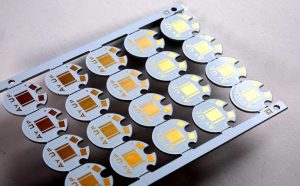
An MCPCB generally consists of a metal core, dielectric layer, and copper circuit layer. The metal core provides a thermal path that can transfer heat away from high-power components more efficiently than conventional organic substrates.
Thermal vias can also be used in suitable multilayer PCB designs to transfer heat between copper layers.
Electrical Layout
The PCB traces must provide stable power to the LED array while maintaining acceptable voltage drop and current density.
Designers should consider:
- Trace width
- Copper thickness
- Current density
- Voltage drop
- Grounding
- Power distribution
- LED array configuration
- Driver placement
For high-current LED systems, wider traces and thicker copper may be required.
Uniform current distribution is also important for maintaining consistent brightness across an LED array.
Optical Design
PCB design can also influence the optical performance of an LED module.
LED position, spacing, orientation, and mechanical tolerances should be coordinated with optical components such as:
- Lenses
- Reflectors
- Diffusers
- Light guides
Accurate LED placement helps achieve the required beam angle, brightness uniformity, color mixing, and illumination pattern.
Component Placement
LED components can be mounted using surface-mount technology (SMT) or through-hole technology (THT), depending on the product requirements.
For high-volume production, automated pick-and-place equipment can provide accurate and repeatable component placement.
The placement process should consider LED polarity, package orientation, thermal pads, solder-pad geometry, and optical alignment.
LED PCB Layout Best Practices
A well-designed PCB Design should balance electrical performance, thermal performance, optical requirements, manufacturing capability, and mechanical constraints.
Important layout practices include:
Keep High-Current Paths Short and Wide
High-current LED power paths should be designed with appropriate trace widths and copper thicknesses.
Shorter current paths can reduce voltage drop and resistive losses.
Place Thermal Components Appropriately
High-power LEDs should be positioned so that heat can flow efficiently toward the cooling structure.
Heat-generating components should be separated from temperature-sensitive components whenever possible.
Optimize LED Spacing
LED spacing should match the optical design requirements.
Insufficient spacing can lead to uneven illumination or unwanted thermal concentration, while excessive spacing may reduce optical efficiency or increase module size.
Separate Sensitive Control Circuits
LED driver circuits, sensors, communication circuits, and control electronics may be sensitive to switching noise.
High-current switching paths should therefore be separated from sensitive signal traces whenever possible.
Consider Manufacturing Tolerances
LED PCB layouts should be designed according to the capabilities of the selected PCB manufacturer.
Pad dimensions, component spacing, hole sizes, copper thickness, solder mask design, and board dimensions should all meet realistic manufacturing tolerances.
Evolution of LED PCB Technology
The development of LED PCBs has closely followed advances in LED semiconductor and packaging technologies.
Early LED circuit boards were relatively simple and mainly served as mounting and electrical connection platforms for individual LEDs.
As LED technology advanced, LED packages became smaller, brighter, and more efficient. This increased the requirements for PCB density, thermal performance, optical alignment, and manufacturing precision.
The introduction of SMT significantly improved LED assembly efficiency and enabled much higher component density.
The development of MCPCB technology was another important advancement. By incorporating a metal core into the PCB structure, manufacturers could improve thermal dissipation for high-power LED applications.
Modern LED PCBs may also integrate sophisticated driver circuits, sensors, control electronics, optical components, and communication interfaces.
Future Trends in LED PCB Technology
LED PCB technology is expected to continue evolving as lighting systems become more intelligent, compact, and energy efficient.
Smart Lighting
Smart LED systems can integrate sensors, wireless communication, automation, and IoT platforms.
Future LED PCBs may increasingly support functions such as:
- Remote control
- Automatic brightness adjustment
- Occupancy detection
- Environmental sensing
- Color-temperature adjustment
- Networked lighting management
Higher Power Density
As LED efficiency and brightness increase, lighting designers are seeking smaller modules with higher optical output.
This creates greater demands on PCB thermal performance and component density.
Advanced materials, improved thermal structures, and optimized MCPCB designs can help address these requirements.
Miniaturization
Smaller LED packages and increasingly compact electronic products are driving PCB miniaturization.
High-density layouts and smaller components can enable thinner and lighter lighting modules while maintaining required electrical and thermal performance.
Advanced Thermal Materials
Future high-performance LED applications may make greater use of advanced thermal substrates, ceramic materials, copper-based structures, and other high-conductivity solutions.
These technologies can provide improved heat transfer and greater stability under high-power operating conditions.
Why Choose Kingda for LED PCB Manufacturing?
Choosing the right PCB manufacturing partner is essential for achieving consistent quality in LED applications.
Kingda can support LED PCB projects with manufacturing solutions tailored to different electrical, thermal, mechanical, and production requirements.
Key capabilities can include:
-
Quality-Focused Manufacturing
LED PCB production requires strict control of material quality, copper thickness, dimensional accuracy, solderability, surface finish, and electrical performance. Kingda can implement appropriate inspection and process-control procedures throughout PCB manufacturing.
-
Customized PCB Solutions
LED PCB requirements vary significantly between products. Kingda can support customized board structures, layer counts, dimensions, copper thicknesses, substrate materials, and thermal solutions according to project specifications.
-
Thermal PCB Solutions
High-power LED applications often require efficient heat dissipation. Kingda can provide solutions based on aluminum-core, copper-based, and other thermally optimized PCB structures.
-
Prototype to Volume Production
LED product development often requires rapid prototype verification before entering mass production. A suitable PCB manufacturing partner should be able to support both prototype development and subsequent production requirements.
-
Engineering Support
LED PCB projects may involve electrical, thermal, optical, and mechanical considerations simultaneously. Engineering support during design review and manufacturing preparation can help identify potential production issues before fabrication.
Tools Required for LED PCB Design
Modern PCB development relies on several categories of engineering tools.
PCB Design Software
EDA software is used for schematic design, component management, PCB layout, design-rule checking, and manufacturing-file generation.
Common PCB design platforms include Altium Designer, Cadence OrCAD, KiCad, and other professional EDA systems.
These tools can generate manufacturing data such as Gerber files, drill files, pick-and-place files, and BOM information.
Simulation and Analysis Tools
Simulation tools can help engineers evaluate circuit behavior before fabrication.
SPICE-based tools can be used to analyze electrical characteristics, while signal-integrity and power-integrity tools can help evaluate more complex designs.
For high-power LED systems, thermal simulation can also provide valuable information about temperature distribution and heat dissipation.
Prototyping and Testing Equipment
Prototype testing is an important stage of LED PCB development.
Depending on the product, testing may include:
- Electrical continuity testing
- Insulation testing
- LED brightness testing
- Thermal testing
- Current and voltage testing
- Optical testing
- Reliability testing
- Environmental testing
Testing helps verify that the PCB and LED assembly meet the required electrical, thermal, optical, and mechanical specifications.
Conclusion
An LED PCB is more than a simple mounting platform for light-emitting diodes. It is a critical part of the electrical, thermal, mechanical, and optical architecture of an LED lighting or display system.
Successful LED PCB development requires careful consideration of substrate material, copper structure, current distribution, component placement, thermal dissipation, optical alignment, manufacturing tolerances, and long-term reliability.
For low-power applications, conventional PCB materials may be sufficient. For high-power LED systems, an Aluminum PCB, copper-based PCB, ceramic substrate, or MCPCB can provide improved thermal performance.
As LED systems move toward higher power density, smaller form factors, smart control, and greater integration, advanced PCB Design and Thermal Management technologies will become increasingly important.
By combining appropriate materials, optimized circuit layouts, reliable manufacturing processes, and professional engineering support, Kingda can help customers develop LED PCB solutions for lighting, automotive, industrial, consumer, display, and other demanding applications.