Book Layup in Multilayer Lamination: The Sequence
The book is the stack of inner layers, prepreg and foil that is assembled before the press closes. It is built by hand or by machine, one layer at a time, and the sequence in which the layers are placed and the condition of each one decide the registration, the bond and the surface quality of the finished panel. A book that is built carelessly cannot be corrected by the press cycle.
Book layup is a short operation with a large number of small decisions: which prepreg, in which orientation, with which separator, aligned by which tooling. Those decisions are documented in a layup drawing, and the discipline of the area is what determines whether the drawing is followed on every shift.
What a Book Is
A book is the complete stack for one press opening. It contains the inner layers with their oxide treatment, the prepreg that will bond them, the copper foil for the outer layers and the separator plates that give the surface its finish. It may contain one panel or several, and the count is part of the cycle.
The book is also the unit of traceability. When a panel is found to have a lamination defect, the question is which book it came from and which materials were in it. That is why the book is identified and recorded rather than being an anonymous stack.
The Layup Sequence
The sequence starts with the press plate and a separator, then the foil, then the prepreg, then the first inner layer, and so on through the stack. Each layer is placed according to the drawing, with the treated side of the copper facing the prepreg, and the stack is aligned on the tooling as it grows.
The order matters because a layer placed the wrong way round cannot be corrected later. A foil placed with the wrong side out produces a surface that will not bond or that shows a different etch result, and a prepreg placed in the wrong position changes the thickness and the resin distribution. The layup drawing exists to make those placements unambiguous.
Prepreg Selection and Orientation
Prepreg is chosen by resin content and by flow, and the choice is made for the stack rather than for a single layer. A stack with a high resin content flows further and produces a thinner panel, while a low flow stack holds more of its thickness and needs a higher pressure to fill the copper features. The sequence of different prepreg types through the stack is part of the design.
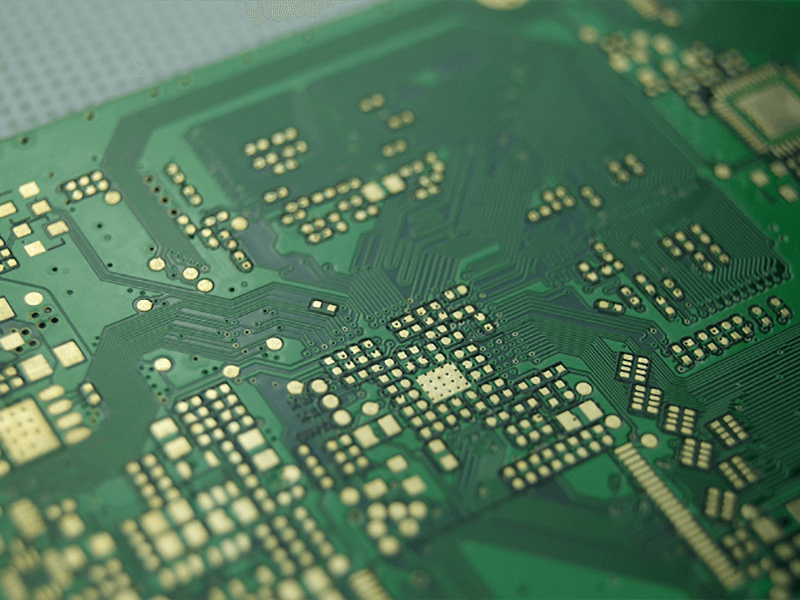
Orientation matters as well. The glass weave of each prepreg sheet runs in a direction, and rotating alternate sheets reduces the effect of the weave on the dimensional stability of the finished panel. The direction is marked on the sheet, and the drawing states whether rotation is required, which is one of the assumptions behind the symmetry rules in the notes on layup symmetry.
Foil and Separator Plates
The copper foil forms the outer layers, and its treatment and thickness are specified with the stack. A foil with a treated side and an untreated side has to be oriented correctly, and a foil that has been creased during handling produces a surface defect that will not laminate flat. Handling practice is what protects it, and the resulting defect is described in the notes on copper foil wrinkle.
The separator plates determine the surface of the finished board. A polished plate gives a smooth surface and a used or damaged plate transfers its texture, so the plates are inspected and replaced on a schedule. The plate also controls the heat transfer into the book, which is why a damaged plate can produce a cure difference across the panel rather than only a cosmetic defect.
Tooling and Registration
Registration in the press comes from tooling, which may be pins through tooling holes in each layer or a plate with a pattern that locates the layers. The tooling has to hold the layers in place while the resin flows, because the stack moves slightly as the prepreg softens. Any movement appears as a layer-to-layer offset in the finished board.
The tooling holes themselves have a tolerance, and the accumulated error across a stack of many layers is larger than the error of a single layer. That is why a high layer count book is aligned with more care than a simple one, and why the registration of the finished panel is checked against the design before drilling rather than after plating.
Cleanliness and Particle Control
A particle the size of a fibre in the layup becomes a visible defect after pressing. The particle holds the layers apart, the resin flows around it and the result is a dimple in the surface or a void in the bond. Layup areas are therefore controlled environments with a defined cleanliness class and a defined dress and glove procedure.
The cleaning of the inner layers before layup is part of the same control. Oxide treated layers are handled by their edges, kept in a clean carrier and used within a defined time, because the treatment degrades and the surface picks up contamination. The preparation discipline is the same as for any other surface in the plant and is described in the notes on surface preparation before lamination.
Press Loading and Symmetry
The books are loaded into the press in a pattern that distributes the pressure and the heat evenly. A single book in the middle of a large press sees a different condition from one at the edge, and the loading pattern is chosen so that every book sees the same cycle. The pattern is documented and the identification of each opening is recorded.
Within a book, the stack is built symmetrically about the centre wherever the design allows, so that the stresses from curing and cooling balance. The rules behind that symmetry and the defects that appear when it is violated are the subject of the notes on press cycle control.
Inspecting the Book Before Press
A final check before the press closes catches the errors that are cheap to fix and expensive to discover later. The check covers the layer order, the orientation of the foil and the prepreg, the tooling engagement, the presence of separator plates and the absence of visible particles. It takes a minute and it prevents a book from being pressed with a defect inside it.
The check is documented with a signature on the layup record, because the value of the check is that it happened rather than that it was defined. Where a defect is found after pressing, the layup record shows whether the book was checked and who built it, which is the starting point for the investigation.
Records and Traceability
The layup record should carry the book identification, the panel identification, the inner layer lots, the prepreg lots with their resin content and flow, the foil lot, the tooling used and the operator. With those fields, a delamination or a registration problem can be traced to a material lot or to a layup event rather than to the press.
Traceability also runs forward. When a prepreg lot is found to be out of specification, the record identifies every book that contains it and therefore every panel that may be affected. That list is the difference between a recall and a contained problem, and the storage and handling rules that keep the material in specification are described in the notes on prepreg and laminate storage. The defects that appear when the process is not controlled are described in the notes on lamination voids and delamination.
FAQ
Can a book be rebuilt after a mistake? It can be dismantled and rebuilt if the layers are undamaged, and the oxide treatment may need to be repeated. The decision is made by the process engineer rather than by the operator.
Why does the prepreg orientation matter? The glass weave has a direction, and rotating alternate sheets reduces the effect of the weave on dimensional stability and on the flow.
What causes a dimple in a laminated panel? Usually a particle trapped in the layup. Cleanliness control in the layup area is the countermeasure.