Nitrogen Reflow Compared With Air Reflow
Reflowing in nitrogen is one of those process choices that is either essential or pointless depending on the product. Nitrogen suppresses the oxidation that competes with wetting, which helps when the surfaces are marginally solderable, when the pitch is fine or when the alloy is difficult. It also costs money, adds a gas supply to manage and changes the appearance of the joint. This article separates the real effects from the sales argument so that the decision can be made on evidence.
Why Oxygen Matters at Reflow Temperature
At reflow temperature the alloy is liquid and the surfaces it must wet are reactive. Copper oxidises quickly when it is hot, and the oxide that forms is not wettable. The flux is there to remove and to prevent that oxide, but the flux has a limited capacity and a limited time, so anything that reduces the rate of oxidation makes the flux job easier.
Oxygen in the oven atmosphere is what drives the reaction. Reducing the oxygen concentration slows oxide growth, which extends the window in which the flux can work. The effect is continuous rather than a threshold, although the benefit becomes noticeable in a practical sense below a certain concentration.
What Nitrogen Actually Changes
The first visible change is wetting. Solder spreads further and forms a smaller contact angle, which means a fillet forms more completely on a pad that is marginal. The second is the elimination of the surface oxide film that produces a dull or slightly textured joint, so joints appear brighter and more uniform.
Both effects reduce certain defects. Bridging can decrease because the solder spreads rather than forming a ball, and incomplete fillets on fine pitch parts become less common. Solder balling also decreases, since the small spheres that form from spattered paste no longer oxidise and remain separate.

Oxygen Concentration and Measurement
The oxygen concentration is the control parameter, and it is measured in parts per million rather than as a percentage. Different products need different levels: a robust assembly with generous pads may work at a moderately reduced level, while a fine pitch assembly with a difficult finish usually needs a substantially lower figure.
Measurement has to be taken where the board actually is. A reading at the oven inlet is not the same as a reading in the zone where the paste melts, because the boards and the conveyor bring air into the tunnel and the gas flow pattern varies. A handheld analyser used at the board plane gives a realistic value, and it should be checked after any change to the conveyor loading or the gas flow.
Effect on Defect Rate
The defect categories that respond most clearly are those related to wetting and to bridging. Opening defects and poor fillets improve on a marginal surface, and bridges on fine pitch devices become less frequent. Defects that do not depend on oxidation, such as tombstoning caused by uneven paste or component shift caused by placement force, are unchanged.
The size of the improvement depends on the baseline. A process that is already comfortable will show a small change, while one that is operating at the edge of the surface finish window can show a large one. The useful approach is to measure the defect rate before and after on the same product rather than to accept a general claim. The criteria for judging the result are the same as for any joint assessment, described in solder joint acceptance criteria.
Interaction With Flux Chemistry
Nitrogen and flux are not independent. A flux that is designed for an air process has a certain activity, and reducing the oxygen concentration means the same flux is doing less work. That can allow a less aggressive chemistry to be used, which reduces residue and improves compatibility with a no clean process.
The reverse is also true: a process that relies on an aggressive flux to overcome an oxidised finish will still work in nitrogen, but it is masking a surface finish problem rather than solving it. Where the finish itself is marginal, as some organic coatings are, the honest solution is a better finish or a shorter storage time, and the factors involved are described in surface finish selection.
Cost and Practical Considerations
The cost of nitrogen includes the gas itself, the supply system, the flow control and the monitoring. Gas consumption rises with the tunnel volume and with the concentration target, so a large oven at a low oxygen level is expensive to run. The cost is continuous, unlike a capital improvement, so it has to be justified per board.
The practical considerations are less obvious. Nitrogen changes the appearance of joints, which means the visual standards for inspection should be reviewed rather than inherited. It also affects the solderability window, so a process qualified in nitrogen must be requalified if the gas is lost, and the procedure for a gas failure should define what happens to boards that were in the oven.
Process Control and Requalification
A nitrogen reflow process needs its own control plan. The oxygen concentration, the gas flow and the oven profile are interdependent, and a change in one invalidates the others. The concentration should be logged continuously rather than checked occasionally, because the failure mode is a gradual rise as a fitting leaks or a flow controller drifts, and the first sign is a change in defect rate rather than an alarm.
Requalification is required whenever the atmosphere changes, in either direction. A product that was developed in air and moved to nitrogen needs a new profile and a new set of acceptance limits, because the alloy will spread differently and the joint appearance will change. Moving in the other direction is more risky, since a process that depended on the inert atmosphere to overcome a marginal surface will produce defects in air, and the effect may take a batch to appear.
When the Extra Cost Is Justified
Nitrogen is most defensible where the assembly is difficult. Fine pitch components, packages with a small standoff, a finish that oxidises quickly, a lead free alloy with a narrow process window and a high value product where a single defect is expensive all make the case. A robust product with generous pads and a fresh finish on a well controlled line does not need it.
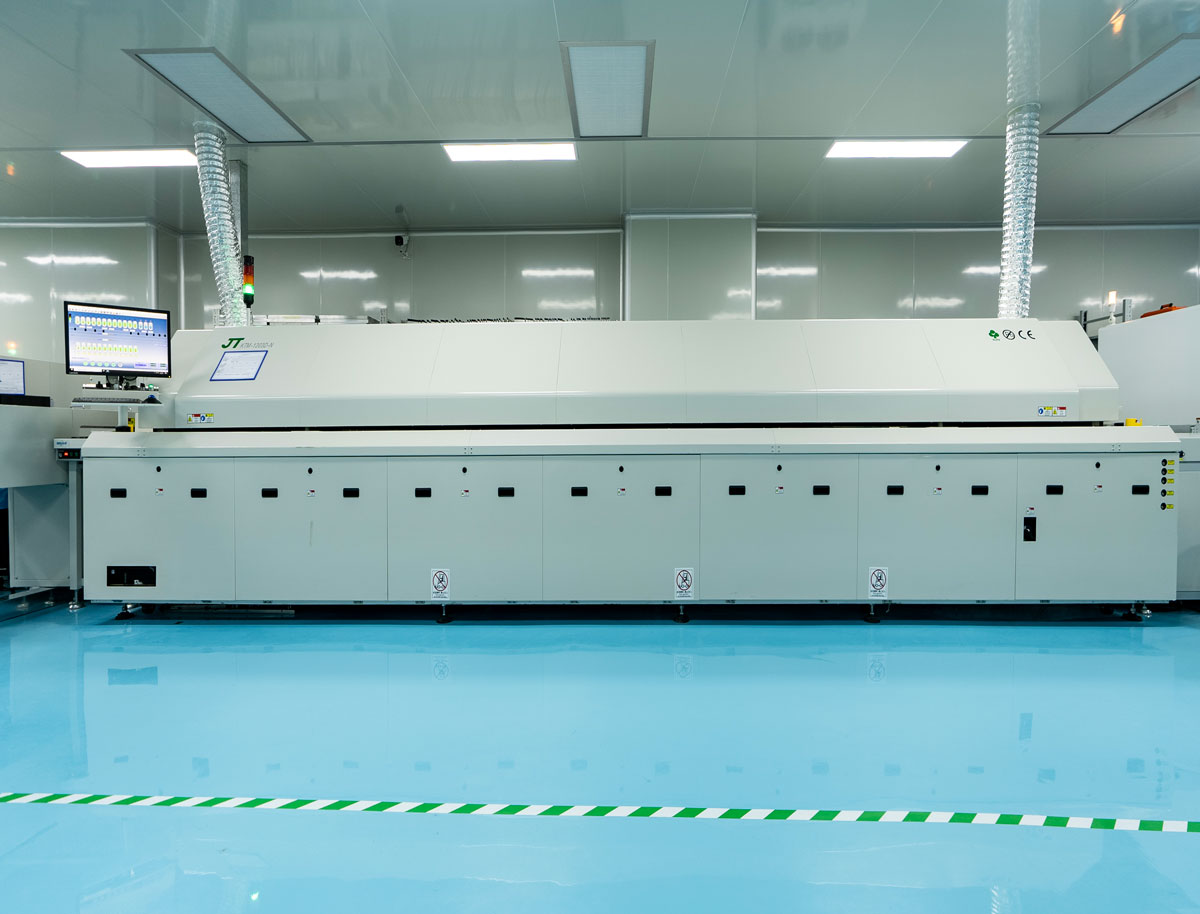
The gopcb reflow engineering team evaluates the decision by running the same product in both atmospheres and comparing the defect rate and the joint appearance against the acceptance criteria. That comparison, taken with the gas cost per board, gives a straightforward answer that does not depend on the supplier of either the oven or the gas. The profile development work that supports it follows the method described in reflow oven profile verification.
Comparing the Two Atmospheres on the Same Product
The comparison should be designed rather than anecdotal. Run the same product, with the same paste and finish, in both atmospheres, with the profile adjusted so that the measured joint temperature is the same. Then compare defect rate by category, joint appearance against the visual standard and any change in the process window, which can be estimated by deliberately varying the peak temperature in each atmosphere.
A nitrogen reflow process normally shows a wider window, which is itself a benefit that is easy to miss in a defect comparison. A wider window tolerates more variation in board loading and thermal mass, which reduces the risk of a profile that works on most of the panel but not all of it. That value should be included in the decision, because it reduces the effort needed to keep the process stable, and the profile development work that establishes the window is described in reflow oven profile verification.
FAQ
Does nitrogen remove the need for flux? No. It reduces the oxygen available for oxidation but it does not clean an oxidised surface, so flux is still required.
What oxygen level is needed for fine pitch work? It depends on the finish and the paste, but fine pitch processes commonly run at a substantially reduced concentration compared with a standard assembly.
Why are joints brighter in nitrogen? Because the thin oxide film that normally forms on the surface does not develop. Brightness is not itself an indicator of joint quality.