No-Clean Residue: Setting a Defensible Allowance
A no-clean process deliberately leaves flux residue on the assembly and relies on that residue being benign for the life of the product. The term describes the process rather than the material, and it does not mean the residue is absent or that its quantity is unimportant. It is a decision about the product and its environment rather than a property of the paste.
An allowance is therefore needed: a statement of how much residue, of what kind, may remain before the assembly is no longer acceptable. Writing that allowance so that it can be checked and defended is harder than applying it, and it is the part of the process most often left undocumented.
What No-Clean Means
The term covers a family of flux chemistries formulated so that their residue is non-corrosive, non-conductive and solid at operating temperature. The residue is designed to stay in place rather than to be removed, and the activators in it are intended to be consumed during reflow. The formulation also aims to keep the residue from spreading onto surfaces it would damage.
Two conditions have to hold for that to work. The flux has to reach its activation temperature for long enough to spend the activators, and the residue that remains has to be benign where it sits. If either condition fails, the material behaves like a conventional flux and the process needs cleaning. The second condition is set by the chemistry and by the amount of residue, and it is the one a specification struggles to express. A residue that meets the electrical requirement can still fail the process, because the two are not the same question.
What the Residue Contains
Residue is a mixture of unreacted flux components, reaction products and any material the flux carried away from the surfaces. Its composition depends on the flux chemistry and on the thermal profile, so the same paste can leave different residues on two different boards. Two boards run with different thermal mass can therefore differ in both the amount and the nature of the residue.

Its electrical behaviour depends on whether it is solid and dry or soft and hygroscopic. A residue that absorbs moisture becomes conductive and mobile, while one that stays glassy and dry remains an insulator for the life of the product. The transition from dry to hygroscopic is gradual, which is why the limit is set with margin rather than at the point of failure.
Why a Residue Allowance Is Needed
Residue cannot be eliminated from a no-clean process, so the only question is how much is acceptable and where. An allowance turns an argument about appearance into a measurement with a limit, which is what makes the process repeatable between operators and between sites. A limit expressed as an area percentage is more useful than a general impression of cleanliness.
The allowance also protects the product. A joint surrounded by heavy residue that covers a test pad or a connector contact is a functional risk even when the solder joint is sound, and the allowance is what makes that risk visible before the product ships. That risk is a function of the product rather than of the process, and it is assessed at the design stage.
Surface Insulation Resistance Testing
Surface insulation resistance testing places a pattern of closely spaced conductors on a test coupon, coats it with the process, and measures the leakage between them at elevated temperature and humidity. It is the accepted way to show that a residue is benign. The test is slow and is run on coupons rather than on product, so it validates the process rather than the batch.
The result depends on the pattern, the bias voltage, the temperature and the humidity, so the test conditions belong with the result. The residue on the coupon also has to be representative, which means the coupon is processed on the same line as production boards.
Electrochemical Migration Risk
Leakage between conductors is a symptom and electrochemical migration is the mechanism. Under bias and moisture, metal dissolves at the anode and deposits at the cathode, forming a filament that grows until it bridges the gap.
The risk rises as spacing falls, as the residue becomes more ionic, and as the environment becomes more humid. The last of the three is often outside the control of the assembly process, which is why the allowance has to be set against the environment the product will actually see.
Coating and Potting Over Residue
A conformal coating applied over residue does not necessarily seal it. The coating covers the surface, and residue beneath it can still absorb moisture that diffuses through the coating and can still support leakage between the features it covers.
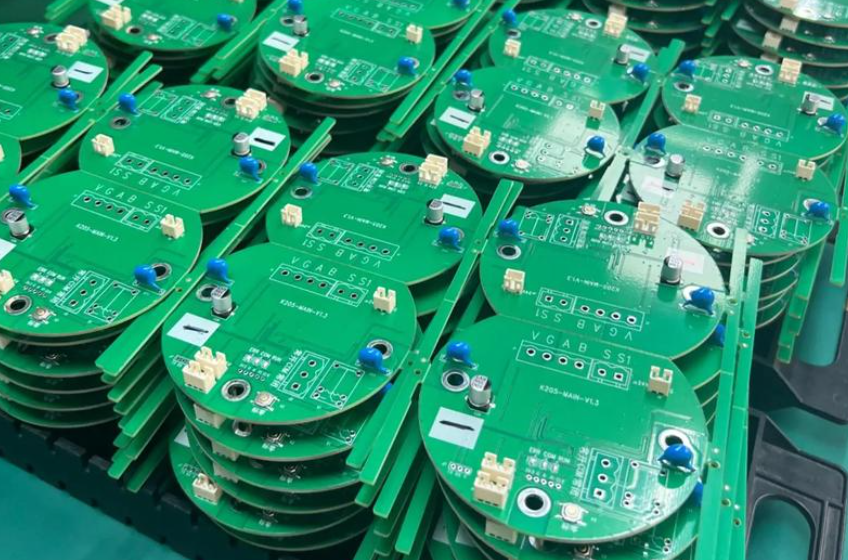
Adhesion is the second issue. A coating bonds to the surface it is applied to, and a soft residue is a poor substrate with a low surface energy. A surface energy measurement on the residue gives a number, and the coating supplier usually publishes a minimum. The cure and adhesion side of the same question is described in the notes on coating cure verification.
Cleaning When It Is Required
Cleaning becomes necessary when residue exceeds the allowance or when the product will be coated. The cleaning method has to match the residue, because a flux designed to be left in place is also designed to be difficult to dissolve. A partial clean is the worst outcome, because it moves the residue rather than removing it.
Water soluble residues need a rinse that reaches under components, and rosin based residues need a saponifier or a solvent. Cleaning for a subsequent process is described in the notes on surface preparation before coating.
Writing the Allowance
An allowance that can be checked has three parts: where residue may remain, where it may not, and a measurable criterion for the amount. The criterion is often a visual classification with reference photographs, because a direct measurement is difficult in production. The three parts are written together, since a location rule without an amount rule cannot be enforced.
Reference photographs have to be produced from the real process and replaced when the flux changes. A set of photographs from a previous product is worse than no reference, because it sets a limit that corresponds to nothing on the current line.
Records and Verification
Verification combines the surface insulation result, the visual check against the reference, and the outcome of any functional test the residue could influence. The records hold the flux lot, the profile, the test conditions and the residue classification.
With those fields, a change in residue appearance can be traced to a flux change or to a profile change rather than treated as a cosmetic variation. The stencil side of the same material question is described in the notes on under stencil cleaning. A trend of increasing residue coverage is more useful than a single classification, because it shows the process moving.
FAQ
Is no-clean residue always safe? No. It is safe when the activators are spent and the residue stays dry. A profile that under-heats the board leaves residue that never fully reacted.
Can residue be measured directly? Ionic extraction gives a number and it is slow. Production usually relies on a visual classification against reference photographs.
Does coating make cleaning unnecessary? No. A coating over soft residue can still allow leakage beneath it and can also adhere poorly.