Board Drying After Cleaning: 6 Rules for Dry Panels
Board drying is the last operation in the cleaning line and the one most often treated as an afterthought. Water that stays on the surface carries dissolved material with it, and when the water finally leaves, that material stays behind as a spot, a stain or a film that no cleaning step will remove. It is also the step that decides how the board behaves months later.
A dry panel is therefore a specification, not a hope. The line has to remove the water fast enough and completely enough that nothing is deposited, and the parameters that decide this are the final rinse quality, the air knife setup and the thermal budget that the panel can accept.
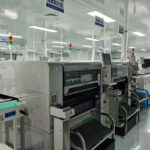
<img src="https://www.gopcba.com/wp-content/uploads/2026/09/225-1.jpg" alt="Board drying line with hot air knife after cleaning” />
Why Board Drying Is a Process Step
Cleaning is a sequence of wetting, dissolving and rinsing, and drying closes it by removing the carrier. If drying is incomplete, the residue that was dissolved in the rinse water is deposited back onto the panel in exactly the places where it will do the most harm.
The result is a board that passes a visual inspection and fails later, usually at coating, at soldering or in a humidity test. Treating drying as a controlled step with its own parameters is what keeps those late failures out of the process. A dry panel also stores better, because moisture left on a surface becomes moisture inside the next process.
Where Water Spots Come From
A spot forms where a droplet evaporates slowly. As the volume falls, the concentration of dissolved salts rises until they precipitate at the edge of the drop, leaving a ring of material behind. A hot, dry panel with slow drainage is the worst case for this mechanism.
Hard water makes the problem worse because it brings its own mineral content, and a final rinse that is not clean enough adds ionic material to every droplet on the surface. The rinse quality controls the damage that a spot can do, not just the number of spots.
DI Water and Final Rinse Quality
The final rinse should use deionized water at a resistivity the process can hold, with enough flow to displace the chemistry from the previous tank. A rinse that is running at a fraction of its design flow carries contaminants forward instead of removing them. Flow and temperature both matter, since cold water rinses more slowly than warm water at the same flow rate.
Resistivity is the fastest indicator of rinse condition, and the measurement described in DI water resistivity control shows whether the bath is doing its job. Rinse design also affects drainage, which is covered in deionized water rinse practice for bare boards.
Hot Air Knife and Air Knife Geometry
A hot air knife removes water by momentum and heat at the same time. The angle, the distance to the panel and the slot width decide how much water is pushed off and how much is simply heated in place, and the two outcomes look identical for the first few seconds.
Air that is too hot dries the surface before the water is gone, which leaves a film behind. Air that is too cold moves the water without removing it, and the droplet travels down the panel to join others at the bottom edge, where it forms a line of residue that inspection will find later.
Blow Off, Vibration and Mechanical Water Removal
A mechanical blow off stage in front of the knife removes the bulk of the water at almost no thermal cost. Rollers, squeegees and air knives each have limits, and the aim is to reduce the load on the drying stage rather than to replace it.
Vibration and panel orientation matter too. A panel travelling flat holds a film of water across its whole surface, while a panel held at an angle drains before the air stage reaches it. Changing the conveyor angle is often the cheapest improvement available on an existing line, and it should be set with the panel and the fixture in mind rather than copied from another line.
Oven Drying and Thermal Load
The oven or the drying tunnel has to evaporate what the air knives leave, and the temperature has to suit the panel rather than the schedule. Solder mask, legend ink and thin laminates all have limits, and exceeding them produces a defect that has nothing to do with cleaning.
Air flow across the panel is as important as the set temperature. A tunnel that is crowded with panels dries unevenly, and the panels that leave the oven first are often the ones with trapped moisture between closely spaced features.
Residue Left Behind by Incomplete Drying
Residue from incomplete drying appears as streaks, as a cloudy film or as a ring of salts around a large feature. Under magnification it often shows the pattern of the last droplet, which is what identifies the cause as drying rather than as cleaning chemistry.
The material is ionic, so it raises the risk of corrosion and electrochemical migration on a biased assembly. Where a coating will be applied, the film also attacks adhesion, which is why the cleanliness methods used in ionic contamination testing and the preparation described for coating adhesion testing belong at the end of the same line.
Verifying That a Panel Is Dry
The practical checks are simple: look for dark or dull patches under an inspection lamp, weigh a sample before and after, or place a dry tissue against a cooled panel and look for a mark. A water break test after re-wetting shows whether the surface has been left clean and uniform.
Where the process follows a published method, such as the cleaning guidance from IPC, that method should be named in the record. The verification needs to be done on a cooled panel, because a warm surface hides the film that appears when the panel reaches room temperature.
Records, Defects and Corrective Action
The useful record carries the rinse resistivity, the knife temperature and pressure, the conveyor speed, the oven temperature and the result of the dryness check. With those fields, a complaint about spotting can be traced to a shift in one of them rather than argued about.
Corrective action usually starts with the final rinse and the air knife, and then moves to the saponifier or chemistry upstream. Where the line handles both cleaned and no-clean work, the discipline in aqueous cleaning and rinse control applies to the same equipment. Repeated spotting on one product usually points at a drainage problem rather than at the rinse chemistry.

FAQ
Why do water spots appear only on some panels? Spotting depends on drainage, rinse quality and the thermal history of the individual panel. Panels that sit in the line during a stop, or that leave the oven with water still trapped, are the ones that show it.
Is a higher oven temperature the answer to wet panels? Only up to the limit of the materials on the board. Beyond that the temperature damages ink and laminate without removing the water faster, so mechanical removal before the oven is the better fix.
Can a panel be too dry? It can be over-heated, which damages the solder mask and can drive moisture out of a laminate that then reabsorbs it in storage. Dryness is a target inside a window rather than a maximum.