Print Head Technology in SMT Printing
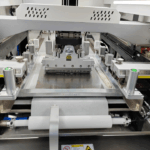
The print head is the part of a stencil printer that turns paste into a deposit. It carries the squeegee, applies the force and moves across the stencil, and the way it does those three things sets the fill of the aperture and the cleanliness of the wipe. Modern heads add closed loop control over the force, which removes an operator judgement from the process and makes the deposit repeatable across a shift.
What the Head Contains
A print head holds one or two squeegee blades, a mounting that sets their angle, a mechanism that applies the downward force and a drive that moves them across the stencil.
A dual blade head uses one blade for the print stroke and the other for the return, which keeps the paste roll in front of the working blade in both directions. A single blade head must return without printing or reverse the roll, and the choice affects the cycle time and the paste behaviour.
The head also carries the paste. In a closed head the paste is held in a chamber and dispensed through an opening, which removes the open roll and the evaporation that comes with it. The trade is a longer changeover and a need to clean the chamber.
Squeegee Material
Metal blades hold a sharp edge and do not absorb solvent, so they maintain a consistent contact angle over a long run. They are the usual choice for fine pitch work because the edge does not deform into the apertures.
Polyurethane blades conform to a stencil that is not perfectly flat and to a board that is uneven, which is an advantage on a rough surface and a disadvantage on a fine pitch aperture where the blade can scoop paste out of the opening.
The hardness of a polyurethane blade is quoted on the Shore scale, and a softer blade conforms more. The choice should be recorded with the product, because a change from one hardness to another changes the deposit without any change to the machine settings.

Angle and Contact
The angle between the blade and the stencil determines how the paste is pushed. A steeper angle, closer to vertical, pushes the paste ahead of the blade and rolls it, while a shallower angle presses the paste into the aperture.
The angle changes as the blade wears if the mounting does not compensate for it. A blade that has become shorter at the edge contacts the stencil at a different angle, and the deposit changes gradually, which is the classic cause of a drift that nobody can explain.
The contact force is the second variable. Too much force pushes paste under the stencil and drives the blade into the apertures, while too little leaves paste on the stencil and produces a short deposit. The force is normally expressed per unit length of the blade rather than as a total, because the same total spread over a longer blade gives a lower pressure and a different deposit.
Closed Loop Control
A closed loop head measures the force and adjusts the pressure as the blade moves, which compensates for the board height, the stencil tension and the deflection of the machine. The result is a constant force per unit length across the board.
The benefit is repeatability. An open loop head relies on a pressure setting and on the mechanical stiffness of the assembly, so the force at the centre of the board differs from the force at the edge, and the difference grows as the machine ages. A machine that has been recalibrated, or whose stencil frame tension has changed, shows the difference in the deposit rather than in the pressure reading.
Closed loop control is not a substitute for a correct setting. A loop that holds the wrong force holds it very consistently, and the deposit will be uniformly wrong rather than variable, which is easier to diagnose but not automatically better.
Print Speed and Separation
Print speed sets the time available for the paste to fill the aperture. A fast stroke leaves a partially filled aperture, which is why a fine pitch stencil is printed more slowly than a coarse one. The relationship is not linear, and a small increase in speed can produce a step change in the deposit rather than a gradual reduction.
The shear rate at the blade changes with the speed, and a paste that is shear thinning behaves differently at different speeds. A process developed at one speed and run at another will produce a different volume even though nothing else has changed.
The separation speed, at which the board drops away from the stencil, controls the release. A slow separation lets the paste detach from the aperture walls, while a fast one pulls the deposit apart and leaves a tail on the stencil.
The Paste Roll
A stable roll has a consistent diameter, it turns in the direction of travel and it stays in front of the blade. It is the sign that the paste is at the right viscosity and that the force is in range.
A roll that stops turning is a sign of paste that has dried or of a head that is not applying enough force. A roll that breaks into pieces indicates too much force or a paste that has separated. The roll diameter is a useful indicator and it should be checked on the first board and after any pause in production.
The volume of paste on the stencil should be kept within a range. Too little and the roll breaks, too much and the paste is pushed over the edge of the print area where it dries and is dragged back into the apertures later.
Maintenance and Records
The blade should be inspected for wear and for damage at each changeover. A nick in the edge leaves a stripe of paste on the stencil and a corresponding line of short deposits.
The head mechanism should be checked for backlash and for consistent travel. A head that hesitates changes the speed profile at the start of the stroke, which changes the fill at the first few apertures of the board.
The settings and the blade type should be recorded per product. When a printing problem appears, the record allows the blade to be checked rather than the printer to be recalibrated, which is a much shorter investigation.
Practical Rules
Match the blade material and hardness to the aperture size, hold the angle constant by mounting rather than by adjustment and keep the roll within a defined volume. Record the blade type with the product.
Record the settings with the build records and the defect history, and review the stencil design rules and the paste inspection data whenever the deposit changes without a setting change.
FAQ
Metal or polyurethane squeegee? Metal holds a sharp edge and suits fine pitch apertures. Polyurethane conforms to an uneven surface but can scoop paste out of a small opening.
What does closed loop control do? It measures the force and adjusts the pressure during the stroke, so the force per unit length is constant across the board and repeatable over time.
What does a stopped paste roll mean? The paste has dried or the head is not applying enough force. A roll that breaks into pieces indicates too much force or a separated paste.