Precision Voltage Reference Design Guide
Every measurement is a comparison with a reference, and in an electronic instrument that reference is a voltage. Its accuracy, its drift and its noise set the limit for the whole channel, and no amount of care in the following stages can recover what the reference has already lost.
The Four Specifications
initial accuracy is the error at the reference temperature with the specified load and supply. It is the number that is quoted most prominently and it is the least important in a calibrated instrument, because it can be removed by calibration.
temperature coefficient is the change over the operating range, and it is usually quoted in parts per million per degree. It cannot be removed by a calibration at a single temperature and it is therefore the specification that matters most.
long term drift is the change over months and years, and it is quoted as parts per million per thousand hours. It is the reason an instrument has to be recalibrated periodically even when nothing has failed.
noise is the fourth, and it has a low frequency component that looks like drift and a broadband component that sets the resolution. Both are quoted separately and both matter.
Reference Technologies
A buried zener reference has the best temperature coefficient and the lowest long term drift, at the cost of a higher supply voltage and a higher current. It is used in instruments where the accuracy justifies it.
A band gap reference works from a low supply and draws little current. Its temperature coefficient is achieved by summing two voltages with opposite slopes, and the curvature of the result over temperature is the residual error.
A floating gate or a chopped reference improves the low frequency performance by removing the offset and its drift. The chopping introduces switching artifacts that have to be filtered, and the improvement in the low frequency region is real.
Package and Thermal Effects
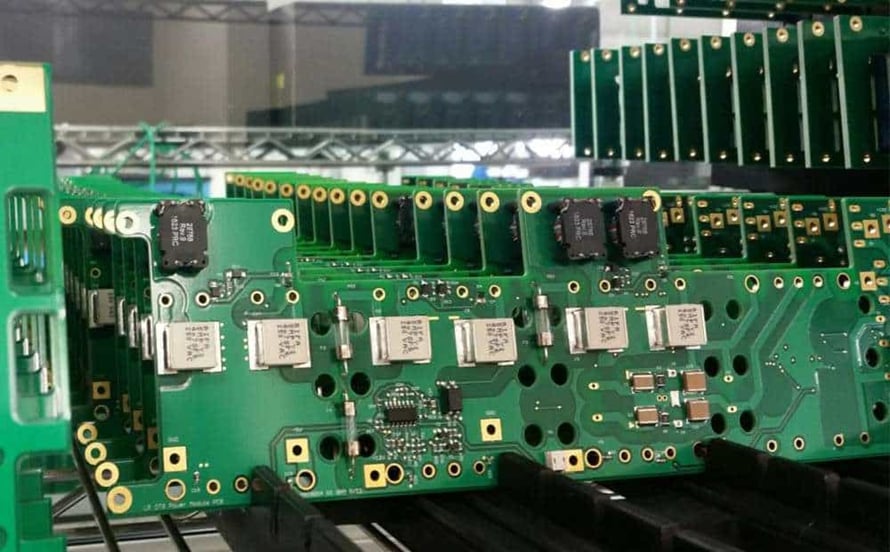
The package of a reference matters more than its schematic symbol suggests. A plastic package transmits mechanical stress to the die, and the stress changes the output by tens of parts per million.
A hermetic metal can or a ceramic package removes most of that effect. Where a plastic part has to be used, the layout should avoid anything that bends the board near the device.
Thermal gradients across the package also produce an error, through the thermoelectric effect in the connections. Keeping the reference away from heat sources and from air movement reduces it, and a small copper island around the part helps to stabilise its temperature.
Layout and Decoupling
The reference should have its own decoupling capacitor placed at the pin, and the ground of that capacitor should be the quiet analogue ground rather than anywhere convenient. The output current flows in that loop and any impedance appears in the reference.
Where the reference drives a converter, the trace should be short and the load current should be constant. A reference that also supplies other loads changes its output as those loads vary, which appears as a scale error that follows the signal.
A buffer amplifier after the reference removes that coupling and allows the reference to see a constant load. The buffer contributes its own offset and drift, which have to be included in the budget.
Temperature coefficient in the Budget
A temperature coefficient of two parts per million per degree over a range of fifty degrees is a hundred parts per million, which is one part in ten thousand or about three counts of a sixteen bit converter.
That calculation is the reason a reference is chosen from its maximum coefficient over the range rather than from its typical value at a nominal temperature. The typical figure is often several times better than the maximum.
Where the coefficient of the reference is still too large, the reference is placed in a small oven or in a thermally stabilised copper island. The improvement is large and the cost is a heater and a control loop.
Long Term Drift and Calibration
long term drift is specified over a period, and the change in the first hundred hours is much larger than the change in the following thousand. The initial settling is the reason an instrument is often aged before it is calibrated.
The drift is not linear in time, so extrapolating from the first month to the first year overestimates the change. The datasheet curve is the source of the figure, and a measurement of the actual part over a few weeks gives a better estimate for a critical design.
A design that is calibrated against a traceable standard after the settling period has an error that grows from the drift alone, and the recalibration interval follows from that number and from the accuracy required.
Reference Noise and Filtering
The low frequency noise of a reference is often quoted as a peak to peak value over a decade of frequency, which makes it look smaller than it is. Converting it to an rms density over the band of interest is what makes it comparable with other noise sources.
A capacitor at the output of the reference reduces the broadband noise, and some parts allow a much larger capacitor that also filters the low frequency component. The datasheet usually states the range of capacitance that keeps the part stable.
Filtering after a buffer amplifier is more effective, because the filter is then not part of the reference loop. A simple RC network with a low leakage capacitor reduces the noise that reaches the converter.
Supply Rejection in Practice
A reference is specified with a supply rejection figure, and its performance in a real circuit depends on the decoupling and on the supply itself. A switching supply in front of a precision reference is a poor combination however good the rejection figure looks.
A pre regulator or a filtered linear supply in front of the reference improves both the rejection and the noise. Where the reference has to work from a switching rail, an RC filter with a low leakage capacitor is the minimum measure and it is usually enough.
Verification and Faults
Verify the reference against a calibrated instrument with a resolution better than the part, and record the value and the temperature. That measurement is the basis of the calibration of the whole channel.
Check the output with the load applied, because a reference with a poor load regulation changes under the current the converter draws. A change that follows the signal indicates that the reference is shared with something it should not be.
A reference that drifts more than expected usually has a thermal or a mechanical cause rather than an electrical one. Flexing the board or directing air at it while watching the output identifies the culprit in a few minutes. The release checks that keep such a board consistent are collected in our PCB design release checklist, the assembly points in judging PCB quality, and the layout measures in our guide to mixed signal board design.
FAQ
Which specification matters most? temperature coefficient and long term drift, because calibration removes the initial accuracy and cannot remove the other two.
Does a bigger output capacitor help? Up to the limit stated in the datasheet. Beyond it some references become unstable, so check the specified range.
Why does my reading change when the load changes? The reference is shared with another consumer. Buffer it so that it sees a constant load.