Quick Turn PCBA: What Fast Assembly Really Involves
Fast assembly is a scheduling achievement rather than a manufacturing one. The placement and reflow processes take roughly the same time however urgent the order is, so a quick turn pcba service compresses the queue, the preparation and the approval rather than the work itself. This guide explains what actually has to happen for a build to be fast.
What Quick Turn Actually Compresses
Three things can be compressed: the preparation before the line, the queue in front of it and the feedback loop after it. Preparation covers stencil fabrication, fixture design and programming. The queue covers line scheduling and changeover. The feedback loop covers first article inspection and approval.
The process itself is largely fixed. Reflow takes what it takes, and a paste profile cannot be shortened without risking the joint quality. Understanding that boundary is what allows a buyer to ask for the parts of the schedule that can genuinely move.
Component Lead Time Is the Real Constraint
Assembly cannot start before the components arrive, and component lead time is usually the longest single item in the schedule. A part on allocation can delay a build by weeks regardless of how fast the assembly house is.
That moves the critical path to the bill of materials. Confirming availability before the order, and identifying approved substitutes for critical parts, is the most effective way to make a build fast. A layout with room for two package options makes the substitution a purchasing decision rather than a redesign.
Stencil and Fixture Preparation
A stencil can be fabricated quickly, but only if the panel design is final. A change to the panel after the stencil is cut invalidates it, and the replacement takes as long as the original. Releasing the panel and the stencil together, rather than sequentially, removes a delay.
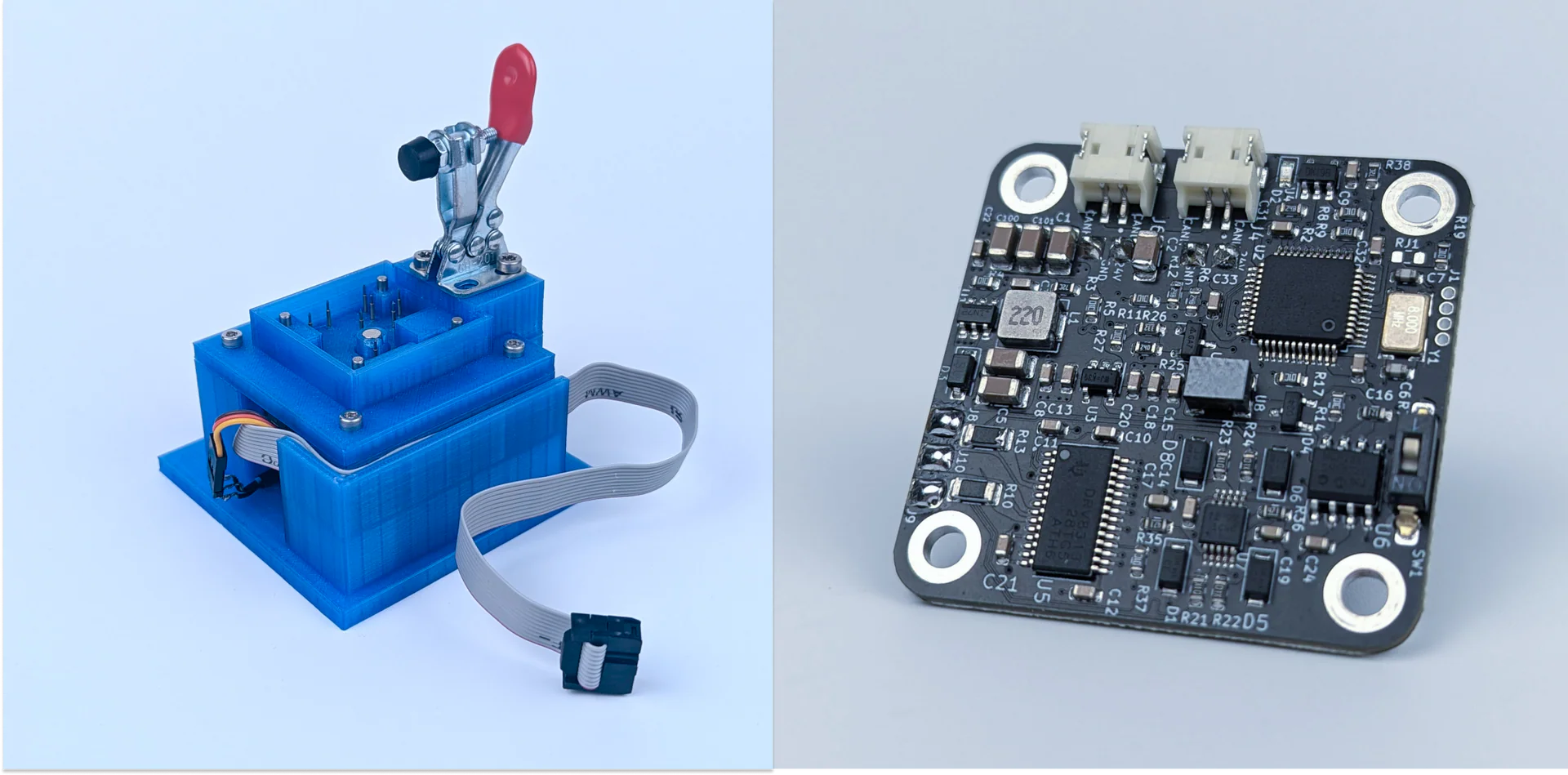
Fixtures take longer than stencils because a bed-of-nails fixture requires mechanical design and assembly. Where the schedule is tight, flying probe test avoids the fixture entirely at the cost of slower testing per board. The trade should be made on the total schedule rather than on the unit cost.
Line Scheduling and Changeover
Changeover is the part of the schedule that a buyer usually cannot see. Every product change requires feeders to be set up, the stencil to be swapped and the reflow profile to be verified. A line that runs a similar product immediately before yours changes over quickly, while one that runs a very different assembly does not.
Choosing a panel footprint and a component mix that resembles common work helps here. A standard panel size, standard fiducials and a placement order that matches the pad positioning conventions all reduce the setup time.
First Article and Fast Approval
The first article is the gate between assembly and volume. It verifies placement, solder joints and often the functional behaviour, and if the approval waits for a meeting then the schedule waits with it. Agreeing the acceptance criteria in advance turns the approval into a checklist.
Fast approvals come from pre-agreed criteria rather than from goodwill. Where the design specifies the joint appearance, the test coverage and the acceptance limits before the build, the first article can be accepted on the evidence rather than on a discussion.
Test and Programming
Programming is often the hidden critical path on a fast build. Firmware, calibration data and configuration all have to be loaded, and a fixture or a programming jig is needed to do it at volume. If the programming method is still being decided when the boards arrive, the schedule stops there.
Test coverage should be agreed at the same time. A functional test at load takes seconds per board but needs a rig and a procedure, while a simple continuity check runs immediately and proves much less. Deciding which level is required before the build prevents a late change.
Cost of Fast Assembly
Fast assembly costs more for three reasons: the schedule premium, the loss of consolidation and sometimes a less efficient test method. Boards that would share a panel or a line slot with other work are instead run on their own, and the setup is charged to one order rather than shared.
There is also a yield risk. A build that is rushed has less time for profile verification and first-article feedback, so a marginal process issue is more likely to reach the whole batch. Applying component shift prevention practices during setup is what keeps the fast build from becoming an expensive one.
Planning a Build That Can Be Fast
The most effective preparation is design-level. Keep the assembly on one side where possible, use standard package sizes, avoid parts that are hard to place, and provide test access at layout stage. Each of those reduces the work required before the line can start.
The second is documentation. A complete package with the bill of materials, the approved substitutes and the assembly drawing lets the preparation run in parallel with the board fabrication rather than after it, which is where most of the recoverable time actually sits in a PCBA development process.
Additional Considerations for This Build
Practical attention to assembly schedule pays for itself here, because it decides whether the finished board behaves as the drawing intended. Where the requirement is not stated on the fabrication drawing or in the assembly notes, the shop has to assume a default, and that default is rarely the value the design was simulated with. Stating assembly schedule explicitly, together with the tolerance that applies, removes the assumption and keeps the result predictable from batch to batch.
Process Control and Verification
Reviewing the design before the data is released is far cheaper than correcting it after the panel is in the tank, because every step downstream inherits the decision made at the front end. Where a value sits close to a process limit, the drawing should say so, since the shop can then open the process window rather than working to a nominal figure that carries no tolerance.
The measurements that matter are the repeatable ones: conductor width and spacing, annular ring, finished hole size, plating thickness and surface finish are all verifiable on a coupon that travels with the panel. Documenting the assumption is part of the design work, and a short note on the drawing prevents a question that would otherwise arrive a day later and cost a day of schedule.
Where a value sits close to a process limit, the drawing should say so, since the shop can then open the process window rather than working to a nominal figure that carries no tolerance. Running a first article through the same checks as the production panel confirms that the two agree, and that comparison is the cheapest form of process control available at prototype stage.
Documenting the assumption is part of the design work, and a short note on the drawing prevents a question that would otherwise arrive a day later and cost a day of schedule. A stack-up that is drawn rather than described removes most of the ambiguity from a quotation, and it lets the fabricator price the board against the dielectric and copper weights that will actually be used.
FAQ
How fast can a PCBA build realistically be? It depends on component availability more than on the assembly house. If the parts are in stock and the stencil and fixture are ready, the assembly itself is a matter of days rather than weeks.
Can assembly start before the boards are finished? Preparation can, and that is where the schedule is won. Programming, fixtures, stencils and the test procedure can all be prepared while the boards are being fabricated.
Does a fast build reduce quality? It should not, but the margin for feedback is smaller. Agreeing the acceptance criteria in advance and verifying the reflow profile properly are what keep speed from becoming a risk.