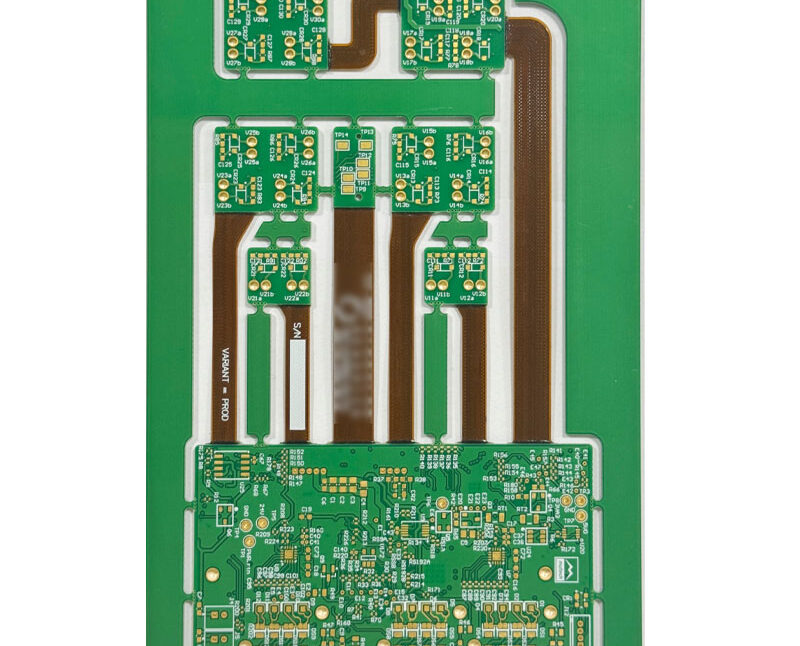
Through Hole Rework Practice
Rework of a through hole joint is harder than rework of a surface mount joint, because the heat has to travel through the board and the alloy is inside a hole. The operation is routine, and the damage it can cause is not.
The damage is cumulative: a lifted pad, a cracked barrel or a delaminated laminate from one repair can make the second repair impossible. The technique should therefore be defined rather than improvised, even for a single joint.
Why Through Hole Rework Differs
The solder is in a barrel and the joint is on both sides of the board, so the heat has to reach the far side before the alloy is molten throughout. A hand iron applied to one side alone does not achieve that in a reasonable time.
The mass of the board and of any plane connected to the joint determines how much energy is required, and the same technique will not work on a plane connected pin and on a signal pin.
Heating From Both Sides
The standard approach is to preheat the board from below and apply the iron or a hot air nozzle from above, so that the joint reaches temperature quickly. Local preheating with a focused nozzle reduces the exposure of the surrounding area.
Where a board carries many joints to be reworked, a small oven or a hot plate under the assembly gives a more even result than a series of local operations.
Desoldering Tools
A vacuum desoldering tool removes the alloy while it is molten, which clears the barrel and allows the lead to be released. The nozzle size should match the joint, because a nozzle that is too large heats the surrounding laminate.
A wick and an iron is the alternative, and it is slower and more likely to leave alloy in the barrel. The choice depends on the joint count and on the value of the board.
Thermal Damage to the Barrel and Pad
Overheating a plated barrel causes the resin to expand and can lift the pad from the laminate. The damage appears as a dark ring or as a lifted annulus, and it is not repairable.
Keeping the joint temperature just above the melting point and the dwell short is the control. A higher iron temperature with a shorter contact time is generally better than a lower temperature applied for longer.
Removing the Component
Removing a multi pin component requires every joint to be molten at the same time, or the pins will be bent and the barrels damaged. A dedicated tip that heats all the pins together, or a hot air nozzle with the correct profile, is the reliable method.
Force applied before the alloy is fully molten is the most common cause of damage during removal. The component should be lifted only when it moves freely.
Clearing and Refitting
The barrel should be cleared of alloy with a vacuum tool while it is hot, and the pads should be cleaned and checked for damage before the new part is inserted. A lead that will not pass through the barrel indicates that alloy remains.
Refitting uses the same thermal approach, with the addition of fresh flux and, where required, a small amount of alloy to supplement the joint. The joint should be formed rather than filled.
Inspection After Rework
The reworked joint should be inspected for a fillet on both sides where the filet is accessible, for barrel damage and for laminate damage around the pad. A cross section is used where the joint is critical.
The inspection standard is the same one that applies to the original joint, and the rework record should note that the joint has an additional thermal history. This belongs with the acceptability criteria described for joint workmanship.
Limits on Repeated Rework
A joint can be reworked a limited number of times, and the limit is set by the laminate rather than by the alloy. Each cycle consumes some of the bond between the resin and the copper.
Where a joint has been reworked twice, the decision should be taken deliberately rather than by default, and the assembly should be considered for scrap if the joint is critical.
Records and Qualification
The rework station should record the joint, the technique and the profile used, because a batch with a high rework count is a signal about the original process. The record also protects the customer, since it shows what was done.
Operators should be qualified on the technique, and the qualification should include the thermal parameters rather than only the appearance of the result. This is the same discipline applied to other process steps in manufacturing processes.
Process Control and Verification
On a design of this kind, preheat is the item that decides how the rest of the board is arranged. Documenting the assumption is part of the design work, and a short note on the drawing prevents a question that would otherwise arrive a day later and cost a day of schedule. The process window is set by the narrowest step in the flow, so an improvement anywhere else shows up as margin rather than as yield until that step is addressed.
A short note on the drawing about handling, storage or packaging is often worth more than an extra decimal place on a tolerance. Where a value sits close to a process limit, the drawing should say so, since the shop can then open the process window rather than working to a nominal figure that carries no tolerance.
A stack-up that is drawn rather than described removes most of the ambiguity from a quotation, and it lets the fabricator price the board against the dielectric and copper weights that will actually be used.
Related reading: our fabrication notes, board quality and design release notes cover the same ground.
Process Control and Verification
On a design of this kind, preheat is the item that decides how the rest of the board is arranged. Documenting the assumption is part of the design work, and a short note on the drawing prevents a question that would otherwise arrive a day later and cost a day of schedule. The process window is set by the narrowest step in the flow, so an improvement anywhere else shows up as margin rather than as yield until that step is addressed.
Process Control and Verification
On a design of this kind, preheat is the item that decides how the rest of the board is arranged. Documenting the assumption is part of the design work, and a short note on the drawing prevents a question that would otherwise arrive a day later and cost a day of schedule. The process window is set by the narrowest step in the flow, so an improvement anywhere else shows up as margin rather than as yield until that step is addressed.
A first article check confirms that the process and the drawing agree on the points listed above, and that the coupon data supports the values used in the design.

Where a measurement falls outside the expected window, the sample is retained so that the cause can be established before the balance of the batch is released.
A first article check confirms that the process and the drawing agree on the points listed above, and that the coupon data supports the values used in the design.
Where a measurement falls outside the expected window, the sample is retained so that the cause can be established before the balance of the batch is released.
FAQ
Can a through hole joint be reworked with hot air alone? It can where the board is thin and the joint is small, and a heavy plane usually requires preheat as well.
Why does the pad lift during removal? Almost always because force was applied before the alloy was fully molten, or because the joint was heated for too long.
Does rework change reliability? It adds a thermal cycle to the laminate and the barrel, so a reworked joint has a different history from its neighbours.
How many times can a joint be reworked? There is no universal figure, and the practical limit is the condition of the pad and barrel, which should be assessed after each cycle.