Through Hole Soldering Method Comparison for Mixed Assemblies
A board that carries both surface mount and through hole parts has to be soldered twice, and the second operation determines the quality of the through hole joints. Three methods are in common use: wave soldering with a masking pallet, selective soldering with a local nozzle, and hand soldering. Each has a different thermal load, a different tooling cost and a different defect signature, and the right choice depends on the board rather than on a general preference. This article compares them on the parameters that decide the outcome.
Why the Second Operation Is Difficult
The through hole joints have to be soldered without damaging the parts that were already reflowed. That constraint rules out a full second reflow for most assemblies and forces the process to apply heat only where it is needed. The methods differ in how precisely they can do that and in how much of the board they must expose to heat.
The second constraint is the board itself. A large board with heavy connectors absorbs heat differently from a small dense board, and a pallet that masks one product may not fit another. The choice of method is therefore partly a question of what tooling the product can justify and partly a question of what the thermal design allows.
Wave Soldering With a Pallet
A wave soldering machine passes the board over a standing wave of molten alloy, and a pallet masks the surface mount area so that only the through hole joints are exposed. It is the highest throughput option by a wide margin, because every joint is soldered in one pass, and it is well suited to boards with many through hole joints.
The pallet is the limiting factor. It has to seal against the board surface, it has to be made for each product, and its dimensions change with temperature. A pallet that does not seal lets solder reach the surface mount side, and one that seals too tightly can hold the board against the wave unevenly. Hole fill is generally good, and the process is well understood.

Selective Soldering
Selective soldering applies a small wave or a fountain of alloy to one joint or a group of joints at a time. It needs no pallet, so the tooling cost is limited to nozzles and a fixture, and it can reach joints that a pallet would cover. The thermal load on the surface mount side is low because the heat is local.
The trade is throughput. Soldering joint by joint takes time, and the cycle is set by the number of joints and the dwell. The process is also more sensitive to fixture support, because the nozzle must contact the joint at a consistent height. Where a board has a modest number of through hole joints, this is usually the better choice, and the parameters that govern it are described in selective soldering nozzle selection.
Hand Soldering
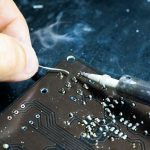
Hand soldering is the fallback for joints that no machine can reach, for rework and for very low volume. The operator applies heat and alloy with a tool, and the result depends on the skill, the tool and the joint geometry. It is the most flexible method and the least repeatable.
The variability is the problem. Two operators will produce different fillets on the same joint, and the same operator will produce different results on a heavy pin and a light one. Where hand soldering is used in production, the tools, the setpoints and the dwell should be specified, and the joints should be inspected against a written standard. Additional techniques are covered in solder joint acceptance criteria.

Comparing Hole Fill and Defect Signature
Hole fill is comparable between wave and selective soldering when both are set up correctly, but the mechanisms that limit it differ. Wave filling depends on the wave height and the thermal relief, while selective filling depends on the dwell and the nozzle. Hand soldering achieves good fill on a single joint and struggles on a connector with many adjacent pins, because the operator heats each pin and the connector body conducts heat away.
The defect signatures are distinct. Wave soldering produces bridging where the pallet does not seal, icicles at the trailing edge and skips where the wave is low. Selective soldering produces incomplete fill where the dwell is short, solder on the component shoulder where the nozzle is high, and spatter from excess flux. Hand soldering produces cold joints, excess solder and flux residue. The comparison of solder defects by category helps to identify which process produced a given failure.
Tooling Cost and Throughput
The three methods scale differently. Wave soldering has a high tooling cost per product and a very low cost per joint, so it wins on volume. Selective soldering has a moderate tooling cost and a moderate cost per joint, so it wins on variety and on moderate volume. Hand soldering has essentially no tooling cost and a high cost per joint, so it wins only at the lowest volumes or for joints that cannot be reached.
The comparison should include the cost of defects and of rework, not only the process cost. A pallet that is difficult to seal can produce a defect rate that erases its throughput advantage, and a selective program that needs frequent adjustment has a hidden labour cost. Both should be measured on the first production run rather than estimated.
Maintenance and Consumable Differences
The three methods demand different maintenance. A wave machine needs the pot chemistry managed, the nozzle and pump inspected and the dross removed, as described in solder pot maintenance. A selective machine needs the nozzle cleaned and the fixture checked, and its consumable cost is mostly flux and nitrogen where it is used. A hand soldering station needs tip condition and temperature verification.
The labour profile differs too. A wave line runs with a small team and a pallet change, a selective line needs programming and fixture attention at every product change, and hand soldering scales linearly with the number of joints. Those differences matter more than the machine price when the product mix is wide, because a method that needs an hour of setup per product will not pay back on a short run.
Selection Criteria
The practical criteria are the number of through hole joints, their distribution, the thermal sensitivity of the surface mount parts, the volume and the board size. A board with a single connector and many fine pitch parts usually suits selective soldering, while a backplane with hundreds of press-fit or soldered pins usually suits a wave.
The gopcb assembly group selects the method at the design review rather than at production, because the choice affects the layout. Clearance for a pallet, the position of keep out areas and the thermal relief design all depend on the method, and changing them after the board is built is expensive. Where two methods are both viable, the design should be arranged so that either can be used, which preserves flexibility if the volume changes.
FAQ
Can selective soldering replace a wave entirely? On many mixed technology boards, yes. It becomes impractical when the through hole joint count is very high, because the cycle time grows with the count.
Is hand soldering acceptable in production? For joints that cannot be reached by machine, and for rework. Where it is used, the tools and the dwell should be specified and the joints inspected against a written standard.
Which method gives the best hole fill? Both wave and selective soldering can achieve full fill when the thermal relief and the parameters are correct. The method matters less than the design and the setup.