Underfill Dispensing and Capillary Flow Control
Underfill is a filled polymer that flows into the gap under a package and surrounds the solder joints, so that the thermal expansion mismatch between the package and the board is shared rather than concentrated at the joints. It is applied after reflow and it cures in place.
What Underfill Does
A large package on a board with a different expansion coefficient puts the outer joints under strain with every thermal cycle. Underfill distributes that strain across the whole joint area instead of leaving the corner joint to carry it.
It is used where the package is large, where the service includes many cycles and where the joint is known to be the limiting item. Where the joint already has margin, underfill adds a process step and a rework obstacle. Our thermal cycling notes describe how the benefit is verified.
Capillary Flow and Its Limits
The material enters the gap by capillary action, which means the gap geometry, the temperature and the surface energy decide whether it fills. A gap that is too small or a material that is too viscous will not flow to the far edge of a large package.
The flow is also the source of the characteristic defect, which is a void or an incomplete fill under the centre of the package. The defect is invisible from outside and is found by scanning acoustic microscopy or by a section. Our BGA inspection notes describe why X-ray does not see it.
Dispensing Pattern and Volume
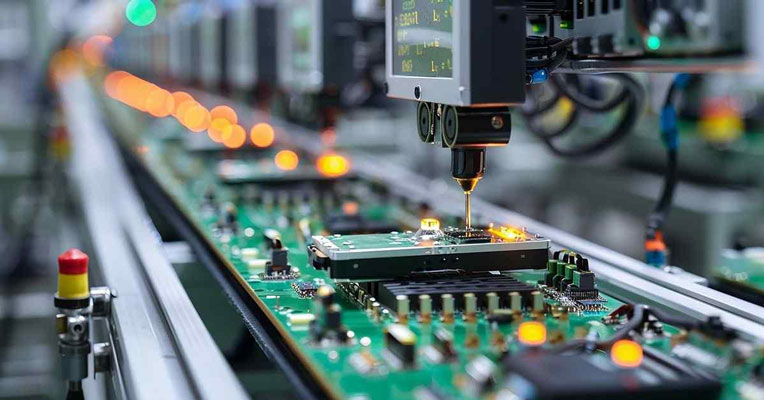
The dispense pattern is a line or a series of dots along one or two edges, and the volume is set so that the flow reaches the far side at the same time from each entry point. A pattern that concentrates material at one corner fills that corner and starves the opposite one.
The pattern is developed on a sample and then held in the program. Changing the package or the gap requires the pattern to be redeveloped, because the flow rate depends on both.
Substrate Preheating
The board is preheated before dispensing so that the material viscosity falls and the flow is fast enough to complete before the material begins to cure. The temperature has to be uniform, because a cold region fills slowly and becomes the void.
Preheat is normally applied from below and measured on the board surface near the package. The measurement is part of the process record rather than an operator judgement. Our joint criteria notes define the acceptance the fill supports.
Cure and Its Effect on the Joint
Cure changes the modulus of the material, and a partially cured underfill does not carry the load it was designed to carry. The cure schedule has to be complete without heating the assembly beyond what the components allow.
The cured material also changes the stress state of the joints, which is why the thermal cycling result after underfill is different from the result before it. That difference is what the qualification test measures.
Rework and Removal
A joint that is underfilled cannot be reworked by ordinary means. The package has to be removed with the material cut or softened, and the site has to be cleaned before a replacement is placed.
That is a real cost of using underfill, and it belongs in the design decision. Where the assembly has a high expected rework rate, a material that can be softened is chosen over one that cannot.
Material Choices
Underfills differ in filler content, cure chemistry and glass transition temperature, and the choice follows the service temperature and the gap. A highly filled material is stiffer and flows more slowly; a lightly filled one flows easily and carries less load.
The second consideration is the thermal expansion coefficient of the material itself, which should sit between the package and the board to reduce the strain rather than add to it. Our board quality notes describe how the finished assembly is judged for the material-related defects.
Process Control and Verification
Where the requirement is not written down, the shop supplies its own default, and the default is chosen for the process rather than for the design. The measurements that matter are the repeatable ones: conductor width and spacing, annular ring, finished hole size, plating thickness and surface finish are all verifiable on a coupon that travels with the panel.
Running a first article through the same checks as the production panel confirms that the two agree, and that comparison is the cheapest form of process control available at prototype stage. Keeping a sample from the panel turns a dispute into a measurement, because the same coupon can be re-examined by both parties without rebuilding the batch.
Reviewing the design before the data is released is cheaper than correcting it after the panel is in the tank, because every step downstream inherits the decision made at the front end.
Checks Before Release
The checks that matter are the ones performed on the product rather than on a sample kept for the purpose, because a coupon that travels with the panel is the only evidence about that panel. Where a requirement can be measured, it should be measured at the point of manufacture and recorded against the board or the lot it applies to.
A parameter that is set once and never re verified drifts, and the drift is usually discovered by a defect rather than by the record. The tooling, the material and the profile form one system, and a change to any of them should be assessed against the other two before it is released.
FAQ
Can underfill be applied before reflow? A no-flow material can be placed before assembly, and it changes the reflow and the voiding behaviour of the joint.
Does underfill make the joint stronger? It shares the strain rather than strengthening the alloy, and the benefit appears in thermal cycling rather than in a pull test.
What does gopcb provide for underfill? We provide material selection against the gap and the service temperature, dispense patterns developed for the package, substrate preheat measured at the package, cure schedules verified by section or acoustic scan, rework guidance, and qualification by thermal cycling.