
Vapor Phase Soldering: 7 Process Controls for Even Heat
Vapor phase soldering heats a board by condensing a hot fluorinated fluid onto it. The fluid boils at a fixed temperature, the vapour carries latent heat, and the board surface stays at that boiling point until the solder melts. Because heat arrives from the vapour rather than from moving air, the whole assembly rises together.
That uniformity is why the process still sits alongside convection reflow. It suits heavy boards, assemblies with mixed thermal mass and packages that dislike a steep ramp. It also brings its own constraints, including fluid cost, chemistry compatibility and a profile that has to be managed rather than simply dialled in.
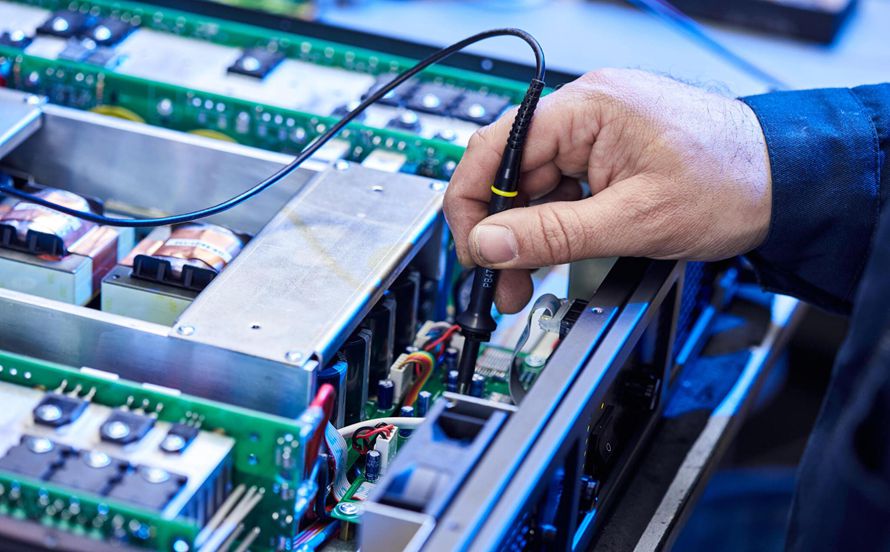
How the Process Transfers Heat
Heat transfer in vapor phase soldering happens by condensation. Vapour that touches a cooler surface releases latent heat and the surface warms towards the boiling point of the fluid. The coefficient is far higher than convection, so a heavy connector and a thin package arrive at temperature at nearly the same moment.
Once a surface reaches the fluid boiling point, condensation stops and the temperature simply holds. That gives the process a natural plateau. The self-limiting behaviour is what protects temperature-sensitive parts, but it also means the peak temperature was chosen the moment the fluid was chosen.
The Fluid and Its Boiling Point
The working fluid is a perfluorinated or hydrofluoroether liquid with a sharply defined boiling point. Common grades boil near 230 C for lead-free alloys and near 215 C for older tin-lead work, so the fluid fixes the peak and the profile is built around it.
Fluid is lost as vapour escapes the tank, and that loss is both a cost and a process variable. Loss rises with door openings, light loads and poor sealing. Because the charge can fractionate over time, the boiling point deserves a check rather than an assumption.
Condensation Soldering Versus Convection Reflow
Convection reflow moves hot air or nitrogen across the assembly, so heat crosses a boundary layer and depends on airflow, part orientation and thermal mass. Condensation soldering removes most of that dependency, which is why it can solder a mixed assembly in a single pass.
The trade-off runs the other way too. A convection oven is profiled zone by zone and tuned for a specific product, while vapour phase offers a peak fixed by the fluid and far less freedom to shape the soak. That is why the working reflow profile is shorter and less adjustable.
Profile Control: Ramp, Dwell and Peak
A vapour phase profile still has a ramp, but the ramp is set by how quickly vapour reaches the board rather than by an oven setting. Boards can be lowered into the vapour directly or held in a preheat zone above the tank, and that choice decides the ramp rate.
The peak is controlled by the fluid, but the time above liquidus is not. It depends on how long the board stays in the vapour and on the thermal mass of the assembly, so identical settings give a long dwell on a heavy board and a short one on a light board. Dwell has to be measured.
Voiding and Flux Behaviour
Voiding is the defect most often linked to this process. Flux volatiles released during the ramp are trapped under the part, and because there is no moving gas to sweep them away, the bubbles have further to travel before they escape. Slow ramps and a soak near the flux activation window let more of them out.
Flux chemistry matters just as much. A flux formulated for a long convective soak may behave differently when the peak arrives quickly and holds flat. Where voiding is critical, the solder joint voiding level should be measured on the same coupon design used in production rather than on a different test vehicle.
Handling Boards and Tooling
Boards are normally carried on a frame or pallet through a sealed door. The carrier has to hold the assembly flat while letting vapour reach both faces, and it must not shadow the board or act as a heat sink that slows the ramp on one side.
Tooling also has to survive repeated thermal cycling without outgassing. Fixtures that shed particles into the tank contaminate the fluid, and contamination raises the boiling point until the process drifts away from the profile that was qualified in the first place.
Throughput, Fluid Loss and Running Cost
Throughput is limited by the cycle rather than by the number of boards. Each batch must be loaded, brought to temperature, held and cooled before the next can enter, and cooling cannot be rushed without risking distortion or an unfinished joint.
Fluid loss dominates running cost, and it follows the seal, the door opening frequency and the load factor. Keeping the tank full and avoiding unnecessary entries does more for cost than any change to the profile, which is why the process suits batches of similar size and shape.
Defects That Point to Process Problems
A cold joint or a partly melted fillet usually means the board never reached the fluid boiling point, which points at a contaminated or fractionated charge rather than at the solder itself. Checking the fluid boiling point is the first step when joints look dry.
Solder balls and flags of flux residue are more often ramp problems, because the flux volatilises after the alloy has begun to flow. Residue baked onto the surface is harder to remove, so the cleaning after assembly stage has to be qualified together with the profile rather than afterwards.
When It Is the Right Choice
Vapor phase soldering fits thick boards, assemblies with very different thermal masses, high-reliability work where every joint must reach the same temperature, and packages that cannot tolerate a steep ramp. It fits badly with high-volume production that mixes many board sizes.
The decision usually turns on one or two difficult joints. Where the joint most at risk can be made reliable in a convection oven with a well designed profile, the extra fluid cost and control burden of a vapour process is hard to justify on throughput alone.
Points to Confirm at First Article
Where a decision is made by judgement, a boundary sample makes the judgement repeatable between operators and between shifts. Where a process is at the edge of its capability, the margin should be bought deliberately rather than discovered during production.
FAQ
Is vapor phase soldering still used in production? Yes, mainly for high-reliability, military, aerospace and medical assemblies, and for boards where thermal mass varies widely. It also appears in prototyping and rework, where a fixed, uniform peak is easier to justify than a fully profiled oven.
Does condensation soldering always cause more voiding? It tends to, because the absence of gas flow makes it harder for volatiles to escape, but the effect depends far more on the ramp and the flux than on the heating medium. Slower entry and a longer soak usually bring voiding back to an acceptable level.
Can any solder paste be used? No. The paste has to tolerate a quick ramp and a flat plateau, and its flux system has to activate within that window. Paste and fluid should be qualified together on the worst production board rather than tested separately.