18-Layer Rigid Flex PCB Cost: Prototype to Volume
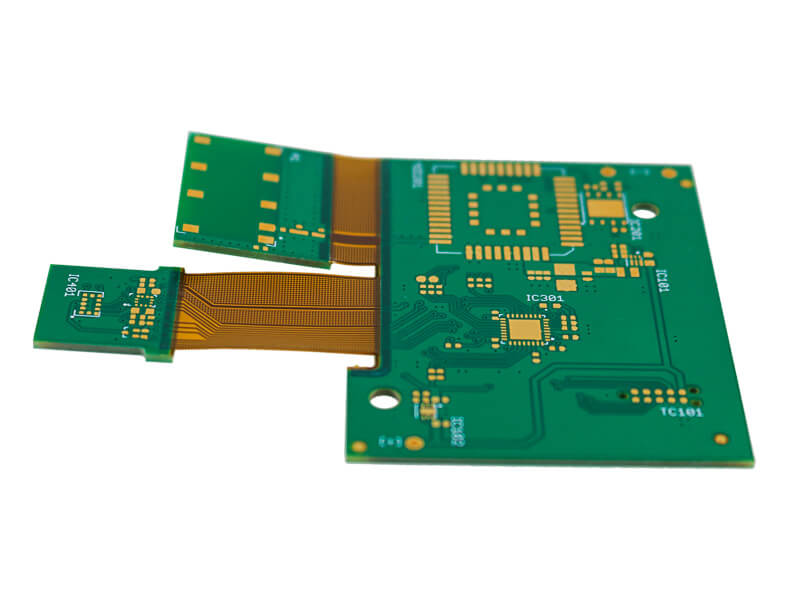
An eighteen layer rigid flex board sits at the top of the interconnect difficulty scale. It combines the lamination complexity of a very high layer count rigid board with the material handling requirements of flexible circuits, and it is usually built because nothing else can meet the mechanical envelope of the product. The result is a price that is driven far more by process steps and yield than by the area of the board, and a quotation that changes significantly between prototype and production quantities.
What Drives the Cost of This Structure
Four factors dominate. The number of lamination cycles determines how many times the board is pressed, drilled and plated, and each cycle consumes yield. The flex material adds cost per unit area because polyimide and the associated bonding films are more expensive than rigid laminate. Stiffeners add bonding operations and alignment steps. And the requirement to keep the whole assembly flat across rigid and flexible regions imposes tighter process control than a rigid board of the same layer count.
The consequence is a board whose price is dominated by engineering and process rather than by raw material. That is why the cost falls so steeply with volume: the non recurring element is large, and once the process is established the incremental cost per board is much lower than the first one suggests.
Prototype Pricing and a Worked Example
Prototype quantities of one to five boards typically quote between 300 and 1,000 dollars per board depending on size, material and complexity. For a medium board of about 100 by 150 mm in a standard construction, a representative breakdown is roughly 420 dollars for materials and processing, 40 dollars for ENIG finish and 30 dollars for inspection and electrical test, giving a total near 490 dollars for a single sample.
That figure is instructive because it shows how little of the prototype price is material. Most of it is the engineering time, tooling and process setup required to produce one board through a sequence designed for panels. The second and third prototypes of the same design cost substantially less.
Material Options
Standard construction uses a high Tg FR-4 for the rigid sections and polyimide for the flex regions, bonded with a suitable adhesive system. Adhesive free polyimide, which eliminates the acrylic adhesive layer and improves long term flexibility, adds about 20 to 50 dollars per board. An EMI shielding film or a high frequency laminate in the flex region adds 40 to 100 dollars, depending on how much of the board is affected.
Environmental requirements add cost as well. Halogen free materials run ten to fifteen percent more than their standard equivalents, which is significant on a board of this size. The choice should be driven by the specification rather than by preference, because the premium is real and the electrical differences are usually small. Where the flex region will be exposed to moisture or contamination, the protection options described in conformal coating for board protection belong in the same review.
Via Structures
Via design is where the technical and commercial decisions intersect. A blind via spanning two or three layers adds 40 to 80 dollars per board in process cost at prototype quantities. A buried via adds 30 to 60 dollars, and HDI microvias add 50 to 100 dollars depending on density. On an eighteen layer board there are usually many vias of each type, so the aggregate effect is large.
The electrical benefit is genuine where stub length matters on high speed nets, as discussed in blind and buried via stack selection. The commercial discipline is to apply the more expensive structures only where the signal integrity analysis requires them, and to use through vias elsewhere even if the routing is slightly less elegant.
Surface Finish
Finish options for this class of board are relatively cheap compared with the structure, but the choice still matters. Hot air solder levelling adds 10 to 15 dollars and is rarely suitable for a fine pitch rigid flex assembly. An organic finish adds 5 to 10 dollars and works where the boards will be assembled quickly. Immersion silver adds 20 to 40 dollars and provides a flat surface with good high frequency behaviour.
ENIG adds 30 to 50 dollars and is the usual choice because it provides a flat pad for fine pitch parts, survives multiple reflow cycles and stores well. On a board whose replacement cost is measured in hundreds of dollars, paying for the finish that maximises assembly yield is a straightforward decision.
Quantity and Regional Comparison
Quantity has a dramatic effect. Prototype orders of one to five boards quote between 400 and 1,000 dollars per board, a batch of ten to fifty falls to 300 to 450 dollars, and orders above a hundred boards reach 180 to 300 dollars per board, provided the design has been optimised and the process has stabilised.
Region adds a large spread on top. Chinese suppliers typically quote 350 to 500 dollars per board at prototype and 180 to 300 dollars at volume. United States suppliers quote 600 to 1,000 dollars at prototype and 350 to 600 dollars at volume. German suppliers sit at 700 to 1,200 dollars and 400 to 700 dollars respectively, and Southeast Asian suppliers at 400 to 700 dollars and 250 to 450 dollars. The differences reflect labour, material sourcing, automation and the certification requirements typical of each market.
Certification and Testing
Medical and defence programs usually require the higher reliability class, and that requirement changes the inspection regime rather than the board itself. IPC Class 3 acceptance criteria are tighter, first article inspection is more detailed, and more electrical and environmental testing is performed. Those steps add cost, but they are part of the specification rather than optional extras.
Testing on a rigid flex board also has to cover the flex regions specifically. Bending tests, adhesion checks and thermal cycling confirm that the transition zones between rigid and flex survive assembly and service. A supplier that understands PCB design quality at this level will propose the tests rather than wait to be asked, and a partner such as gopcb includes them in the quotation so that there are no surprises later.
Getting the Best Value
The most effective savings come before the quotation. Reducing the number of rigid-to-flex transitions, consolidating stiffener zones, keeping blind and buried vias to the nets that need them, and confirming that the flexible sections genuinely need to flex all reduce cost without affecting function.
Volume planning matters too. Because the non recurring cost is large, ordering prototypes and production boards separately means paying that cost twice. Grouping revisions so that the design is stable before the small batch build is the single most effective way to reduce the total program spend on a board of this class.
FAQ
Why is an 18-layer rigid flex PCB so expensive at prototype quantity? Because most of the price is engineering, tooling and process setup rather than material. One board still has to pass through the full multi-cycle manufacturing sequence.
How much does volume reduce the cost? Substantially. Prototype pricing of 400 to 1,000 dollars per board falls to 180 to 300 dollars per board above a hundred pieces once the process is established.
Is adhesive free polyimide worth the premium? It is where the flex region must survive repeated bending or a long service life. Where the board bends only during assembly, standard polyimide with adhesive is usually adequate.