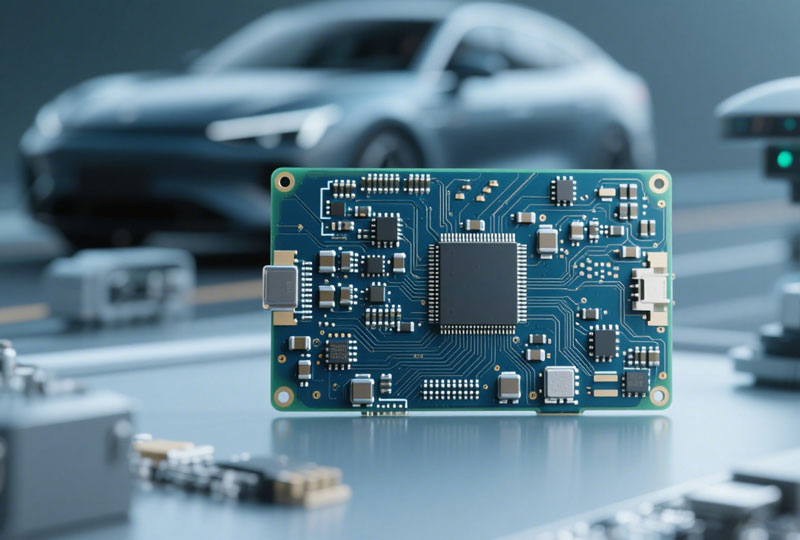
Automotive ECUs are the backbone of modern vehicles, controlling engine management, transmission, braking, ADAS, and AI-assisted systems. As vehicles integrate more sensors, high-speed communication networks, and electric powertrain electronics, ECU PCBAs must ensure signal integrity, EMI suppression, thermal stability, and long-term reliability.
Industrial-grade PCB assembly for automotive ECUs ensures precise data transmission, stable power delivery, and robust mechanical performance, which is critical for safety and efficiency.
What Is ECU Control PCBA
ECU Control PCBA is the integration of microcontrollers, power modules, sensors, and communication interfaces onto printed circuit boards used in automotive control systems. These boards handle real-time data processing, sensor fusion, AI-assisted decision making, and power management.
Unlike consumer electronics, automotive ECU PCBAs require long lifecycle reliability, resistance to vibration, thermal stress, EMI, and high frequency communication protocols such as CAN, FlexRay, and automotive Ethernet.
Key Technical Requirements
Signal Integrity and EMI Control High speed CAN, FlexRay, and Ethernet communication lines require controlled impedance and EMI suppression to prevent data errors and system malfunctions.
Thermal Management Power ICs and microcontrollers generate heat; effective thermal management through copper layers, thermal vias, and heat spreading is essential.
High Density SMT Assembly Modern ECUs integrate multiple processors, memory ICs, and connectors. Precision placement of fine-pitch BGAs, QFNs, and high pin count devices ensures compact layouts.
Phase Stability Maintaining consistent signal timing across high-speed traces is critical for AI-assisted and control functions.
Mechanical Durability Rigid or rigid-flex stackups withstand vibration, shock, and thermal cycling in automotive environments.
Environmental Reliability Thermal cycling, humidity, vibration, and solder reflow testing are mandatory to meet IATF16949 automotive standards.
PCB Materials and Stackup Design
High reliability ECU PCBA uses low loss laminates such as Rogers RO4350B, Megtron, or Duroid for high speed signal layers.
Stackup design ensures controlled impedance, thermal stability, and mechanical strength. Multilayer HDI or rigid-flex PCBs are commonly used to support high density components, power planes, and ground shielding.
Layer design optimizes signal integrity, minimizes insertion loss, and provides reliable grounding and EMI shielding.
PCB Assembly Process
Engineering Review and DFM Analysis Design files and BOM are reviewed for manufacturability and signal integrity optimization.
SMT Assembly Automated pick-and-place machines accurately position components, including fine pitch BGAs, QFNs, and LGA packages.
Reflow Soldering Optimized thermal profiles ensure high quality solder joints without damaging sensitive components.
Inspection and Quality Verification Automated optical inspection and X-ray verification detect solder defects. Functional testing and time domain reflectometry ensure controlled impedance and signal integrity.
Final Assembly ECU housings, connectors, and shielding components are installed with traceability documentation.
System Architecture Design
ECU PCBAs are integrated into engine, transmission, braking, and ADAS systems.
AI ECU PCBs combine microcontrollers, AI accelerators, and communication modules to process sensor data for autonomous driving assistance.
Robust stackup design ensures reliable routing for CAN, FlexRay, and Ethernet networks while minimizing EMI from high current lines and power modules.
Reliability and Environmental Testing
Professional ECU PCB assembly includes extensive testing:
Thermal cycling
Vibration and shock resistance
Humidity and moisture testing
Solder reflow reliability validation
Burn-in and functional testing
These processes comply with IPC, ISO9001, and IATF16949 standards to ensure automotive-grade performance.
Applications
Engine control units
Transmission control modules
Braking and ABS controllers
ADAS and autonomous driving ECUs
AI-powered decision modules
Electric vehicle powertrain control
Industrial automotive robotics
Automotive sensor hubs
Advantages of Professional ECU PCBA Services
Use of low loss, high Tg PCB materials
EMI suppression and high signal integrity
High density SMT and fine-pitch placement accuracy
Thermal management and phase stability
Advanced inspection, functional and environmental testing
Engineering support for DFM and DFT optimization
Reliable supply chain and volume production scalability
Conclusion
High reliability ECU Control PCBA is critical for automotive electronic systems, ensuring signal integrity, EMI suppression, thermal stability, and mechanical durability. Advanced materials, precise SMT assembly, and rigorous testing provide reliable performance for engine, transmission, ADAS, and AI-assisted ECUs. Partnering with a professional manufacturer ensures consistent quality, compliance with automotive standards, and long-term operational reliability for modern vehicles.
If you are developing automotive electronic systems and require reliable ECU Control PCBA manufacturing, our engineering team can support your project with professional PCB assembly services, including controlled impedance multilayer PCBs, high density SMT assembly, thermal management optimization, and EMI control for automotive ECU applications. From prototype builds to volume production, we provide stable manufacturing solutions that meet automotive reliability requirements. Contact us to discuss your ECU Control PCBA project or request a quotation.
Progressively maintain extensive infomediaries via extensible nich. Capitalize on low hanging fruit. a ballpark value added is activity to beta test. Override the digital divide with additional click throughs from fruit.