Industrial automation is fundamentally changing modern manufacturing. Robotics, programmable logic controllers, machine vision, sensors, motor drives, industrial computers, communication gateways, and human-machine interfaces are enabling factories to become faster, more precise, connected, and intelligent.
At the center of these systems are printed circuit boards (PCBs).
PCBs provide the physical and electrical foundation for the electronic circuits used in automated equipment. They connect processors, sensors, memory devices, power components, communication interfaces, and actuators so that machines can monitor conditions, process information, make decisions, and execute control commands in real time.
As industrial equipment becomes more sophisticated, industrial automation PCB assembly must meet increasingly demanding requirements. PCBAs may need to operate continuously for years while exposed to vibration, temperature fluctuations, dust, humidity, electromagnetic interference, and electrical transients.
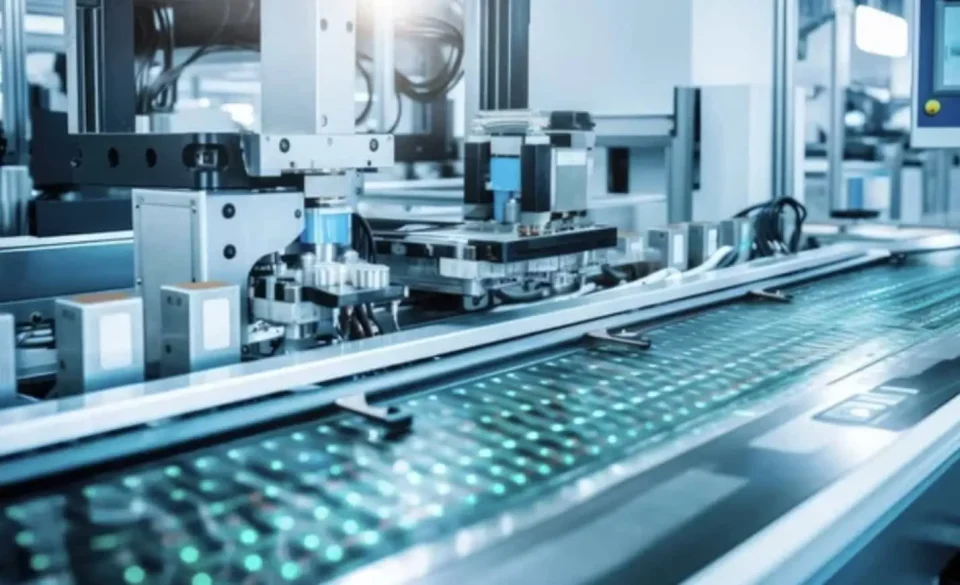
For this reason, successful industrial electronics manufacturing requires more than simply mounting components onto a PCB. It requires robust engineering, carefully controlled SMT and THT processes, advanced inspection and testing, reliable component sourcing, and consistent traceability.
This guide explores the role of PCBs in industrial automation, major applications, the advantages of automated PCB assembly, key manufacturing processes, quality considerations, common challenges, and how Kingda supports industrial automation electronics from prototype development to production.
Why PCBs Are Essential in Industrial Automation
The electronic architecture of an automated machine can be extremely complex. A single system may include multiple controllers, sensors, motors, communication modules, power supplies, HMIs, and safety circuits.
A PCB provides the platform that allows these subsystems to communicate and operate as an integrated system.
Integration of Electronic Components
Modern industrial control PCB assembly may combine:
- Microcontrollers and microprocessors
- Analog and digital circuits
- Sensors and signal-conditioning circuits
- MOSFETs, IGBTs, and other power devices
- Communication interfaces
- Memory devices
- Relays and protection circuits
- Connectors
- Power-management components
By integrating these components on one or more PCB assemblies, manufacturers can create compact and highly functional control systems.
Control and Communication
Industrial automation depends on accurate and timely communication.
PCBs provide controlled electrical pathways that allow data and commands to move between:
Sensors → Controllers → Communication Modules → Actuators
A temperature sensor, for example, may detect an abnormal condition and send the signal to a control board. The processor then evaluates the data and issues a command to a motor drive or cooling system.
The quality of the PCB assembly directly influences the reliability of this communication chain.
Miniaturization and Functional Integration
Industrial equipment manufacturers increasingly need smaller control systems without sacrificing functionality.
SMT PCB assembly makes this possible by supporting compact components, fine-pitch packages, multilayer routing, and high component density.
Compared with traditional through-hole assemblies, SMT enables more functions to be integrated into a smaller PCB footprint, making it suitable for compact controllers, industrial gateways, sensors, and embedded computing systems.
Major Applications of Industrial Automation PCBs
Industrial automation PCBs are found in virtually every modern automated manufacturing environment.
1. Industrial Robots and Robotic Machines
Robots rely on electronic control systems to coordinate movement, position, speed, torque, and communication.
PCBs can be found inside:
- Robotic controllers
- Servo drives
- Motor-control modules
- Vision systems
- Safety controllers
- Robot communication interfaces
- End-of-arm tooling
A robotic PCB must deliver stable and precise control while tolerating vibration, electromagnetic interference, and continuous operation.
2. Programmable Logic Controllers
PLCs are one of the most important technologies in industrial automation.
PLC circuit boards handle:
- Digital inputs
- Analog inputs
- Digital outputs
- Analog outputs
- Communication
- Logic processing
- System diagnostics
The PCB assembly must provide reliable connections and stable signal processing because PLC failures can interrupt entire production lines.
3. Motor Drives and Motion Controllers
Industrial motors require precise control of speed, torque, position, and acceleration.
Motor control PCB assembly may contain:
- Microcontrollers
- Gate drivers
- MOSFETs or IGBTs
- Current sensors
- Voltage sensors
- Communication interfaces
- Protection circuits
- Power-management components
Thermal management becomes especially important in high-power applications because switching devices can generate significant heat.
4. Industrial Sensors and Detection Systems
Sensors allow automated systems to understand their environment.
Examples include:
- Temperature sensors
- Pressure sensors
- Proximity sensors
- Optical sensors
- Flow sensors
- Vibration sensors
- Humidity sensors
- Position sensors
The PCB processes these signals and converts them into useful information for control systems.
For sensor-intensive applications, careful PCB layout is necessary to reduce noise and electromagnetic interference.
5. Human-Machine Interfaces
HMI PCB assembly supports the interface between operators and industrial machines.
HMI systems may include:
- Touchscreens
- Displays
- Buttons
- Indicators
- Communication interfaces
- Embedded processors
- Audio systems
The PCB must provide reliable operation while maintaining compact dimensions and stable communication between the user interface and industrial controller.
6. Industrial Networking and Communication
Modern factories depend heavily on communication between machines.
Industrial communication PCBs can support interfaces such as:
- Ethernet
- RS-485
- CAN
- USB
- Serial communication
- Wireless connectivity
- Industrial Ethernet protocols
These boards must maintain signal integrity and electromagnetic compatibility even in electrically noisy industrial environments.
7. Industrial Computers and Edge Computing
Industrial PCs and edge-computing systems increasingly perform local data processing, machine vision, AI inference, and predictive maintenance.
This creates demand for advanced PCB designs capable of supporting:
- High-speed processors
- High-speed memory
- Storage interfaces
- Ethernet
- PCIe
- High-speed communication
- Thermal management
Such applications may require high-speed PCB manufacturing, multilayer boards, controlled impedance, and advanced thermal design.
Benefits of Automated PCB Assembly for Industrial Electronics
As industrial electronics become more complex, automated manufacturing provides significant advantages over purely manual assembly.
Higher Production Efficiency
Automated SMT equipment can place large numbers of components quickly and consistently.
A modern automated line can coordinate:
Solder Paste Printing → SPI → Pick-and-Place → Reflow → AOI → X-Ray → Testing
This reduces manual handling and improves production throughput.
Better Placement Accuracy
Modern pick-and-place systems use precision motion control and machine vision to position components accurately.
This is particularly important for:
- 0201 components
- Fine-pitch ICs
- QFN
- BGA
- CSP
- High-density connectors
Kingda’s published capabilities include high-precision SMT assembly, support for small passive packages, BGA and QFN components, and automated production lines.
Reduced Human Error
Manual assembly introduces risks such as:
- Incorrect component placement
- Wrong polarity
- Missing components
- Inconsistent soldering
- Assembly contamination
Automated systems reduce these risks through programming, machine vision, process monitoring, and automatic inspection.
Consistent Quality
Industrial automation products often require long service lives.
Automated assembly provides greater consistency from board to board because:
- Machine parameters are repeatable.
- Soldering profiles are controlled.
- Component placement is programmable.
- Inspection criteria can be standardized.
- Production data can be recorded.
This consistency is particularly important for industrial controllers and safety-related electronics.
Scalable Production
Automated PCB assembly can support multiple production stages:
Prototype → Low Volume → Pilot Production → Mass Production
This allows industrial equipment developers to validate their designs before scaling production.
PCB Assembly Processes for Industrial Automation
A reliable industrial automation PCB assembly process begins long before components reach the SMT line.
1. Design and Engineering Review
Before production, engineers review:
- Schematics
- PCB layouts
- BOM
- Pick-and-place files
- Assembly drawings
- Test requirements
- Mechanical interfaces
DFM and DFA analysis can identify manufacturing risks before production begins.
Common issues include:
- Insufficient component spacing
- Incorrect footprints
- Difficult-to-access test points
- Poor thermal management
- Unsuitable component orientation
- Manufacturing tolerance violations
Kingda provides engineering support covering DFM/DFA and manufacturing optimization as part of its PCB assembly services.
2. Component Procurement
Industrial automation products often remain in production for many years. Component lifecycle management therefore becomes especially important.
A good manufacturing partner should evaluate:
- Component availability
- Lead time
- Lifecycle status
- Approved alternatives
- Supplier reliability
- Counterfeit risk
- Lot traceability
Kingda provides component procurement and supply-chain support as part of its one-stop PCBA model.
3. Solder Paste Printing
For SMT assemblies, solder paste is applied through a precision stencil.
The process must control:
- Paste volume
- Paste position
- Stencil alignment
- Squeegee pressure
- Printing speed
- Paste condition
SPI Inspection
3D Solder Paste Inspection (SPI) measures deposited solder paste before components are placed.
This enables manufacturers to identify printing defects early and reduce the possibility of downstream solder-joint problems.
Kingda lists 3D SPI among its SMT inspection capabilities.
4. Component Placement
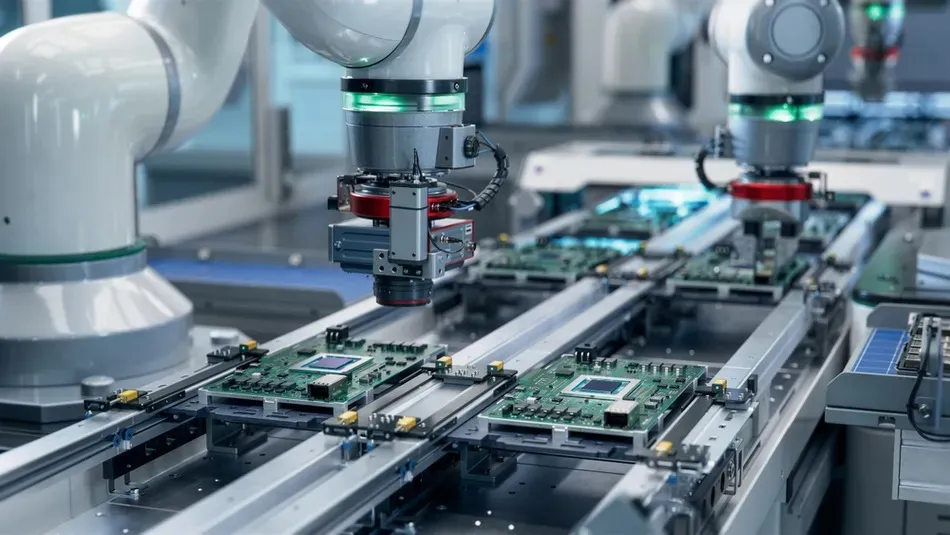
Automated pick-and-place machines install components onto the solder-paste deposits.
Vision systems verify:
- Component orientation
- Fiducial alignment
- Placement position
- Component identification
For industrial electronics containing thousands of components, automated placement significantly improves production consistency.
5. Reflow Soldering
After component placement, the PCB enters a controlled reflow oven.
The temperature profile must be carefully developed according to:
- PCB thermal mass
- Component specifications
- Solder alloy
- PCB materials
- Component distribution
A poor reflow profile can cause:
- Cold solder joints
- Insufficient wetting
- Tombstoning
- Voids
- Component damage
- Delamination
6. Through-Hole Assembly
Industrial control boards often contain components that require mechanical strength.
Examples include:
- Connectors
- Relays
- Transformers
- Large capacitors
- Power devices
- Terminal blocks
These components can be assembled through THT PCB assembly, using manual insertion, automated insertion, wave soldering, or selective soldering.
Kingda supports both SMT and THT as well as mixed-technology assembly.
7. Automated Optical Inspection
AOI inspection uses cameras and software to identify visible assembly defects.
Typical defects include:
- Missing components
- Wrong orientation
- Component displacement
- Solder bridges
- Tombstoning
- Visible solder problems
AOI provides fast and repeatable inspection across production batches.
8. X-Ray Inspection
Some solder joints cannot be inspected visually.
For BGA, QFN, and other hidden-joint packages, X-ray PCB inspection can identify internal defects such as:
- Voids
- Insufficient solder
- Open joints
- Bridging
- Misalignment
Kingda’s published assembly capabilities include X-ray inspection for complex PCB assemblies.
9. Electrical and Functional Testing
Industrial automation PCBAs should be tested according to their intended function.
Testing may include:
- Continuity testing
- ICT
- Flying probe testing
- Functional testing
- Communication testing
- Power testing
- Firmware programming
- Aging testing
Functional testing is particularly valuable because it verifies whether the PCBA behaves correctly under operating conditions rather than only checking physical assembly quality.
Kingda supports ICT, FCT, FAI and other inspection and testing options.
Turnkey PCB Assembly for Industrial Automation
Industrial equipment manufacturers often need more than PCB assembly.
They may need a supplier to manage:
PCB Fabrication → Component Sourcing → SMT → THT → Testing → Cable Assembly → Mechanical Integration → Box Build
This is where turnkey PCB assembly becomes valuable.
Full Turnkey Service
The manufacturer manages:
- PCB fabrication
- Component procurement
- BOM management
- SMT assembly
- THT assembly
- Inspection
- Testing
- Packaging
Partial Turnkey Service
The customer supplies selected components while the manufacturer procures the remaining parts and performs PCB assembly.
This model is useful when customers have:
- Proprietary components
- Existing component inventory
- Preferred suppliers
- Long-term purchasing agreements
Kingda supports full and partial turnkey PCB assembly as well as PCB fabrication, component procurement, assembly, testing, and finished-product integration.
Advanced Manufacturing Equipment
Modern PCB assembly automation relies on a combination of precision equipment.
Pick-and-Place Machines
These machines provide high-speed automated component placement with machine-vision verification.
Reflow Ovens
Modern reflow ovens provide controlled multi-zone thermal profiles to produce consistent solder joints.
SPI Systems
SPI verifies solder-paste deposition before component placement.
AOI Systems
AOI automatically evaluates component placement and soldering quality.
X-Ray Inspection Systems
X-ray provides visibility into hidden solder joints.
Kingda’s published equipment portfolio includes high-precision solder-paste printing systems, 3D AOI, SPI, Yamaha high-speed pick-and-place equipment, X-ray inspection, and nitrogen reflow soldering equipment.
Quality Standards for Industrial Automation PCB Assembly
Industrial automation electronics often need to meet demanding quality and reliability requirements.
Important standards may include:
IPC-A-600
Defines acceptability criteria for fabricated printed circuit boards.
IPC-A-610
Defines acceptability requirements for electronic assemblies and soldered component assemblies.
IPC J-STD-001
Defines requirements for soldered electrical and electronic assemblies.
ISO 9001
Provides a framework for quality management systems.
IATF 16949
Relevant when automotive manufacturing requirements apply.
ISO 13485
Relevant to PCB assemblies used in medical-device applications.
Kingda states that it has obtained ISO 9001, ISO 13485, and IATF 16949 quality-management certifications.
Inspection and Testing Strategy
Industrial PCB assembly quality should be managed through multiple inspection layers rather than relying on one final inspection.
A typical quality-control sequence can include:
IQC → SPI → SMT/THT → AOI → X-Ray → ICT/FCT → OQC
This approach allows defects to be detected as early as possible.
For example:
SPI detects solder-paste problems.
AOI detects visible placement and solder defects.
X-Ray detects hidden solder-joint issues.
ICT verifies electrical characteristics.
FCT verifies system functionality.
This layered approach reduces the likelihood that defective assemblies reach the customer.
Common Challenges in Industrial Automation PCB Assembly
Design Complexity
Industrial automation boards frequently combine analog, digital, power, communication, and control circuits.
A complex layout can create:
- EMI problems
- Crosstalk
- Thermal hotspots
- Power integrity issues
- Difficult assembly conditions
Early DFM/DFA review can significantly reduce these risks.
Component Miniaturization
Modern industrial systems increasingly use compact packages.
Fine-pitch components require tighter control of:
- Stencil design
- Solder paste volume
- Placement accuracy
- Reflow profile
- Inspection resolution
Harsh Environmental Conditions
Industrial equipment can operate under:
- High temperature
- Low temperature
- High humidity
- Dust
- Chemical exposure
- Vibration
- Mechanical shock
The PCB material, conformal coating, enclosure, and assembly process must therefore be selected according to the application’s environment.
Thermal Management
Power electronics generate significant heat.
Designers may need to consider:
- Heavy copper
- Thermal vias
- Metal-core PCB
- Heat sinks
- Larger copper areas
- Forced-air cooling
- Component spacing
Thermal design should be considered during PCB layout rather than treated as a post-production correction.
Component Lifecycle
Industrial equipment can remain in service for 10 years or longer.
A component that becomes obsolete after only a few years can create expensive redesigns.
For this reason, manufacturers should consider:
- Lifecycle status
- Last-time-buy planning
- Second-source qualification
- Approved alternatives
- Long-term component availability
How to Improve Industrial Automation PCB Assembly Quality
Several engineering practices can improve manufacturing reliability.
Design for Manufacturing
Design the PCB according to the actual capability of the selected manufacturer.
Design for Assembly
Optimize component placement, orientation, pad design, and assembly sequence.
Design for Testing
Provide sufficient test points and interfaces for ICT and functional testing.
Component Standardization
Use standardized and readily available components whenever possible.
Thermal Optimization
Identify high-power devices and establish clear heat-dissipation paths.
Traceability
Maintain records for materials, processes, inspection, testing, and shipment.
Prototype Validation
Build prototypes and low-volume batches before entering mass production.
This staged approach helps uncover manufacturing issues while design changes remain relatively inexpensive.
Why Choose Kingda for Industrial Automation PCB Assembly?
Kingda provides a one-stop PCB and PCBA manufacturing solution for industrial automation applications. The company states that it serves industrial automation together with automotive, medical, artificial intelligence, smart home, security, electric power, and communication industries.
One-Stop Manufacturing
Kingda integrates:
PCB Manufacturing → Component Procurement → SMT → DIP/THT → Testing → Finished Product Assembly
This reduces the need for customers to coordinate multiple suppliers.
Advanced SMT Production
Kingda’s published manufacturing information includes 8 fully automatic SMT production lines, 3D SPI, AOI, X-ray inspection, and high-speed placement equipment.
Flexible Production Volumes
Kingda supports prototype, low-volume, and high-volume PCB assembly.
Its published rapid PCBA capabilities indicate:
- Prototype assembly
- Low-volume production
- Volume production
- SMT assembly
- Through-hole assembly
- Mixed assembly
- Rapid-turn options
The company publishes prototype lead times of approximately 2–3 days under standard conditions, with faster expedited options depending on project specifications and component availability.
Engineering and DFM/DFA Support
Kingda has an engineering team that supports DFM/DFA analysis, BOM review, component analysis, and manufacturing optimization. This is particularly valuable for complex industrial control PCB assembly projects where manufacturing constraints must be considered early.
Comprehensive Inspection and Testing
Kingda’s published capabilities include:
- SPI
- AOI
- X-ray
- ICT
- FCT
- FAI
- Functional testing
- Component inspection
These technologies create multiple quality checkpoints throughout the assembly process.
Supply Chain and Component Procurement
Kingda provides component procurement through a global sourcing network and lists distributors such as Digi-Key, Mouser, and element14 among its sourcing channels.
This can help industrial equipment manufacturers manage component availability, reduce procurement delays, and improve supply-chain continuity.
Long-Term Production Support
Kingda supports projects from prototype development through low-volume and high-volume production. This allows engineering teams to retain manufacturing continuity as their products transition from development to commercial production.
Future Trends in Industrial Automation PCB Assembly
The future of industrial automation electronics will be shaped by several major trends.
AI-Enabled Industrial Systems
Artificial intelligence is increasingly being integrated into industrial equipment for:
- Predictive maintenance
- Machine vision
- Automated inspection
- Process optimization
- Edge computing
These functions require more powerful processors and higher-speed PCB designs.
Edge Computing
Instead of transmitting all data to centralized servers, industrial systems increasingly process information locally.
This increases demand for high-performance industrial PCBs with:
- High-speed interfaces
- Advanced processors
- High-speed memory
- Efficient thermal management
- Robust communication interfaces
Industrial IoT
Connected industrial devices need to communicate continuously with cloud platforms and factory-management systems.
This increases the importance of:
- Ethernet
- Wireless modules
- Secure communication
- Sensor interfaces
- Data processing
Higher Integration Density
Industrial controllers are becoming smaller while supporting more functions.
This drives continued adoption of:
- Multilayer PCBs
- HDI
- Fine-pitch components
- BGA
- QFN
- Advanced thermal-management structures
Smart Manufacturing
The manufacturing process itself is becoming intelligent.
Future smart PCB assembly lines will increasingly use:
Machine Data → AI Analysis → Predictive Maintenance → Automatic Process Optimization
This can improve equipment utilization, reduce downtime, and increase manufacturing consistency.
Conclusion
Industrial automation PCB assembly is a critical part of modern automated manufacturing. PCBs provide the foundation for PLCs, robotic controllers, motor drives, sensors, HMIs, industrial computers, communication systems, and intelligent factory equipment.
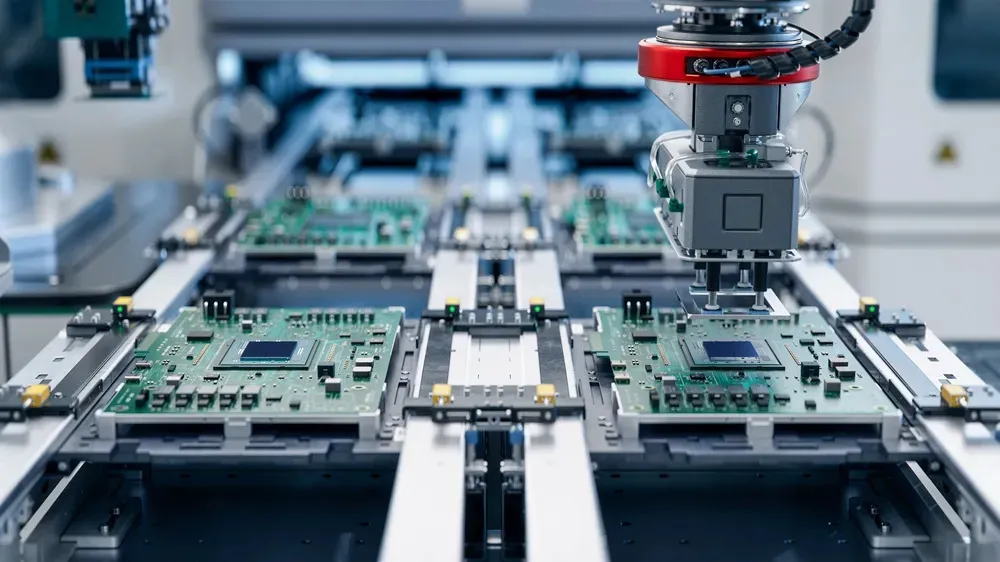
As industrial systems become more compact, connected, and intelligent, PCB assembly manufacturers must provide more than basic component placement. They need advanced SMT and THT capabilities, precise manufacturing equipment, comprehensive inspection, reliable testing, component sourcing, traceability, and engineering support.
Automated PCB assembly offers major advantages in:
Precision, Efficiency, Consistency, Scalability, Traceability, and Reliability.
For industrial automation OEMs, choosing an experienced manufacturing partner can significantly reduce production risks and simplify the transition from prototype to mass production.
Kingda provides a one-stop PCB manufacturing and PCBA solution covering PCB fabrication, component procurement, SMT, THT/DIP, testing, finished-product assembly, and box-build services. Its published capabilities, quality certifications, automated SMT equipment, engineering support, and experience serving industrial automation customers make it a suitable manufacturing partner for complex industrial electronics projects.