Top 15 PCB Manufacturing Companies in 2026: Global PCB Manufacturers Compared
Choosing the right PCB manufacturing company is critical to the quality, reliability, cost, and manufacturing efficiency of an electronic product. Whether you are developing a prototype, launching a new product, or preparing for high-volume production, the right PCB manufacturing partner can help reduce defects, improve production efficiency, control manufacturing risks, and meet industry-specific quality requirements.
The global PCB industry includes thousands of manufacturers with different levels of technical expertise, production capacity, certifications, engineering capabilities, and manufacturing technologies. Selecting the right partner should therefore involve much more than comparing prices. Factors such as manufacturing capabilities, quality certifications, engineering support, production capacity, material compatibility, testing capabilities, and delivery performance should all be evaluated.
This guide introduces 15 notable PCB manufacturers in 2026 and compares their major technologies, manufacturing capabilities, industry experience, and service offerings. It also explains how to evaluate a PCB manufacturer and select a suitable manufacturing partner for your project.
What Is PCB Manufacturing?
PCB manufacturing is the process of converting copper-clad laminate and other substrate materials into finished bare printed circuit boards that can subsequently undergo PCB assembly. Depending on the board structure and application, the manufacturing process may include material preparation, inner-layer imaging, lamination, drilling, copper plating, outer-layer imaging, etching, solder mask application, surface finishing, electrical testing, and final inspection.
The process begins with customer design data, including Gerber files, drill files, stack-up information, material specifications, impedance requirements, and manufacturing notes. These design files are transformed into a physical circuit board through a series of tightly controlled manufacturing processes.
Important parameters such as trace width, trace spacing, copper thickness, via plating, dielectric thickness, layer alignment, annular ring dimensions, and controlled impedance must be carefully managed throughout production.
A professional PCB manufacturing company should have effective process controls, quality assurance procedures, automated inspection systems, electrical testing capabilities, and traceability systems to ensure consistent production quality.
For advanced applications, manufacturers may also provide engineering services such as DFM analysis, stack-up optimization, impedance simulation, material selection, and manufacturing process recommendations.
Types of PCB Manufacturing Services
Modern PCB manufacturing services cover a broad range of technologies, from simple single-layer boards to advanced multilayer, HDI, rigid-flex, RF, heavy-copper, and metal-core PCBs.
Different applications require different manufacturing capabilities. Consumer electronics may prioritize miniaturization and cost efficiency, while aerospace, automotive, medical, telecommunications, and industrial electronics often require tighter process control and higher reliability.
Standard Rigid PCB Manufacturing
Standard rigid PCBs are commonly manufactured using FR-4 or high-Tg FR-4 materials and may range from simple single-layer boards to complex multilayer constructions.
These boards are widely used in consumer electronics, industrial equipment, telecommunications, power supplies, control systems, and commercial products.
Typical manufacturing capabilities include:
- Single- and multilayer PCB fabrication
- FR-4 and high-Tg materials
- HASL, ENIG, OSP, and other surface finishes
- Through-hole and plated-through-hole technology
- Controlled impedance options
- Electrical testing and automated optical inspection
- Prototype and volume production
HDI PCB Manufacturing
HDI PCB technology enables high-density routing in compact electronic products. It uses technologies such as laser-drilled microvias, blind vias, buried vias, via-in-pad structures, and sequential lamination.
HDI manufacturing is particularly important for smartphones, wearable devices, tablets, networking equipment, advanced automotive electronics, and compact industrial controllers.
The major benefits of HDI include:
- Higher wiring density
- Reduced board size
- Improved electrical performance
- Shorter signal paths
- Better utilization of PCB real estate
- Greater design flexibility for miniaturized products
Rigid-Flex PCB Manufacturing
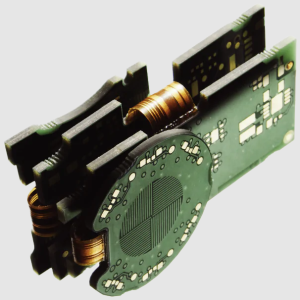
Rigid-flex PCB technology combines rigid circuit sections with flexible polyimide sections within a single integrated board.
This configuration eliminates or reduces the need for connectors and cable assemblies and enables three-dimensional electronic packaging.
Rigid-flex PCBs are commonly used in:
- Wearable electronics
- Medical equipment
- Aerospace systems
- Cameras
- Automotive electronics
- Portable electronic devices
- Compact industrial equipment
Manufacturing rigid-flex boards requires specialized material handling, coverlay processing, lamination, flexible-area protection, and mechanical reliability control.
Heavy Copper PCB Manufacturing
Heavy copper PCB technology uses substantially thicker copper layers than conventional circuit boards. Depending on the design, copper thickness can range from several ounces to much higher values.
Heavy-copper boards are particularly suitable for high-current and high-power applications, including:
- Power supplies
- Battery systems
- Motor controllers
- Power converters
- Industrial equipment
- Renewable energy systems
- Automotive power electronics
Manufacturing heavy-copper PCBs requires carefully controlled etching, copper plating, thermal management, and dimensional compensation.
High-Frequency and RF PCB Manufacturing
High-frequency PCB and RF PCB manufacturing requires specialized materials and tightly controlled electrical characteristics.
Materials such as PTFE-based laminates, Rogers materials, and other low-loss dielectric systems may be selected for radar, 5G communications, satellite systems, microwave equipment, and high-speed networking applications.
Important manufacturing considerations include:
- Controlled dielectric thickness
- Low-loss materials
- Tight trace-width tolerances
- Controlled impedance
- Surface roughness
- Copper profile
- Layer-to-layer registration
- TDR impedance testing
The PCB manufacturer must work closely with the designer to maintain the electrical characteristics specified in the original design.
Metal Core PCB Manufacturing
Metal-core PCBs, commonly known as MCPCBs, use aluminum or copper as a heat-spreading substrate.
They are widely used in:
- LED lighting
- Power electronics
- Motor drives
- Automotive lighting
- Industrial power systems
- High-power electronic modules
The primary advantage of an MCPCB is improved thermal management. Heat generated by components can be transferred more efficiently through the metal core and dissipated into the surrounding environment.
Top 15 PCB Manufacturing Companies in 2026
The following list represents a capability-oriented selection of notable PCB manufacturers. The ranking is editorial rather than an official global ranking and considers factors such as technology capabilities, certifications, engineering expertise, manufacturing scale, industry experience, and overall service capabilities.
1. TTM Technologies — United States
TTM Technologies is a major PCB manufacturer serving demanding industries including aerospace, defense, medical, automotive, networking, and telecommunications.
The company is known for advanced circuit technologies, including complex multilayer PCBs, HDI, RF and microwave circuits, and rigid-flex technologies.
Key capabilities include:
- Advanced multilayer PCB manufacturing
- HDI PCB technology
- RF and microwave PCB manufacturing
- Rigid-flex PCB solutions
- Aerospace and defense applications
- High-reliability manufacturing
- Engineering and DFM support
- Global manufacturing capabilities
TTM Technologies is particularly suitable for applications where electrical performance, reliability, traceability, and manufacturing quality are critical.
2. AT&S — Austria
AT&S is a leading European manufacturer specializing in advanced interconnect technologies, HDI PCBs, and IC substrates.
The company serves automotive, medical, industrial, mobile electronics, and semiconductor-related applications.
Key capabilities include:
- Advanced HDI PCB manufacturing
- IC substrate technology
- High-density interconnect solutions
- Automotive electronics
- Medical electronics
- Advanced packaging technologies
- High-reliability manufacturing
AT&S has developed extensive expertise in advanced interconnect technologies for increasingly compact and high-performance electronic products.
3. Tripod Technology — Taiwan
Tripod Technology is a major PCB manufacturer based in Taiwan and is known for producing multilayer printed circuit boards for consumer electronics, automotive electronics, and other high-volume applications.
Key capabilities include:
- High-volume PCB manufacturing
- Multilayer PCB production
- Consumer electronics applications
- Automotive PCB manufacturing
- High-density circuit technologies
- Large-scale production capabilities
- International supply-chain support
Its manufacturing capabilities make it particularly relevant to applications requiring consistent production quality and high-volume output.
4. Kingboard Holdings — Hong Kong
Kingboard Holdings is a major manufacturer of PCBs and copper-clad laminates serving commercial, industrial, telecommunications, and consumer electronics markets.
The company’s vertically integrated manufacturing capabilities provide advantages in materials, production capacity, and supply-chain management.
Key capabilities include:
- Large-scale PCB manufacturing
- Copper-clad laminate production
- Multilayer PCB manufacturing
- Industrial electronics applications
- Telecommunications applications
- Large production capacity
- Integrated materials supply
5. Shennan Circuits — China
Shennan Circuits is a major Chinese PCB manufacturer with expertise in HDI, high-frequency circuits, packaging substrates, and high-reliability printed circuit boards.
Its products serve telecommunications, automotive electronics, aerospace, industrial control, data communications, and other advanced applications.
Key capabilities include:
- HDI PCB manufacturing
- High-frequency PCB technology
- Advanced multilayer PCB production
- Packaging substrate technologies
- Automotive electronics
- Telecommunications applications
- High-reliability PCB manufacturing
6. Sanmina — United States
Sanmina provides electronic manufacturing and PCB-related manufacturing solutions for aerospace, defense, medical, industrial, networking, and communications applications.
Its capabilities extend beyond bare-board production and include engineering, assembly, testing, and integrated manufacturing services.
Key capabilities include:
- Complex multilayer PCB manufacturing
- High-reliability PCB solutions
- Aerospace and defense applications
- Medical electronics
- Industrial electronics
- Engineering support
- Integrated manufacturing services
7. Würth Elektronik — Germany
Würth Elektronik is a well-known European electronics manufacturer with PCB manufacturing and technology expertise serving automotive, industrial, medical, and other demanding applications.
Its capabilities include advanced circuit technologies, engineering support, and specialized PCB solutions.
Key capabilities include:
- Industrial PCB manufacturing
- Automotive electronics
- Multilayer PCB technology
- High-reliability applications
- Engineering support
- Customized PCB solutions
- Prototype and production services
8. Eltek — Israel
Eltek specializes in high-reliability printed circuit boards and serves industries such as aerospace, defense, medical, industrial, and power electronics.
The company is particularly recognized for advanced and high-reliability PCB technologies, including boards designed for demanding environments.
Key capabilities include:
- High-reliability PCB manufacturing
- Multilayer PCB technology
- Heavy-copper PCB solutions
- Aerospace and defense applications
- Industrial electronics
- Advanced materials
- High-reliability manufacturing processes
9. Kingda — China
Kingda provides customized PCB manufacturing and PCB assembly solutions for customers requiring prototype development, small-batch production, and volume manufacturing.
Its service model can integrate PCB fabrication, engineering support, component sourcing, and assembly to simplify the product-development process.
Key capabilities include:
- Custom PCB manufacturing
- PCB prototyping
- Multilayer PCB production
- HDI PCB solutions
- Rigid PCB manufacturing
- PCB assembly
- SMT and THT assembly
- DFM engineering support
- Quality-controlled production
For companies developing new electronic products, an integrated manufacturing partner can reduce communication complexity between PCB fabrication and assembly.
10. PCBWay — China
PCBWay is an online PCB manufacturing platform offering prototype and production services for a broad range of PCB technologies.
Its service portfolio includes conventional multilayer boards, HDI, flexible PCBs, rigid-flex PCBs, and metal-core boards.
Key capabilities include:
- Custom PCB fabrication
- Multilayer PCB manufacturing
- HDI PCB manufacturing
- Flexible PCB production
- Rigid-flex PCB production
- Aluminum PCB manufacturing
- Prototype manufacturing
- Global delivery
11. JLCPCB — China
JLCPCB is widely recognized for rapid PCB prototyping and online PCB manufacturing services.
Its highly automated manufacturing infrastructure enables engineers and OEM customers to order prototypes and production boards through an online platform.
Key capabilities include:
- Rapid PCB prototyping
- Automated PCB production
- Multilayer PCB manufacturing
- Prototype-to-volume production
- Online ordering
- PCB assembly services
- Global logistics support
12. Gold Phoenix PCB — China
Gold Phoenix PCB focuses on customized multilayer PCB manufacturing, rapid-turn production, and specialized circuit-board solutions.
Its products can serve industrial equipment, telecommunications, automotive electronics, consumer products, and other electronic applications.
Key capabilities include:
- Custom PCB manufacturing
- Multilayer PCB production
- Rapid-turn PCB services
- Industrial PCB solutions
- Telecommunications applications
- Flexible production volumes
- Quality-focused manufacturing
13. Sierra Circuits — United States
Sierra Circuits is a high-reliability PCB manufacturer serving aerospace, defense, medical, and industrial customers.
The company emphasizes engineering support, DFM analysis, advanced PCB technologies, and manufacturing quality.
Key capabilities include:
- High-reliability PCB manufacturing
- HDI PCB technology
- Rigid-flex PCB manufacturing
- Advanced DFM analysis
- Aerospace and defense applications
- Medical electronics
- Precision manufacturing
14. Advanced Circuits — United States
Advanced Circuits provides PCB prototyping and production services for engineers, startups, OEMs, and electronics manufacturers.
Its service model focuses on fast-turn PCB manufacturing, engineering support, and flexible production options.
Key capabilities include:
- PCB prototyping
- Quick-turn PCB manufacturing
- Multilayer PCB production
- Engineering support
- Online ordering
- Production PCB services
- Rapid delivery options
15. Kinwong Electronic — China
Kinwong Electronic is a major Chinese PCB manufacturer serving automotive, energy storage, industrial control, communications, and consumer electronics markets.
The company provides multilayer and HDI PCB technologies and supports high-volume manufacturing for demanding electronic applications.
Key capabilities include:
- Automotive PCB manufacturing
- Energy-storage PCB solutions
- HDI PCB manufacturing
- Multilayer PCB production
- Industrial control applications
- High-volume manufacturing
- International quality management
Key Capabilities of Leading PCB Manufacturers
Evaluating a PCB manufacturer’s capabilities requires more than reviewing marketing claims. Buyers should examine manufacturing data, certifications, process controls, inspection procedures, and engineering documentation.
The following capabilities are particularly important when selecting a PCB manufacturer.
| Capability | What to Evaluate |
|---|---|
| Layer count | Confirm the maximum number of layers manufactured in-house rather than outsourced. |
| Minimum trace and spacing | Verify actual production capability for standard and HDI designs. |
| Via technology | Evaluate through vias, blind vias, buried vias, microvias, and via-in-pad capability. |
| Material compatibility | Confirm support for FR-4, high-Tg FR-4, Rogers, PTFE, polyimide, and metal-core materials. |
| Copper thickness | Verify standard and heavy-copper processing capabilities. |
| Surface finishes | Evaluate HASL, lead-free HASL, ENIG, OSP, ENEPIG, immersion silver, and hard gold options. |
| Impedance control | Confirm controlled-impedance manufacturing and TDR verification capability. |
| Rapid-turn production | Evaluate actual prototype and production lead times. |
| IPC inspection | Confirm appropriate IPC-A-600 inspection and acceptance criteria. |
| Quality certifications | Check ISO 9001 and applicable industry-specific certifications such as IATF 16949, AS9100, or ISO 13485. |
Why Cross-Section Analysis Matters
Microsection or cross-section analysis is one of the most valuable techniques for evaluating PCB manufacturing quality.
A properly prepared cross-section can reveal:
- Copper plating thickness
- Hole-wall quality
- Interlayer alignment
- Dielectric thickness
- Lamination quality
- Via reliability
- Internal defects
- Plated-through-hole integrity
For demanding applications, customers should consider requesting cross-section reports from representative production lots.
How to Choose the Best PCB Manufacturing Company
Choosing the right PCB manufacturing company should be based on technical compatibility, quality assurance, engineering support, production reliability, and total cost—not simply the lowest quotation.
Step 1: Define Your Technical Requirements
Before contacting manufacturers, prepare detailed technical specifications.
These may include:
- Number of PCB layers
- Board dimensions
- Material type
- Copper weight
- Minimum trace and spacing
- Via structure
- Controlled impedance requirements
- Surface finish
- Solder mask requirements
- RoHS requirements
- Testing requirements
- Annual production volume
A clear technical specification allows manufacturers to determine whether their capabilities match your design.
Step 2: Verify Certifications
Do not rely solely on certification logos displayed on a manufacturer’s website.
Request copies of relevant certificates and scope statements. More importantly, verify that the certification applies to the specific manufacturing facility producing your PCB.
For example:
- ISO 9001 — General quality management
- IATF 16949 — Automotive quality management
- AS9100 — Aerospace quality management
- ISO 13485 — Medical-device quality management
Certification alone does not guarantee PCB quality, but it provides evidence of an established quality-management framework.
Step 3: Request a DFM Review
A professional manufacturer should be able to review your PCB design before production.
A useful DFM analysis may identify potential issues involving:
- Trace width and spacing
- Drill sizes
- Annular rings
- Via structures
- Copper distribution
- Layer stack-up
- Impedance
- Solder mask clearance
- Manufacturing tolerances
A detailed DFM report is often a strong indicator of a manufacturer’s engineering capability.
Step 4: Request Impedance and Cross-Section Data
For high-speed and RF designs, request representative impedance test data.
Time-domain reflectometry (TDR) can be used to verify controlled impedance, while cross-section analysis can evaluate plated holes and internal structures.
The objective is not simply to obtain a certificate, but to confirm that the manufacturer’s actual production process can consistently meet your design requirements.
Step 5: Order Prototypes Before Mass Production
Prototype production provides an opportunity to validate the manufacturer’s actual capabilities.
Before moving to high-volume production, evaluate:
- Dimensional accuracy
- Trace width
- Hole size
- Copper thickness
- Via quality
- Surface finish
- Solder mask registration
- Controlled impedance
- Electrical performance
Prototype validation can significantly reduce the risk of expensive production problems.
Step 6: Evaluate Delivery Reliability
A quoted lead time is not enough.
Evaluate the manufacturer’s ability to consistently meet promised delivery dates. Reliable on-time delivery reflects production planning, capacity management, material availability, process stability, and supply-chain control.
Industries That Depend on PCB Manufacturing
Different industries have different requirements for PCB manufacturing.
Consumer electronics typically prioritize cost, miniaturization, and production volume, while automotive, aerospace, medical, industrial, and telecommunications applications often require greater reliability, traceability, specialized materials, and stricter process control.
Consumer Electronics
Smartphones, wearable devices, smart-home products, tablets, laptops, and other portable electronics represent a major portion of global PCB demand.
These applications often require:
- HDI technology
- Fine-pitch routing
- Microvias
- High-density packaging
- Compact multilayer structures
- Cost-efficient mass production
Manufacturers serving this market must balance miniaturization, electrical performance, manufacturing yield, and cost.
Automotive and Electric Vehicles
Automotive electronics and EV systems increasingly depend on advanced PCBs for:
- Electronic control units
- ADAS systems
- Battery management systems
- Inverters
- Power converters
- Vehicle networking
- Sensors
- Infotainment systems
Automotive PCB manufacturing typically requires strong process control, traceability, reliability testing, and compliance with applicable automotive quality standards such as IATF 16949.
Aerospace and Defense
Aerospace and defense electronics place extremely demanding requirements on PCB reliability.
Applications may include:
- Avionics
- Radar
- Communications
- Navigation
- Guidance systems
- Satellite electronics
- Military control systems
Depending on the application and customer specification, manufacturers may need to support AS9100, IPC Class 3 requirements, specialized material qualifications, environmental testing, and rigorous traceability.
Medical Electronics
Medical devices such as diagnostic systems, patient monitors, imaging equipment, and other medical electronics require reliable and traceable PCB manufacturing.
Manufacturers serving this sector may need ISO 13485 quality-management systems and documented process controls appropriate to the customer’s medical-device requirements.
Important considerations include:
- Material traceability
- Process documentation
- Lot control
- Electrical testing
- Reliability verification
- Change management
Industrial and Energy
Industrial control systems, motor drives, power converters, renewable-energy equipment, battery systems, and smart-grid equipment often require robust PCB structures capable of handling elevated current, voltage, temperature, and mechanical stress.
Depending on the application, manufacturers may provide:
- Heavy-copper PCBs
- Metal-core PCBs
- High-Tg materials
- High-voltage PCB designs
- Thermal-management solutions
- High-reliability multilayer boards
Why Engineering and Quality Control Matter in PCB Manufacturing
A reliable PCB manufacturer should function as more than a production supplier.
Engineering support can identify design problems before fabrication, while process control helps ensure that the same design can be reproduced consistently across production lots.
Important quality-control methods include:
- Automated optical inspection (AOI)
- Automated X-ray inspection (AXI)
- Electrical testing
- Flying-probe testing
- Microsection analysis
- Impedance testing
- Solderability testing
- Dimensional inspection
- Material traceability
- Statistical process control
A strong quality system reduces the likelihood of open circuits, shorts, insufficient copper plating, delamination, impedance deviations, registration errors, and other manufacturing defects.
Conclusion
Selecting the right PCB manufacturer is an important decision that directly affects product reliability, manufacturing cost, production efficiency, and time to market.
The companies discussed in this guide represent different strengths across advanced PCB manufacturing, HDI technology, multilayer PCB production, rigid-flex technology, high-frequency PCB manufacturing, heavy-copper processing, rapid prototyping, and high-reliability applications.
However, there is no single PCB manufacturer that is best for every project.
The right choice depends on your specific requirements, including board complexity, material selection, production volume, industry regulations, reliability targets, delivery requirements, and budget.
When evaluating a PCB manufacturing partner, look beyond the quoted price. Examine its manufacturing capabilities, engineering support, quality certifications, process controls, inspection systems, material compatibility, prototype performance, and delivery record.
For companies seeking a reliable manufacturing partner, Kingda can provide customized PCB manufacturing solutions designed around project-specific technical and production requirements. By combining engineering support, manufacturing capabilities, quality control, and flexible production services, Kingda can help customers move from PCB prototype development to stable production while reducing manufacturing risks.