SMT Reflow Oven Types: Full-Board and Local Heating Systems Compared
Why Reflow Oven Type Matters in SMT Assembly
Reflow soldering is one of the most critical processes in surface mount technology, and the reflow oven is the heart of that process. The machine must heat thousands of solder joints to the correct peak temperature, hold them there long enough for the solder to wet the pads, and cool them without damaging components or creating defects. The choice among SMT reflow oven types directly affects soldering quality, throughput, energy use, and the range of products a factory can accept.
Selection has become more demanding since the industry moved to lead-free solder. Lead-free alloys such as SAC305 have a higher melting range, poorer wetting behavior, and a smaller process window than the old tin-lead materials. A furnace that could handle tin-lead comfortably may struggle to meet the tight temperature requirements of lead-free profiles, so assembly factories must choose their heating technology carefully and verify the result on real boards.
This article explains the main SMT reflow oven types, how full-board and local heating systems differ, and which applications each technology suits best.
Full-Board Heating: Hot Plate and Infrared Furnaces
The earliest reflow systems heated the entire printed circuit board. Hot plate reflow furnaces, used in the early days of SMT, pushed a board across a heated plate or through heated zones. The concept was simple, but the results were limited: thermal efficiency was low, the surface of the board heated unevenly, and the outcome depended heavily on board thickness and copper distribution. Thick boards or boards with large ground planes could not reach a uniform temperature, so hot plate furnaces were soon replaced by more controllable technologies.
Infrared reflow furnaces became popular in the 1980s. Radiant heaters emit infrared energy that is absorbed by the board and the components, and dark bodies absorb more heat than light ones. The fundamental weakness of pure infrared heating is that it has almost no penetrating ability and casts shadows: components hidden behind tall parts stay cooler than exposed areas, so different parts of the same board reach very different temperatures. For dense assemblies this temperature spread creates poor solder joints, so pure infrared furnaces are rarely used for production today.
Both technologies taught the industry the same lesson: reflow quality depends on delivering the same thermal profile to every joint on the board. That requirement pushed manufacturers toward forced convection, which moves heated air across the surface and equalizes temperatures far more effectively than radiation alone.
Hot Air Reflow Ovens: The Modern Standard
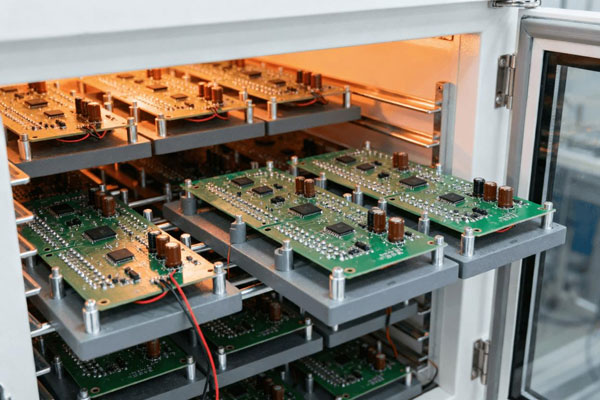
Forced hot air convection has been the backbone of reflow since the mid-1980s. A hot air reflow oven contains a series of heated zones above and below the conveyor, and blowers circulate heated air through nozzles so that the board is heated from both sides at once. Because moving air transfers heat quickly and evenly, the temperature difference across the board stays small, which is exactly what lead-free soldering requires. Continuous development of airflow design, zone control, and software has made hot air the preferred SMT reflow oven type for nearly all production lines.
Modern hot air ovens offer fine control over each zone. The machine can be configured with more zones in the preheat area for gentle ramp rates, a shorter soak section to activate the flux, and a precisely set peak zone so that the solder reaches the correct liquidus temperature. Nitrogen capability is an option in many designs: replacing air with nitrogen reduces oxidation during soldering and improves wetting for fine-pitch and high-reliability assemblies, at the cost of higher operating expense.
Conveyor speed and temperature settings are validated with a thermal profiler that travels through the oven with thermocouples attached to the board. The profile data confirms that every critical solder joint stays inside the required window, which is why factories treat profiling as a routine step whenever a new product is introduced to the line.
Infrared Hot Air Combinations for Lead-Free Work
Some furnaces combine hot air with infrared heaters. Because lead-free soldering needs higher peak temperatures and faster heating in the reflow zone, manufacturers add infrared emitters at the entrance and beneath the reflow section of a convection oven. The infrared energy supplements the hot air, raising the heating speed and improving thermal efficiency while the convection continues to equalize the temperature across the board.
This hybrid approach has a practical place in lead-free production. Pure hot air ovens must often run hotter or slower to push thick assemblies to peak temperature, while an infrared-assisted zone can deliver the additional energy exactly where it is needed. The result is a wider effective process window and better energy use, which is why infrared hot air ovens still appear in modern factories alongside full convection systems.
Selection between a pure convection oven and an infrared-assisted model depends on the product mix. Boards with heavy copper planes, large thermal masses, or components that absorb radiation differently benefit from the combination, while standard consumer assemblies are usually fine with convection alone. A reliable supplier validates the choice by profiling actual boards rather than relying on marketing specifications.
Vapor Phase Reflow for Difficult Assemblies
Vapor phase reflow soldering takes a completely different approach. The board is lowered into the saturated vapor of a specialty fluid with a precisely defined boiling point, and the vapor condenses on the assembly, releasing its latent heat to the board. Because the vapor temperature cannot exceed the boiling point of the fluid, the peak temperature is naturally limited and extremely uniform across the whole board, including shadowed areas that convection and radiation struggle to reach.
Vapor phase systems were first used in the early 1970s but were set aside because the equipment and the heat transfer fluid were expensive. The revival of interest came with lead-free soldering and high-reliability electronics. Different fluids with different boiling points can be matched to different solder alloys, the oxygen-free vapor environment reduces oxidation, and the heating speed is high with excellent heat conversion efficiency. For boards with large thermal mass, complex shapes, or components that cannot tolerate a large temperature gradient, vapor phase often produces the best soldering result.
The main trade-off is cost and throughput. Vapor phase ovens consume specialty fluid and are generally slower than convection tunnels, so they are typically reserved for demanding products such as aerospace modules, automotive electronics with heavy copper, and sensitive RF assemblies rather than for high-volume consumer boards.
Local Heating Reflow Systems
Not every soldering task needs a full oven. Laser reflow systems focus a high-power laser beam onto a small area through an optical system, creating a concentrated local heating zone in a fraction of a second. The rest of the board and the surrounding components stay cool, which keeps soldering stress low and protects heat-sensitive parts. Laser systems are expensive, so they are used where their precision is essential: fine-pitch joints, valuable substrates, and boards that cannot withstand whole-board heating.
Focused infrared heating serves similar local roles. A focused infrared reflow station is commonly found at the repair bench, where operators rework a single component or a small area without heating the entire assembly. The energy is directed through a lens or reflector, and the operator controls the power and duration to match the size and thermal mass of the joint.
Hot air rework tools complete the picture. A hot air reflow pencil or nozzle directs heated air or nitrogen onto one component, using interchangeable nozzles sized for different solder joints. These tools are slower than full ovens and demand steady operator technique, but they are indispensable for rework, engineering samples, and prototype development, where replacing a single part saves the whole board.
Choosing the Right SMT Reflow Oven Type
The correct SMT reflow oven type depends on the products a factory builds. High-volume consumer electronics are best served by multi-zone hot air convection ovens with nitrogen options and strong profiling support. Mixed assemblies with heavy copper or large thermal mass may justify infrared-assisted zones. High-reliability, hard-to-heat boards are candidates for vapor phase. Prototype and rework operations need local heating tools even when the main line uses a full oven.
Whichever technology is used, process control decides the outcome. Furnace maintenance, airflow balance, zone calibration, and profile verification are part of normal operation in a disciplined SMT line, and defects such as cold joints, head-in-pillow, and component cracking are usually traced back to a furnace condition that drifted outside the window.
How gopcb Controls the Reflow Process
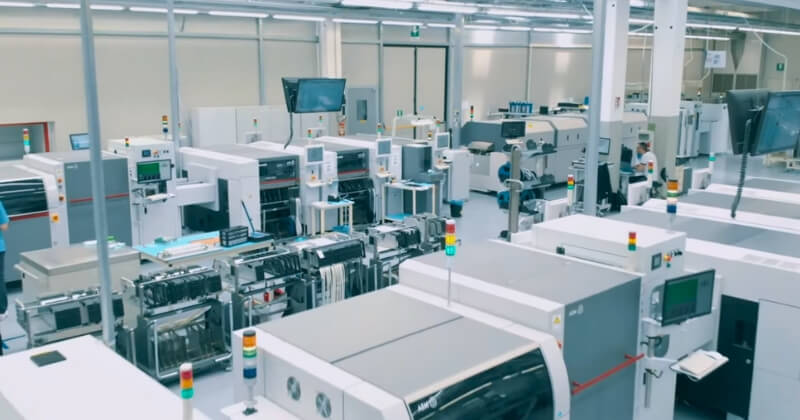
gopcb operates modern hot air reflow lines with full profiling, nitrogen capability, and routine calibration as part of its SMT PCB assembly service. Each new product is profiled before production, and the profile data is kept with the batch records so that soldering conditions can be traced later. The engineering team selects the furnace configuration and any special technology based on the board design and the solder alloy.
For demanding boards, gopcb applies the same discipline across PCB manufacturing, assembly, and PCBA testing, and the process results are documented under the quality management system so customers receive consistent, inspectable quality. Send gopcb your design files to discuss the right soldering approach for your product through turnkey PCB assembly services.