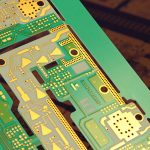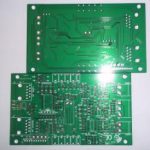
Whether a PCB uses a gold, silver, or other surface finish, the primary purpose is to protect exposed copper surfaces from oxidation and maintain reliable solderability.
During PCB Manufacturing, copper features that need to be soldered cannot simply remain exposed to the atmosphere for extended periods. Oxidation and surface contamination can negatively affect solder wetting, electrical contact, and assembly yield.
For this reason, PCB manufacturers use different PCB Surface Finish technologies to protect exposed copper pads and maintain their performance during storage, transportation, and assembly.
Depending on the selected finish, the required storage conditions and shelf life may vary. Proper packaging, including moisture- and oxygen-resistant packaging where appropriate, is also important for protecting finished PCBs before they reach the customer.
1. Why Does PCB Copper Need Protection?
Copper is widely used as the conductive material in printed circuit boards because of its excellent electrical conductivity, processability, and relatively good cost-performance ratio.
However, exposed copper can gradually react with oxygen, moisture, and contaminants in the environment.
This can result in surface oxidation.
The problem becomes particularly important for exposed solder pads.
If the copper surface of a pad becomes heavily oxidized or contaminated, solder may not wet the surface properly during assembly. This can increase the risk of:
- Poor solder wetting
- Insufficient solder joints
- Voids or defects
- Higher contact resistance
- Reduced assembly yield
- Long-term reliability problems
Therefore, exposed copper areas generally require an appropriate protective treatment.
2. What Is Solder Mask?
A PCB normally contains large areas of copper that are not intended to be soldered.
These areas are generally covered by solder mask, a protective coating applied over the PCB surface.
The solder mask serves several important functions:
- Protects copper from environmental exposure
- Reduces the risk of accidental solder bridging
- Provides electrical insulation between conductive features
- Improves PCB durability
- Defines areas where solder should and should not be applied
The solder mask is different from a PCB surface finish.
The two technologies have different purposes.
Solder mask primarily protects the PCB surface and defines solderable areas, while PCB Surface Finish protects the exposed copper pads and other conductive areas that require soldering or electrical contact.
This distinction is important when discussing PCB manufacturing processes.
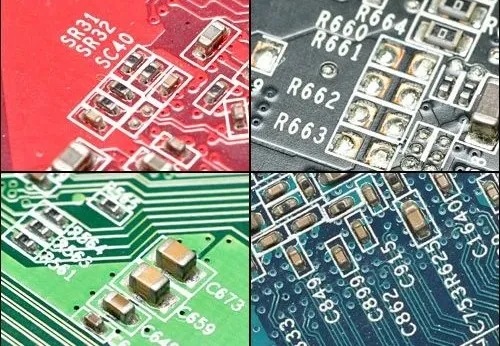
3. Why Do PCBs Have Different Solder Mask Colors?
Solder mask can be produced in different colors, including green, blue, red, black, yellow, and other colors.
Green has traditionally been one of the most common choices because it provides good visual contrast between the PCB surface, copper features, markings, and component locations.
The color itself does not determine PCB electrical performance.
For PCBs with otherwise identical materials, structures, and manufacturing processes, changing the solder mask color generally does not make one board electrically superior to another.
Solder mask color is primarily related to manufacturing visibility, inspection, product identification, and aesthetic requirements.
Why Can Black PCBs Be More Difficult to Inspect?
Black solder mask can provide less visual contrast between certain PCB features and the board surface.
This may make some details more difficult to inspect manually, particularly during repair or troubleshooting.
However, this does not mean that black PCBs are inherently lower quality or that green PCBs are inherently better.
The quality of a PCB depends much more on:
- Material selection
- Circuit design
- Manufacturing precision
- Plating quality
- Surface finish
- Electrical testing
- Process control
- Reliability requirements
Therefore, PCB color should not be used as an indicator of PCB quality.
4. Why Are Gold and Silver Used on PCBs?
Gold and silver are sometimes used as PCB Surface Finish materials because they provide specific electrical, chemical, and mechanical advantages.
When a PCB is manufactured, the copper areas that need to be soldered or used as electrical contacts are exposed through the solder mask.
These exposed areas are commonly called pads.
Pads may be round, rectangular, square, or another shape depending on the component and PCB design.
Because exposed copper can oxidize, an appropriate surface finish is applied to protect the pad.
Common PCB surface finishes include:
- ENIG (Electroless Nickel Immersion Gold)
- Immersion silver
- HASL
- OSP
- ENEPIG
- Hard gold plating for specific contact applications
Each finish has different characteristics and should be selected according to the PCB application.
5. Gold PCB Surface Finish
A Gold PCB generally refers to a PCB using a gold-containing surface finish.
One commonly used technology is ENIG, or Electroless Nickel Immersion Gold.
In an ENIG finish, a nickel layer is deposited over the copper surface, followed by a thin immersion-gold layer.
The gold layer provides an oxidation-resistant surface and helps protect the underlying nickel and copper.
Key advantages of ENIG include:
- Good surface flatness
- Good solderability
- Good oxidation resistance
- Compatibility with fine-pitch components
- Suitable for SMT assembly
- Suitable for applications requiring a relatively flat pad surface
Because of these characteristics, ENIG is widely used in electronics requiring reliable assembly and good surface quality.
However, ENIG is not automatically the best finish for every application.
The appropriate finish depends on component requirements, assembly technology, reliability targets, storage conditions, and cost.
6. Silver PCB Surface Finish
Silver PCB surface finishes typically use immersion silver to protect exposed copper.
Immersion silver forms a thin silver layer on the copper surface through a chemical displacement process.
Its advantages may include:
- Good solderability
- Relatively flat surface
- Suitable for fine-pitch components
- Good electrical contact characteristics
- Compatibility with lead-free assembly processes
Immersion silver can be useful for applications where a flat and solderable surface is required.
However, silver surfaces can be sensitive to storage conditions and environmental contamination. Proper packaging and handling are therefore important to maintain surface quality before assembly.
7. Gold PCB vs. Silver PCB
Gold and silver surface finishes should not be considered simply as “better” or “worse.”
Their suitability depends on the application.
| Characteristic | Gold-Based Finish | Immersion Silver |
|---|---|---|
| Oxidation protection | Excellent | Good |
| Surface flatness | Excellent | Excellent |
| Fine-pitch SMT | Suitable | Suitable |
| Solderability | Excellent when properly processed | Excellent when properly processed |
| Storage sensitivity | Generally stable | Requires appropriate storage |
| Typical applications | High-reliability, fine-pitch, demanding assemblies | SMT, fine-pitch, cost-sensitive applications |
| Cost | Generally higher | Generally lower |
The actual performance also depends on the specific process and manufacturing quality.
A high-quality surface finish produced under controlled manufacturing conditions is more important than simply choosing a particular metal.
8. Does Gold or Silver Prevent PCB Oxidation?
One of the primary reasons for applying a surface finish is to protect exposed copper.
The surface finish acts as a protective interface between the copper and the surrounding environment.
Without appropriate protection, exposed copper can gradually develop an oxide layer.
This can make soldering more difficult and may affect electrical contacts.
Gold is particularly resistant to oxidation and corrosion, which is one reason gold-based finishes are widely used in applications requiring stable contact surfaces.
Silver also provides a protective surface for copper and offers good solderability, although its storage and handling requirements should be carefully controlled.
For either finish, the goal is to preserve the condition of the exposed pad until the PCB reaches the assembly process.
9. Why PCB Packaging Is Important
Surface finish alone does not eliminate all environmental risks.
After PCB Manufacturing, finished boards may be exposed to:
- Oxygen
- Moisture
- Dust
- Chemical contaminants
- Temperature fluctuations
- Improper handling
Therefore, packaging and storage are important parts of maintaining PCB quality.
Depending on the surface finish and customer requirements, manufacturers may use moisture-resistant packaging or vacuum packaging to reduce exposure to environmental conditions.
Customers should also follow the manufacturer’s recommended storage conditions and shelf-life requirements.
If a PCB has been stored for an extended period, its surface condition should be evaluated before assembly.
Where necessary, additional procedures such as baking or surface inspection may be considered according to the applicable material and manufacturing specifications.
10. Does Gold or Silver Reduce PCB Heat Generation?
A common misunderstanding is that using gold or silver on PCB pads will significantly reduce heat generation because both metals have relatively low electrical resistance.
In practice, this effect is generally negligible for conventional PCB surface finishes.
The heat generated by a conductor is related to electrical resistance and current, commonly expressed as:
P = I²R
However, the metal layer used for a PCB surface finish is extremely thin compared with the main copper conductor.
For example, the thickness of a surface-finish layer is generally much smaller than the thickness of the copper circuitry underneath it.
As a result, the contribution of the gold or silver surface finish to the total resistance of a typical PCB current path is usually very small.
Therefore, it would be inaccurate to claim that choosing gold or silver surface finishing will significantly reduce the operating temperature of a PCB.
11. What Really Determines PCB Thermal Performance?
If thermal performance is the objective, designers should focus on the factors that have a much greater influence on heat generation and heat dissipation.
These include:
- Copper thickness
- Copper area
- Current density
- Trace width
- Thermal vias
- PCB material
- Thermal conductivity
- Component power dissipation
- Component placement
- Heat spreaders
- Heat sinks
- Airflow
- Enclosure design
For high-power applications, the complete thermal path should be considered.
A typical thermal path is:
Component → Package → PCB Copper → Thermal Structure → Heat Sink or Chassis → Ambient Environment
Therefore, selecting an appropriate PCB material and designing an effective thermal structure are generally much more important for thermal management than choosing between gold and silver surface finishes.
12. Surface Finish and Solderability
One of the most important purposes of a PCB surface finish is maintaining reliable Solderability.
During SMT or through-hole assembly, molten solder must properly wet the exposed pad surface.
A contaminated or oxidized pad may result in:
- Poor wetting
- Non-wetting
- Solder bridging
- Insufficient solder joints
- Open connections
- Assembly defects
A properly selected and manufactured surface finish helps provide a clean, stable surface for soldering.
However, surface finish quality also depends on manufacturing process control.
Important parameters include:
- Surface cleanliness
- Coating thickness
- Uniformity
- Chemical process control
- Storage conditions
- Packaging
- Handling procedures
This is why PCB Manufacturing quality plays an important role in final soldering performance.
13. Choosing the Right PCB Surface Finish
There is no universal surface finish that is suitable for every PCB.
The selection should be based on the actual product requirements.
Engineers may consider:
Component Pitch
Fine-pitch components often benefit from flat surface finishes that provide consistent pad geometry.
Assembly Process
SMT, through-hole assembly, wire bonding, and other assembly technologies may have different surface-finish requirements.
Storage Time
Some surface finishes are more sensitive to environmental exposure and therefore require stricter storage conditions.
Electrical Contact
Applications involving repeated electrical contact may require a different finish from conventional solder pads.
Reliability Requirements
High-reliability applications may require a surface finish with specific corrosion resistance, solderability, and long-term stability.
Cost
Surface finish selection should also consider the total manufacturing cost rather than the price of the finish alone.
14. Kingda’s PCB Surface Finish Capabilities
At Kingda, surface finish selection can be evaluated as part of the overall PCB Manufacturing process.
For each project, the appropriate finish should be matched to the PCB’s electrical, mechanical, assembly, storage, and reliability requirements.
Engineering evaluation may consider:
- PCB material
- Copper thickness
- Pad structure
- Component pitch
- Surface finish
- Finish thickness
- Solderability
- Storage requirements
- Assembly process
- Electrical testing
- Reliability requirements
Kingda can support customers with PCB manufacturing solutions for applications requiring different board structures and surface-finish technologies.
Early communication between the PCB designer, manufacturer, and assembly team can help ensure that the selected finish is compatible with the complete product-development process.
15. Key Takeaways
The color of a PCB should not be confused with its technical quality.
Green, blue, red, black, and other solder mask colors primarily represent different coating-color choices and do not inherently determine PCB performance.
Gold and silver, on the other hand, are used for specific PCB Surface Finish applications because they provide useful characteristics for protecting exposed copper and maintaining reliable solderability.
The most important points are:
- Exposed copper can oxidize when exposed to the environment.
- Solder mask protects areas that do not need to be soldered.
- Surface finishes protect exposed copper pads.
- Gold-based finishes offer excellent oxidation resistance and surface stability.
- Immersion silver provides a flat and solderable surface.
- Proper packaging and storage are important for maintaining surface quality.
- Gold and silver surface finishes do not significantly reduce overall PCB heat generation.
- PCB thermal performance depends much more on copper design, materials, component power, thermal vias, heat dissipation structures, and airflow.
- Surface finish should be selected according to the specific application rather than simply according to appearance or perceived quality.
Conclusion
The purpose of gold and silver finishes on a PCB is not primarily to make the board look more premium or to reduce its operating temperature.
Their main role is to provide a reliable protective surface for exposed copper pads and support stable Solderability, electrical contact, and long-term PCB performance.
Different PCB Surface Finish technologies have different advantages and limitations. ENIG, immersion silver, OSP, HASL, ENEPIG, and other finishes should be evaluated according to component requirements, assembly processes, storage conditions, reliability targets, and cost.
For demanding electronic products, selecting the right surface finish is only one part of the overall solution. Material selection, circuit design, thermal management, manufacturing precision, inspection, packaging, and storage must all work together.
With appropriate process control and engineering support, Kingda can help customers select and manufacture PCB solutions that meet their specific performance, assembly, and reliability requirements.