PCB Lamination Process: Materials, Temperature and Pressure
What Lamination Does
Lamination is the step that turns separate inner layers into one solid multilayer board. The inner layers are stacked with sheets of partially cured resin between them, and the whole stack is pressed under heat and pressure until the resin flows, fills the spaces around the copper features and cures into a single rigid structure. Everything the multilayer board will be depends on this step: layer registration, final thickness, dielectric spacing, impedance, and whether the board comes out flat or warped. It is the least visible process in PCB manufacturing and one of the most influential.
The Materials
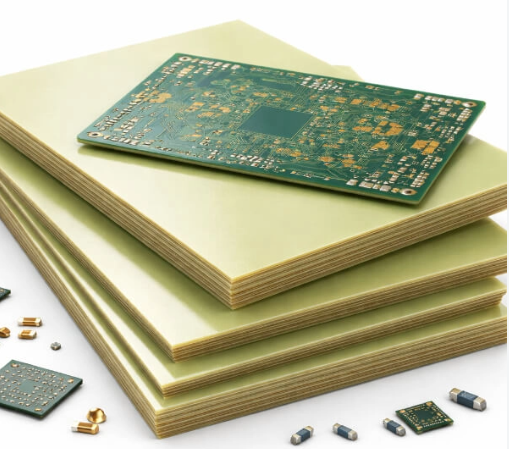
Prepreg. Woven glass fabric impregnated with resin in a partially cured, B-stage state. It flows under heat and pressure and then cures, bonding the layers. Prepreg thickness and resin content control the dielectric spacing, which sets impedance. Core. A fully cured, C-stage laminate with copper foil on both faces, carrying the inner layer circuitry. Copper foil. The conductor itself, from standard one ounce up to heavy copper for power layers. Resin systems. Standard FR4 epoxy, high-Tg epoxy, polyimide, BT and specialist high frequency materials, each with its own flow and cure behaviour, which is why a lamination recipe is material specific.
The Lamination Cycle
Lay-up. Inner layers, prepreg sheets, copper foil and release films are stacked in the correct sequence and aligned with tooling pins or optical targets. Cleanliness matters here, because a single particle becomes a void or a dent. Preheat and vacuum. The stack is heated and the press is evacuated, which pulls air and volatiles out of the prepreg so the resin can fill without trapping bubbles. Pressure ramp. Pressure is applied gradually, allowing the resin to flow and fill the copper features rather than being squeezed out unevenly. Cure. Temperature is held at the cure point long enough for the resin to cross-link fully. Controlled cool-down. The stack is cooled under pressure to below the glass transition temperature before unloading, which is what keeps the board flat. Cold press. Some processes add a separate cold press step to relieve stress.
Temperature, Pressure and Time
For standard FR4, the cure stage typically sits around 180 to 200 degrees Celsius, with pressure in the range of roughly 200 to 400 psi, held for about 60 to 120 minutes depending on the stack and the material. High-Tg and polyimide systems run hotter and often longer. Temperature must be uniform across the panel, because a cold spot cures incompletely and shows up later as delamination. Pressure must be high enough to close the stack but not so high that resin is starved from the edges. Time is set by the resin system, not by convenience: shortening the cure to gain throughput produces boards that pass electrical test and fail in reflow.
Registration and Dimensional Stability
Resin and glass move as they heat, so the layers shift during the press. Fabricators compensate with scaling factors applied to the artwork, based on the measured behaviour of each material. Typical layer to layer registration for standard multilayer boards is within about 75 to 100 microns, and tighter targets need better scaling, more tooling pins and often a slower press cycle. Dimensional stability also determines whether blind and buried vias line up in a sequential lamination build, where the board is pressed more than once.
Defects and Their Causes
Voids and bubbles. Insufficient vacuum, trapped volatiles or a pressure ramp that is too fast. Resin starvation. Too little prepreg, or pressure applied before the resin can flow. Delamination. Incomplete cure, contaminated copper surfaces or absorbed moisture. Thickness variation. Uneven stack, poor press platens or inconsistent prepreg. Warp and twist. Asymmetric stack-up, or unloading before the board has cooled below its glass transition temperature. Registration shift. Incorrect scaling factor for the material.
Quality Control
Lamination quality is verified by measuring final thickness across the panel, checking layer registration with a coupon, and cutting a micro-section to inspect the dielectric, the bond line and the copper to resin interface. Where the board is used for controlled impedance, the dielectric thickness measured in the cross-section is what confirms the impedance calculation. Thermal stress testing on a coupon exposes poor cure and weak bond lines before the boards reach assembly.
Lamination is where the stack-up you specified becomes physical, so it has to be planned with the fabricator rather than assumed. Review how PCB manufacturing builds multilayer stacks for your material, confirm that your PCB design and layout keeps the stack symmetric, and check the design and manufacturing considerations before release. A prototype PCB assembly run then proves that the laminated board survives reflow and the real thermal profile.
FAQ
What is the difference between prepreg and core? Prepreg is partially cured resin that bonds the layers; core is fully cured laminate that carries the inner layer circuitry.
Why is vacuum used in lamination? To remove air and volatiles so the resin fills completely instead of leaving voids.
What causes a warped multilayer board? An asymmetric stack-up or unloading the press before the board has cooled below its glass transition temperature.
How is lamination quality checked? By measuring thickness, checking registration on a coupon and inspecting a micro-section of the bond line and dielectric.
Conclusion
Lamination is a controlled combination of material, temperature, pressure and time, and errors in any one of them show up later as voids, delamination, warpage or wrong impedance. Use a symmetric stack, match the prepreg to the dielectric thickness you need, cure fully and cool under pressure, and check the result with a cross-section. Handled that way in 2026, the press cycle gives a flat, well-registered board that behaves exactly as the stack-up promised.