High-Density Placement: Matching the Line to the Work
Demand for dense electronic assemblies has grown faster than the capacity to build them, and the effect is felt in the ordinary parts of a project rather than in the exotic ones. Boards that carry area-array packages, fine-pitch devices and large numbers of small passives are being ordered in greater quantities, and the lines that can place them reliably are the same lines everyone else is trying to book.
For a customer, the useful consequence is that high-density placement is now a scheduling question as well as a technical one. Understanding what makes a line suitable for this work — and what limits it — makes it possible to judge whether a promised date is realistic and which of two apparently similar services is the right one.
What Makes a Board Dense
Density is not simply the count of components. It is the combination of the smallest device on the board, the pitch of the finest package, the number of placements per unit area and the quantity of different parts that have to be loaded at once.
A board with two thousand passives is dense in a different way from a board with a hundred components that includes a fine-pitch processor and two area-array devices. The first stresses the machine’s throughput and its feeder capacity; the second stresses accuracy, paste volume and the thermal profile.
Both are demanding, and a line that handles one well does not automatically handle the other. That is why the question to ask is not whether a supplier can build dense boards, but which kind of density is routine for them.
Equipment Accuracy and the Smallest Device
Placement accuracy is quoted as a tolerance, and it determines the smallest device that can be placed reliably rather than the smallest that can be placed at all. At the limit, a machine can place a component and still produce a joint that is marginal, because the deposit and the termination do not overlap sufficiently.
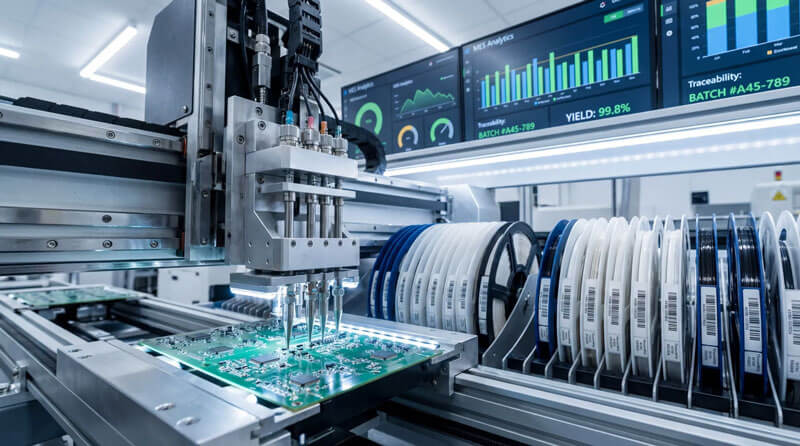
Vision systems matter as much as the mechanics. A machine that recognises a package accurately will place a fine-pitch device consistently, while one that struggles with the marking will hesitate and misplace it occasionally. Where the board carries devices with unusual shapes or a low-contrast body, that difference is visible in the reject rate.
Feeder capacity and setup flexibility belong in the same assessment. A board with a large number of different parts requires many feeder positions, and a line that has to change feeders during the run to fit them all is a line that will struggle with the schedule as well as the quality.
Inspection Coverage and the Choice It Imposes
As density rises, the proportion of joints that can be seen falls. Optical inspection remains effective for the visible periphery, the small passives and the general assembly condition, but it cannot report on joints beneath a package.
That produces a choice which is worth stating explicitly in the order: whether the hidden joints are inspected at all, on which units, and by what method. Running an X-ray check on the first article and on a defined sample is a reasonable arrangement for a product whose process is stable, and it produces a record of the process rather than a claim about it.
Automatic paste inspection belongs in the same discussion, because on a dense board the deposit is where many of the eventual defects are decided. A line that measures the print before placement has information that a line which does not cannot have.

Where the Capacity Pressure Appears
A capacity constraint does not announce itself as a refusal. It appears as a longer quotation time, a date that moves after the order is placed, or an enquiry that is answered with a price but no schedule.
The pressure is uneven. Lines are committed to large orders which are themselves scheduled far ahead, and a small order must be fitted into the intervals. When demand is high, the intervals narrow, and the customers affected first are those whose orders are least prepared: unclear data, undecided material, an exploratory enquiry rather than a requirement.
That is also the practical lever available to a customer. An order with settled data, a decided material list and a defined test requirement is easier to schedule than one which is still being defined, because it can be planned rather than held open. Where the product has been built before, with the stencil and the programme retained, the order is easier still.
Matching the Service to the Work
Two suppliers may both be credible and still not be interchangeable. One may be organised around a small number of large, stable products, where the process is tuned once and left alone. Another may be organised around many small orders, where changeover speed and data handling are the competencies that matter.
A dense board with a short deadline usually belongs with the second kind, unless the quantity is large enough to justify the first. What matters is that the customer knows which situation they are in, and that the supplier’s description of the work matches the way the order will actually be handled.
The technical questions follow the same logic. Which of these packages have you placed recently? What is the smallest device you place routinely? How is the profile established for a board with a heavy plane? Who reviews the data before the stencil is ordered?
Data That Makes a Dense Order Predictable
The information that reduces risk on this kind of work is specific. An accurate statement of the package for every device, particularly where two variants of one part number exist. The pad geometry as designed, since the stencil will be derived from it. The identification of the positions that should be treated as difficult, and the function of the product, which explains why they are difficult.
Where the board carries inserted components as well, that requirement belongs in the same package, because it changes the sequence and the handling. The relevant operations are SMT assembly for the placed devices, mixed technology assembly where inserted parts are present, PCBA testing for verification and the controls under quality management that keep a batch repeatable.
One further item is worth stating because it is often left implicit: the number of reflow cycles the assemblies may tolerate. Where a board carries devices with a maximum exposure, or where a rework is likely, that constraint belongs in the order along with the profile. It is also the reason a dense board benefits from getting the process right on the first pass rather than correcting it afterwards, since every additional cycle consumes part of the margin the components were specified with.
FAQ
Does density mean a higher price per placement? Usually, because the process window is narrower and the inspection is more demanding, and because the preparation for a new board is greater.
What is the first limit to check? The smallest device and the finest pitch that the line places routinely, rather than the smallest it has ever placed.
How should hidden joints be handled? By defining in the order which units are to be checked by X-ray and what the check is for, so that the result is a record rather than an assurance.