Potting Compounds and Dispensing Adhesives on PCBs
Not every board lives in a dry, temperature-controlled cabinet. Products used outdoors, in vehicles, in kitchens or on factory floors are exposed to moisture, dust, salt and vibration, and the electronics inside them have to keep working for years. Potting and dispensing are the processes that provide that protection, and because they affect both the electrical behaviour and the mechanical reliability of the assembly, they belong in the design discussion rather than only in the production plan.
What Dispensing Adds to a Board
A dispensing compound is applied as a liquid or gel to a defined area of the board, where it cures into a flexible elastomer. The cured material provides moisture protection, forming a barrier against vapour, dust and corrosive contaminants, and it also gives mechanical support that damps vibration and absorbs the stress of thermal expansion. For products that operate outdoors or in humid environments, that moisture protection is the primary reason the process exists. The goal is not to seal the product against the world and hold that seal forever; it is to keep the assembly inside its operating envelope for the life of the product.
The materials used for this purpose have stable dielectric insulation properties, and that matters because the coating sits directly over conductors and between pads. A compound with poor insulating resistance or with ionic contamination could create leakage paths that did not exist before it was applied, turning a protective step into a failure mode.
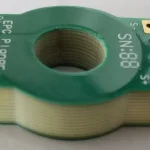
<img src="https://www.gopcba.com/wp-content/uploads/2026/08/image_1-e1723035717714-1200×671-1.jpg" alt="potting compound dispensed onto a protected circuit board” />
Material Families and Cure Behaviour
Two chemistries dominate: condensation cure systems and addition cure systems. Condensation systems release a by-product as they cure, which limits the thickness that can be applied reliably because the by-product must escape. Addition systems cure without a by-product, which allows thicker sections and faster, more uniform curing.
Both families cure in place without a second heat cycle in the cases most relevant to board protection, and the cured result is a flexible elastomer rather than a rigid shell. That flexibility is deliberate. A rigid encapsulant transfers the full thermal expansion mismatch between the board, the solder joints and the component bodies; a flexible one absorbs part of it.
Cure speed in addition systems is largely independent of the thickness of the applied layer and of how enclosed the assembly is, which is a significant practical advantage. It means the process window is wide and that the properties at the surface are the same as those deeper in the compound. Moisture-cure systems behave differently, since the cure rate depends on how quickly moisture diffuses into the material, and the surface can skin over while the interior remains uncured.
Where to Apply and Where to Avoid
Dispensing coverage is a design decision made jointly with the process engineer. The usual targets are the areas most exposed to the environment: connectors and their solder joints, the board edges, large components whose joints carry thermal stress, and any region where condensation is expected to collect.
Certain areas must be excluded. Connector mating surfaces cannot be coated, nor can test points, nor the contacts of a switch or an adjustable component. Optical devices need a clear window, and some sensors must be exposed to the air to function. Where a coating must stop, the layout can help by providing a defined boundary, such as a solder mask dam or a dedicated keepout area, so the operator or the dispenser has an unambiguous edge.
The material also has to be compatible with everything it touches. Adhesion to solder mask, bare laminate and metal is different, and a coating that does not adhere will lift at the edges and trap moisture underneath, which is worse than leaving the area uncoated. Surface cleanliness before dispensing is as important as the choice of compound.
Thermal Cycling, Vibration and Stress
The mechanical benefit of a flexible compound is easiest to see in thermal cycling. When the assembly is heated and cooled, the laminate, the copper, the solder and the component body expand by different amounts. With no coating, the solder joint absorbs the entire mismatch, and a joint that is already marginal will eventually crack. With a compliant coating, some of that displacement is shared with the compound, and the strain on the joint falls.
The same compliance cushions vibration. A heavy component on a thin board can oscillate under a sustained vibration input, and the oscillation concentrates stress at the solder joints at the ends of the part. A compound that surrounds the component and connects it to the board surface changes the resonant behaviour and reduces the amplitude of the movement.
The choice between a compliant and a rigid material is therefore a trade-off. A rigid encapsulant gives better protection against direct impact and better dimensional stability, at the cost of transferring more stress into joints. A soft compound gives better fatigue performance under thermal and vibration loading, at the cost of less resistance to abrasion.
Design Consequences and the Interface With Fabrication
The presence of a coating changes several layout considerations. Components cannot be reworked after potting, so test coverage must be complete before the coating is applied, and the design should not rely on any post-assembly adjustment. Thermal paths change as well: a compound that insulates thermally will raise the operating temperature of a hot component, which matters for parts that rely on convection to a heatsink.
The compound also interacts with the board surface and with the vias. Coating that flows into an unplated hole can wick through to the other side, and coating over a via that must remain open for test or venting needs to be controlled. These geometric constraints sit alongside the other manufacturing rules described in this article on copper plating defects and their prevention, and the surface finish and mask formulation affect adhesion, which the discussion of solder mask ink thixotropy covers for the mask and the article on conformal coating and board protection covers for thin coatings.
Process Control
The reliability of a coated board depends on process control as much as on material selection. Mixing ratio for two-part systems must be accurate, because an off-ratio mix cures incompletely and leaves a tacky surface that absorbs contaminants. Pot life limits how long a batch can be used, and dispensing equipment must be calibrated so that the applied volume is consistent from board to board. Inspection is usually visual, with the coverage boundary and the absence of voids or bubbles as the acceptance criteria.
FAQ
What is the difference between condensation cure and addition cure compounds? Condensation systems release a by-product during curing, which limits the thickness that can be applied because the by-product must escape. Addition systems cure without by-products, allowing thicker sections, faster cure and more uniform properties regardless of layer thickness.
Can a potted board be reworked? Generally not. Once the compound has cured, the components underneath it cannot be removed without damaging the assembly. Test coverage must therefore be complete and the design should contain no features that require adjustment after potting.
Does potting help with thermal management? It depends on the material. A thermally conductive compound can improve heat spreading away from a hot component, while an insulating one will raise its temperature by suppressing convection. The thermal behaviour should be checked with the coating in place rather than assumed.