Tapping Test and Drop Test in Electronics Production
Between final assembly and electrical test, a manufacturing line usually has one or two mechanical screening stations that look crude compared with the rest of the process. A product is tapped with a rubber ball on a stick, or dropped onto a wooden table, and then tested electrically. The stations exist because a joint that is only marginally attached will pass a static measurement and fail in the customer’s hands, and no amount of visual inspection catches every one of them. Tapping and dropping introduce the mechanical stimulus that makes those joints reveal themselves while the product is still on the line.
What the Tapping Test Finds
The tapping test is aimed at assembly defects rather than at design faults. Its targets are cold or partial joints, the classic solder joint defect that is touching but not bonded, solder balls and splashes that may bridge a joint when the board flexes, and mechanical hardware that has not been seated or tightened. In each case the defect is invisible under normal test conditions and only appears when the assembly is excited mechanically. A screw that is one turn loose, or a connector that is not fully latched, will also show up under tapping, which is why the station is often placed immediately after assembly rather than after electrical test.
How the Test Is Performed
The tool is a rubber ball mounted on a wooden handle, and the test consists of striking the product with the ball while the product is powered and running. The ball should be chosen for size and weight, because both change the energy delivered and therefore the sensitivity of the test; the wrong ball makes the test either ineffective or destructive. Tapping is normally done three times at each location rather than once, so that an intermittent fault that does not appear on the first strike has a second and third chance. For products with a display, the operator watches for any glitch in the image while tapping, because a marginal joint often shows up as a momentary artefact rather than as a hard failure. The general defect mechanisms that this stimulus exposes are the same ones described in this article on SMT component shift causes.
Where to Tap
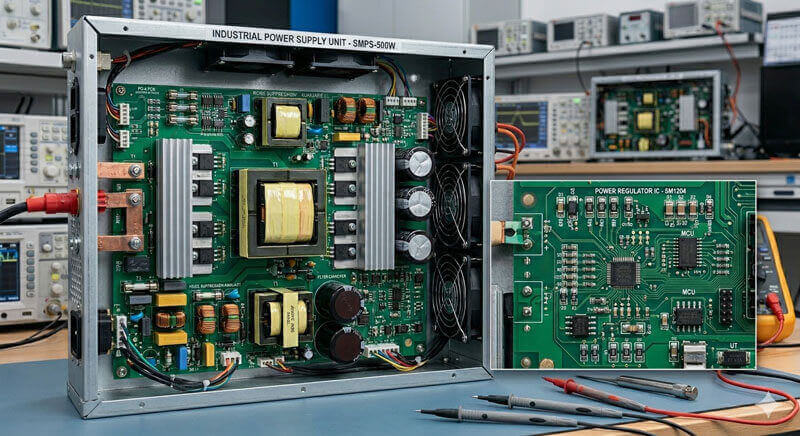
Location matters more than force. The useful places to strike are the solid areas that can resonate, particularly the mounting points and the areas where the board is supported, because resonance is what flexes a joint enough to open it. Striking a hollow region produces almost no effect, since the energy is absorbed by the enclosure rather than transferred to the assembly. The most productive approach is to identify the weakest mechanical point of the design and tap there, and to include the board edges, the connector areas and any heavy component that is supported only by its leads. A test that only ever strikes the centre of a rigid enclosure is not testing much.
The Drop Test and How It Differs
The drop test performed on a production line is a quality screen for finished goods, not a design qualification test. Its purpose is the same as the tapping test, but the stimulus is different: a single free fall onto a solid wooden table covered with an antistatic mat a few millimetres thick. The product is dropped without power applied and without any cable connected, and the drop is performed once rather than repeatedly. Drop height is normally chosen according to the product’s mass, with heavier products dropped from a lower height; the range that covers most consumer products is roughly 76 mm to 300 mm. The exact figure should be taken from the company’s own procedure, because a height that is too high will damage good product and a height that is too low will pass bad product.
Why Both Tests Are Followed by Electrical Test
Neither test produces a conclusion on its own. Tapping or dropping a product can open a marginal joint without making the failure permanent, and can also create a new intermittent fault that the next station must catch. For that reason the electrical test or functional test always follows, and the acceptance criterion includes both function and appearance. A product that fails electrically after tapping is not necessarily bad, but it must be investigated rather than reworked blindly, because the failure may point at a design weakness rather than at a single bad joint. Placing a screen after the test rather than before it is what prevents a defective unit from reaching a customer. The cost of missing that screen is set by the process choices made during layout, which are described in this article on how PCB layout decisions affect production.
Operator Attitude and Test Discipline
The effectiveness of these stations depends on the operator, and this is their practical weakness. A tester who is reluctant to damage good product will gradually reduce the drop height or tap more gently until the screen no longer does anything. The purpose of the station should therefore be explained: it exists to remove defective units from the line before they are shipped, and a unit that fails here has been caught at the cheapest possible point. A product that survives a properly specified drop is not at risk from an accidental fall during normal handling; the concern on the line should be about superficial damage, not about function.
What the Design Can Do to Help
Design choices determine how well these screens work and how often they are needed. Connectors that latch positively, heavy components that are mechanically supported rather than held only by solder, and hardware that is retained with thread-locking or positive stops all reduce the number of defects the station has to find. Mass distribution matters as well, because a heavy part mounted far from a support will flex the board more under the same stimulus. Product designs that pass tapping and dropping cleanly at the prototype stage usually do so because the mechanical structure was considered part of the electrical design; the characteristics worth reviewing are described in this article on PCB design quality characteristics.
Limits of Mechanical Screening
These two stations are effective, but they are not a substitute for process control. A board with a systemic soldering problem will produce enough intermittent failures to overwhelm the screen, and a station that is passing nearly everything is not proving that the product is good. Neither test gives a quantitative result: the output is pass or fail, and a unit that passes has only been shown to survive one particular stimulus at one particular energy. Where a joint is critical, the process that formed it should be qualified by inspection and by thermal cycling rather than by tapping. The useful role of tapping and dropping is as a last filter that catches the small number of defects that escaped every earlier stage, and it should be sized and staffed as such.
FAQ
How many times should the product be tapped? Three strikes at each useful location is the common practice, chosen so that an intermittent fault has several chances to appear.
Is the production drop test the same as a design drop test? No. The production test is a single free fall at a height based on product mass, used as a screen, while a design qualification test uses higher drops onto harder surfaces.
Should the product be powered during tapping? Yes. Powering the product and monitoring its function, including the display, is what turns a mechanical stimulus into a detectable electrical result.