PCB Plating Types and Thickness: How to Choose a Finish
Surface finish is one of the last decisions a designer makes and one of the first that assembly engineers ask about. It determines how well solder wets the pad, how long the board survives on a shelf, and whether a fine-pitch component can be placed reliably. Getting it right starts with understanding the available PCB plating types and the thickness each one can realistically hold.
What the Finish Has to Do
A surface finish performs three jobs at once. It protects the copper from oxidation between fabrication and assembly, it provides a solderable surface with predictable wetting, and it survives the thermal excursions of the assembly process without degrading. On fine-pitch boards it also has to hold a flat surface, because coplanarity affects paste release.
No single finish does all three jobs equally well. Each choice trades shelf life against cost, flatness against robustness, and gold consumption against rework convenience, which is why the decision has to follow the product rather than a preference.
The Main PCB Plating Types
The finishes in common use fall into three families. Metallic coatings such as hot air solder leveling and gold over nickel provide a solderable metal surface. Immersion coatings such as immersion silver and immersion tin deposit a thin metallic layer by chemical displacement. Organic solderability preservatives are not metals at all, but a thin protective film that disappears during soldering.
Each family behaves differently in storage, in reflow and in rework, and the differences become significant as pitch shrinks and board complexity grows.
Hot Air Solder Leveling and Lead-Free HASL
HASL coats the pad with molten solder and levels it with hot air. It is the most robust finish available, forgiving of handling and storage, and inexpensive. Its weakness is topography: the coating is uneven, which makes it a poor match for fine pitch pads where a few tens of microns of variation affects paste transfer.
Lead-free HASL raises the process temperature and requires a laminate that can tolerate it, and its surface is slightly rougher than the tin-lead version. That trade-off is usually acceptable for through-hole and coarse SMT boards and unacceptable for 0.4 mm pitch devices.
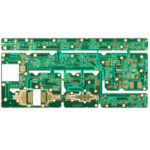
<img src="https://www.gopcba.com/wp-content/uploads/2026/09/711.jpg" alt="PCB panels with ENIG surface finish before assembly” />
ENIG: Nickel Barrier and Gold Layer
Electroless nickel immersion gold deposits a nickel layer that acts as a diffusion barrier and a thin gold layer that protects the nickel from oxidation. The result is a flat, solderable surface with excellent shelf life, which is why ENIG became the default for fine-pitch and high-reliability work.
Thickness control matters more than the headline gold figure. A typical specification calls for roughly 3 to 6 microns of nickel and 0.05 to 0.1 micron of gold, and the nickel layer is what actually carries the solder joint. Too thin a nickel layer allows the gold to diffuse and leaves a joint that fails under thermal cycling.
The classic ENIG failure mode is black pad, in which over-active plating chemistry corrodes the nickel surface before the gold is deposited. The visible joint looks acceptable while the interface is brittle, which is why plating process control matters as much as the specification.
Immersion Silver and Immersion Tin
Immersion silver deposits a thin layer directly on copper and offers excellent solderability and a flat surface at moderate cost. Its limitation is tarnish and electrochemical migration in humid, sulfur-bearing environments, so it needs good packaging and a controlled storage area.
Immersion tin performs similarly in assembly but forms intermetallic compounds with the copper underneath as it ages, and those compounds consume the tin over time. Shelf life is therefore shorter than ENIG, typically measured in months rather than years.
<img src="https://www.gopcba.com/wp-content/uploads/2026/06/ISO-9001-雅鑫达电子-scaled.png" alt="Cross section showing plating thickness over copper pads” />
OSP: Organic Solderability Preservative
An organic solderability preservative is a water-based film that bonds to copper and protects it until soldering. It is the cheapest finish, offers a perfectly flat surface, and disappears cleanly in the reflow process. It works well for consumer boards assembled shortly after fabrication.
Its constraints are handling and thermal exposure. The film degrades with repeated reflow, and it can be damaged by excessive probing or by storage in humid conditions. Where a board may be reworked twice, a metallic finish is usually the safer choice.
Hard Gold and Edge Connectors
Hard gold, deposited over nickel with a cobalt or nickel hardening agent, is the standard for edge connectors and contact fingers because it resists wear far better than soft gold. Thickness is specified in terms of wear cycles rather than solderability, commonly in the range of 0.5 to 1.5 microns for moderate insertion counts and more for harsh duty.
Note that hard gold is a contacting surface, not a soldering surface. Solder does not wet it reliably, and designers who extend the plating across a solder pad usually create a joint that looks fine and performs poorly.
Choosing Surface Finish Thickness
Plating thickness is a specification with tolerances, not a number. A data sheet that quotes a nominal 0.1 micron of gold may accept 0.05 to 0.15 in production, and the low end is what determines whether the batch behaves as expected. Write the minimum into the drawing rather than the nominal.
The measurement method also matters. X-ray fluorescence measures coating mass per unit area and converts to thickness using an assumed density, so both parties should agree on the instrument and the calibration standard before the first article is accepted.
Cost, Shelf Life and Assembly
Cost follows the amount of gold or silver involved and the number of process steps. Selection therefore follows the product: ENIG for fine pitch and long shelf life, HASL for robustness and low cost, OSP for a fast consumer build, immersion silver where a flat surface is needed at lower cost than gold, and hard gold only where contacts wear against a mating part.
Whatever is chosen, confirm the assembly process matches it. Combinations such as ENIG with lead-free solder are well understood, and boards stored for long periods benefit from a conformal coating once assembly is complete. If the finish must also survive a full thermal profile, review design and fabrication practice with the fabricator before the order is placed.
Verifying Plating Thickness in Production
Specifying a thickness is only half the task; the other half is agreeing how it will be verified. X-ray fluorescence is the standard non-destructive method, and it measures the mass of coating per unit area before converting to thickness using the density of the deposit. Two labs using different calibration standards can report different numbers from the same board.
Coupon-based cross sectioning provides a direct measurement and is normally used for the first article or for periodic process validation, while XRF handles routine production checking. Agreeing on the method, the instrument and the acceptance window before the order is placed prevents a dispute that neither side can resolve from the data alone.
FAQ
Is thicker gold always better on ENIG? No. Gold above roughly 0.15 micron embrittles the joint, and the parameter that actually controls reliability is nickel thickness and chemistry. Specify both, and treat the gold layer as protection for the nickel rather than as the solderable surface.
Can immersion silver survive a second reflow? Usually yes, provided the assembly is completed reasonably soon after fabrication and the boards are stored in sulfur-free packaging. Repeated rework is where immersion silver starts to show its limits.
What finish suits a board that will sit in a warehouse for a year? ENIG is the safest answer, followed by lead-free HASL. OSP and immersion tin both age quickly, and both should be treated as finishes for builds that are assembled within a few months of fabrication.