PCBA Conformal Coating: Types, Methods and Standards
Coating an assembled board is the step that turns a working circuit into a product that survives its environment. It is applied after soldering, so it protects components and joints rather than bare laminate, and the choice of material determines not only how well it protects but whether the assembly can ever be repaired.
What PCBA Conformal Coating Does
PCBA conformal coating is a thin polymer film applied over an assembled board to exclude moisture, dust, corrosive gases and chemical contamination. It also raises the surface insulation resistance between closely spaced conductors, which matters most where humidity condenses on a board carrying high voltage or high impedance nodes.
The coating is not a potting compound. It conforms to the surface, leaving a film measured in tens of microns, so it adds very little weight and no meaningful mechanical support. Where mechanical protection is needed, potting is the appropriate choice instead.
Coating Types at a Glance
Five chemistries dominate. Acrylic cures quickly and stays reworkable. Silicone tolerates wide temperature swings and high humidity. Polyurethane resists chemicals and abrasion. Epoxy is hard and durable but almost impossible to rework. Parylene is deposited from vapour and forms an exceptionally uniform, thin film at a correspondingly high cost.
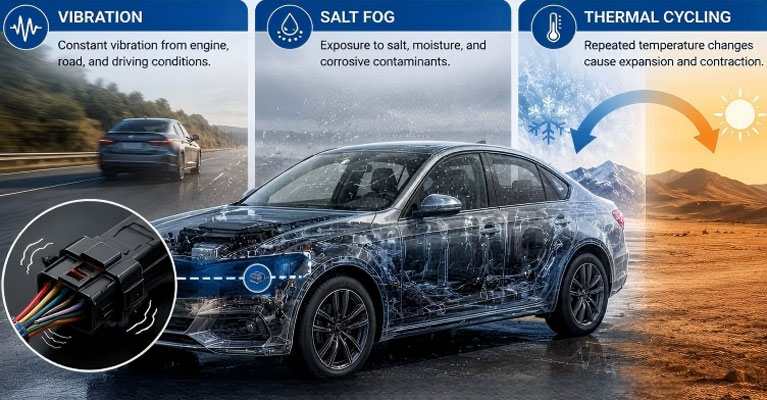
The choice follows the environment and the repair policy. A consumer product that may need service favours acrylic. An automotive module exposed to salt spray and thermal cycling favours silicone or polyurethane. A medical implant or an aerospace assembly may justify parylene.
Acrylic Coating
An acrylic coating is the general-purpose choice. It dries by solvent evaporation rather than by a chemical cure, so it can be applied and handled quickly, and it can be removed with a suitable solvent to allow component replacement.
Its protection is adequate rather than exceptional, and the film stays flexible across the range of temperatures an indoor product sees. It also reflows slightly at high temperature, which self-heals small scratches but limits its use in hot environments. Moisture resistance is good in moderate environments, but acrylic is less tolerant of sustained high humidity and aggressive chemistry than silicone or polyurethane, and it offers the lowest resistance to abrasion.
<img src="https://www.gopcba.com/wp-content/uploads/2026/05/smart-energy-PCBA.jpg" alt="Selective coating machine applying silicone to an assembled PCBA” />
Silicone Coating
Silicone keeps its flexibility across a wide temperature range and sheds water effectively, which makes it the usual choice for automotive, outdoor and high-voltage assemblies. It also relieves mechanical stress on solder joints because the cured film remains compliant as the assembly expands and contracts.
The trade-offs are cure time, which is longer than acrylic, and adhesion to some surfaces, which requires clean preparation. Silicone is also harder to remove cleanly for rework, though it can be cut away locally.
Polyurethane and Epoxy
Polyurethane provides the best combination of chemical resistance and mechanical toughness among the brushable materials. It resists solvents, fuels and abrasion, which is why it appears in industrial control and under-hood electronics, at the cost of a longer cure and more demanding surface preparation.
Epoxy is the hardest option, with excellent dielectric strength and wear resistance. It is essentially not reworkable, so it is chosen when the assembly is not expected to need repair and the environment is severe.
Parylene by Vapour Deposition
Parylene is applied in a vacuum chamber, where the monomer deposits and polymerises directly on the board. Because the process is a vapour rather than a liquid, coverage is uniform even under components and on sharp edges, and the film can be very thin while remaining pinhole-free.
Its dielectric performance and barrier properties are excellent, which is why medical, aerospace and high-reliability instruments use it. The constraints are cost, the need to mask connections carefully and the limited number of coating houses that can run the process.
Application Methods
Brushing suits repair work and very small batches, giving control without equipment. Spraying, manual or automated, is the most common production method and offers a good balance of speed and coverage. Dipping gives complete coverage of both sides in one operation and suits high volumes, though it consumes more material and requires masking on both faces.
Selective coating uses a programmed machine to apply material only where it is needed, keeping connectors, test points and press-fit areas clean. It reduces material consumption and masking labour, which makes it attractive for complex boards where most of the surface does not need protection.
Standards and Qualification
IPC-CC-830 defines the qualification and performance requirements for coating materials, including moisture and insulation resistance testing. MIL-I-46058C is the corresponding military specification, and UL 746E lists recognized insulating materials. Environmental compliance with RoHS and REACH applies to the coating as much as to the components.
For a product destined for a regulated market, coating qualification should be part of the reliability plan rather than a finishing detail, and the material data should be retained with the build records, in the same way that design and fabrication documentation is kept for the board itself.
Defects: Bubbles, Pinholes and Delamination
Most coating failures trace back to preparation. Contamination, flux residue or moisture on the surface prevents adhesion and produces delamination or blistering after cure. Bubbles and pinholes leave a path for moisture straight through the film, defeating the purpose of the coating entirely.
Uneven thickness comes from unstable spray parameters, while coating that intrudes into a connector is a masking error and causes contact problems that appear only after assembly. All four are avoided by controlling cleanliness, masking and process parameters, and by inspecting the coated board rather than assuming the process is correct. The design side matters too: the guidance on conformal coating and board protection explains which features should be kept clear.
Coating Behaviour Under Thermal Cycling
A coating that looks flawless after cure can still fail in service if its expansion behaviour does not match the assembly. As the board warms and cools, the film, the solder joints and the laminate move by different amounts, and a rigid coating concentrates that strain at the joints and at the edges of large components.
This is why compliant materials such as silicone are preferred for assemblies that see wide temperature swings, while hard materials such as epoxy suit applications where the environment is stable and mechanical protection matters more. Parylene sits between the two, being thin enough to accommodate some movement while remaining a coherent barrier.
A second effect is outgassing. Some materials release volatiles during cure or during subsequent thermal exposure, and trapped gas under a coating forms blisters. Choosing a material with low outgassing and giving it a full cure before the assembly is enclosed prevents a defect that only appears after weeks in the field.
FAQ
Should the coating cover connectors and test points? No. Connectors must remain free of coating to maintain contact, and test points are usually left bare so that the assembly can still be probed. Both should be masked, and the masking geometry belongs in the design rather than in a verbal instruction.
How thick should the coating be? Thickness is specified by the material datasheet and by IPC-CC-830 rather than chosen freely, and is typically measured in tens of microns. Uniformity matters more than the average value, because a thin spot is where moisture will enter.
Can a coated board be repaired? Acrylic and silicone can be locally removed and recoated. Polyurethane is more difficult and epoxy is effectively permanent, so the repair policy should be decided before the material is chosen. Where larger volumes must be encapsulated, review the options in potting and dispensing adhesives.