
Standard PCB Service Cost: Materials, Layers and Volume
Most projects do not need the fastest board or the most exotic material, and the ones that do usually know it early. For everything else a standard PCB service, built with mainstream materials and mainstream process capability, gives the best combination of cost, yield and delivery predictability. Understanding where the money actually goes makes it easier to ask for a better price without damaging the product.
What a Standard Service Covers
A standard service works inside a defined process window. That means ordinary FR-4 laminate, common layer counts of two, four and six, standard copper weight of one ounce, routine tolerances on hole size and outline, and a lead time measured in working days rather than hours.
The value of that definition is repetition. A process that runs the same material and the same geometry every day holds its yield, and the price reflects the yield rather than the ambition. Work that steps outside the window becomes a special job, with new setup, new process control and a different price.
Material Is the First Cost Driver
Laminate is a large share of the material cost and its grade changes the price measurably. Ordinary FR-4 sets the baseline, a mid range glass transition material adds roughly ten to twenty per cent, and a high Tg laminate intended for lead free assembly and higher service temperature adds twenty to thirty five per cent.
The choice should follow from the assembly process and the working temperature rather than from habit. A board that will be reflowed at lead free temperatures and used in an enclosure that reaches eighty degrees benefits from a higher glass transition material, while a simple control board in a ventilated box rarely needs it.
Layer Count and Stackup Complexity
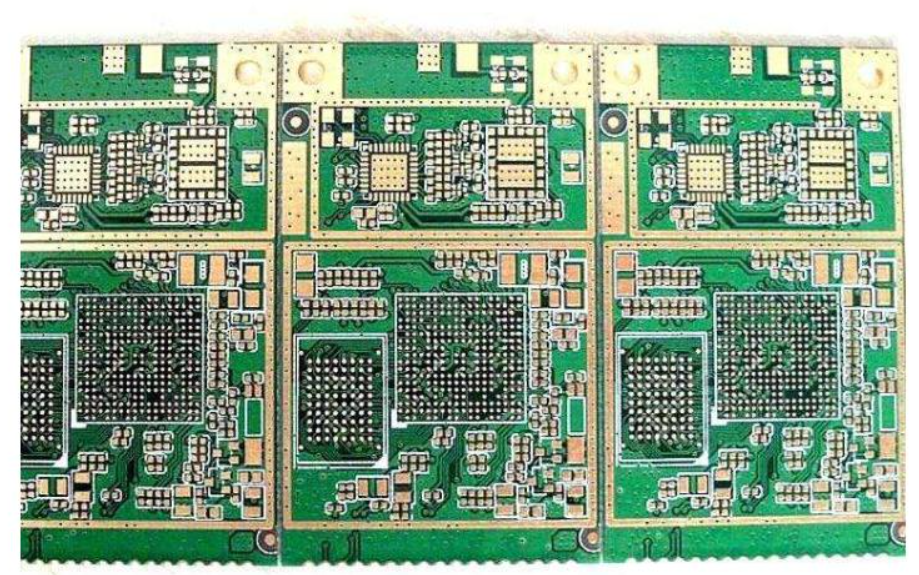
Each additional layer pair adds a lamination cycle, another drilling and imaging step and another registration tolerance to hold. That is why the price rises in steps rather than linearly, and why a four layer board can cost noticeably more than twice a two layer board of the same size.
Stackup complexity adds cost on top of the layer count. A symmetrical stackup using standard prepreg thicknesses is easy to build, while one that requires a specific dielectric thickness for impedance control needs a non standard combination and tighter lamination control. Designing the stackup from available materials rather than from ideal values is the simplest way to hold the price down, and the options are set out in layer stackup from one to eight layers.
Copper Weight
Copper thickness affects both material cost and process time. Heavier copper takes longer to etch, requires more careful compensation for undercut and reduces the minimum gap that can be held, so a design that moves from one ounce to two or three ounces pays twice: once for the foil and once for the process.
Where the current genuinely requires heavy copper, the cost is unavoidable. Where it is added as insurance, it may not be. Calculating the trace width from the actual current and the acceptable temperature rise usually shows that one ounce copper is sufficient for signal and low current paths, with heavier copper confined to the power section.
Surface Finish
The finish is a small part of the total cost but an easy place to overspend or underspend. Hot air solder levelling is the cheapest option and gives good solderability, with the drawback of a rough, uneven surface that is unsuitable for fine pitch parts.
Immersion tin and immersion silver cost more and give a flat surface, and electroless nickel immersion gold costs more again while providing the flattest surface and the longest shelf life. Selecting the finish from the component pitch and the storage requirement keeps the decision grounded, and the same logic appears in the manufacturability discussion in PCB design guidelines for manufacturability.
Panel Utilisation and Board Size
Fabricators price by panel, not by the individual board. A design that fits neatly into the standard panel size with little waste is cheaper per unit than one whose dimensions leave unusable strips around every piece, even if the board area is identical.
Outline shape matters for the same reason. A rectangular board nests efficiently, while a shape with cut outs and curved edges wastes material and adds routing time. Where the product allows it, adjusting the outline slightly to improve nesting is one of the few cost reductions available after the design is complete.
Order Quantity and Tooling
Prototype orders carry setup charges that dominate the unit price. Films, drill programs, tooling and first article inspection are paid once, so spreading them over a hundred boards instead of five reduces the unit cost dramatically even though the material cost per board barely moves.
Volume pricing settles once the setup is amortised. Beyond that point the savings come from panel efficiency and from process familiarity, which is why a repeat order of a design that has already been built is cheaper than a first order of the same quantity. The practical advice is to run one prototype with the production stackup rather than to iterate on a different construction, as described in multilayer PCB prototype requirements.
Design Choices That Reduce Cost
Standard hole sizes, minimum annular ring, generous spacing and a small number of drill sizes all reduce process time. Large numbers of distinct drill sizes mean more tool changes, and very small holes mean slower drilling with higher breakage risk.
Impedance control is another decision point. Where it is genuinely needed it should be specified properly with a coupon, and where it is not, the requirement should be removed rather than left in the notes. An unnecessary impedance specification adds cost and constrains the stackup for no benefit.
Reading a Quotation
A useful quotation separates material, process, tooling, test and finish, because that breakdown shows which choices are actually driving the price. A single lump sum hides the fact that the finish or the copper weight is responsible for a large part of the total.
Delivery terms matter as much as price. A standard lead time quoted honestly is more valuable than an aggressive lead time that slips, especially where the board feeds an assembly schedule. The board that arrives predictably keeps the whole programme moving, and the cost of a late panel is usually far greater than the difference between two quotations.
FAQ
Is a higher grade laminate worth the extra cost? Where the assembly is lead free and the product runs warm, usually yes. Where the board sits in a benign environment, the standard grade performs perfectly well.
What is the cheapest way to get a four layer board? Keep the stackup symmetrical with standard prepreg, use one ounce copper, choose hot air levelling if the pitch allows, and order a quantity that uses the panel area efficiently.
Should prototypes use the production stackup? Yes. Switching materials between prototype and production invalidates the electrical results and usually triggers another round of validation, which costs more than the material saving. Where a customer insists on a change, it should be made before the electrical validation is repeated rather than after, so that the validation result applies to the board that will actually be produced.