FR-4 vs G-10 Laminate: Flame Retardant and Mechanical Differences
FR-4 and G-10 are both glass fabric laminates bonded with epoxy resin, and they are often described as if one were simply a better version of the other. The real difference is narrow and specific: G-10 is the older, non flame retardant grade, while FR-4 uses a modified resin system that meets a flammability rating. Everything else follows from that single change.
Where the Names Come From
G-10 is a military grade designation for a glass reinforced epoxy laminate, defined by its mechanical and electrical properties rather than by any fire performance requirement. FR-4 belongs to the same family but carries the prefix FR, which stands for flame retardant, and the number four identifies the specific material system.
Both are made from woven glass fabric and epoxy. The glass provides mechanical strength and dimensional stability, the resin binds it together and provides the electrical insulation, and the ratio between them determines many of the finished properties.
The Flame Retardant Difference
Standard FR-4 achieves its flammability performance with a brominated epoxy resin system, most often based on tetrabromobisphenol-A, which interrupts the combustion reaction in the gas phase. The material is qualified to UL 94 V-0, meaning that a vertical specimen self-extinguishes within a short time and does not drip flaming material.
G-10 has no such additive. It will burn, and although it does not ignite easily, a sustained flame will propagate along the laminate. That single difference makes G-10 unsuitable for most electronic products, because an internal fault that starts a fire can spread through the board. It also means that a product built on G-10 will not meet the requirements of many safety standards, regardless of how good its electrical performance is.
Electrical and Mechanical Properties
Electrically, the two are close. Dielectric constant for both sits near 4.2 to 4.6 at low frequency, breakdown strength is similar at the same thickness, and both are good insulators with low dielectric loss compared with many other materials.
Mechanically they are also similar, with high flexural strength, good impact resistance and excellent machinability. Both can be drilled, milled, turned and tapped without delaminating, which is why they appear in both electronic and mechanical applications: jigs, fixtures, busbar supports and insulation plates as well as circuit boards.

Water Absorption and Dimensional Stability
Absorbed moisture changes both the electrical and the mechanical behaviour of a laminate. It raises the dielectric constant, lowers insulation resistance, and causes the material to swell slightly. Both materials absorb a small percentage of water by weight, and the difference between them is modest, but it is worth checking on the specific datasheet.
Dimensional stability matters most in multilayer work, where the inner layers must register with one another after pressing. For a board, the property that matters is the coefficient of thermal expansion, which is dominated by the glass fabric in the plane of the laminate and by the resin through the thickness.
Appearance and Machinability
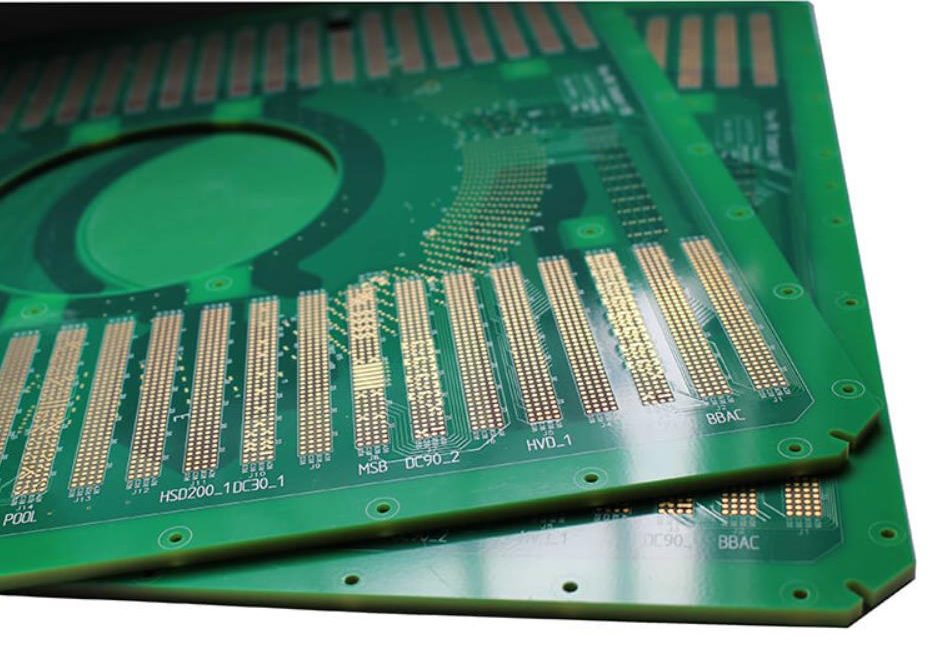
G-10 usually appears as a yellowish green, slightly translucent sheet, because it contains no fillers beyond the glass and the resin. FR-4 is commonly seen as a pale green or blue-green, but boards are also produced in black, white, red and blue, because the colour comes from a pigment added to the resin rather than from the base chemistry.
Both machine similarly. Carbide tooling is used for drilling and routing, dust extraction is required because the dust is abrasive, and thin sheets benefit from a backing board to prevent chipping at the exit face.
Cost and Availability
FR-4 is made in enormous volume and is stocked in a wide range of thicknesses, copper weights and glass transition temperatures. That volume is why a circuit board laminate is often cheaper than the equivalent G-10 sheet, even though the resin system is more complex.
G-10 remains available because it is used for mechanical parts where the flammability requirement does not apply, and because some legacy specifications still call it out. Where a drawing specifies 3240 or an older G-10 grade, the intent is usually the non flame retardant epoxy glass laminate rather than a specific modern product.
Which One to Specify
For any electronic assembly, specify FR-4 with the required flammability rating. The rating itself must be confirmed on the laminate datasheet, because the term FR-4 describes a family and different grades carry different performance levels. Where a product must meet a safety agency requirement, the recognised grade matters more than the generic name.
For structural insulation parts where there is no ignition source, G-10 is a reasonable and often cheaper choice. For high temperature applications, a high glass transition temperature FR-4 or a polyimide laminate is a better answer than either of the standard grades, because neither G-10 nor ordinary FR-4 performs well above its transition temperature.
Glass Transition Temperature and Its Limits
The glass transition temperature of a standard laminate in this family is around 130 to 140 °C, with high performance grades reaching 170 to 180 °C. Above that temperature the resin softens, the coefficient of thermal expansion through the thickness rises sharply, and the laminate becomes much more sensitive to mechanical stress.
That behaviour matters in assembly, because a lead-free reflow process takes the board close to the transition temperature of a standard grade. Selecting a higher transition temperature material is the usual answer where the process demands it, and the same reasoning applies whether the base laminate is described as FR-4 or G-10.
How the Choice Affects Downstream Processes
Flammability is not the only consequence of the resin formulation. The additive that makes FR-4 flame retardant also raises the decomposition temperature slightly and changes the way the laminate behaves in a press and in an oven, which is one reason FR-4 became the standard material for multilayer boards while G-10 stayed in mechanical work.
Thermal behaviour in assembly is the practical issue. A lead-free reflow profile takes the board close to the glass transition temperature of a general purpose grade, and the laminate that survives that exposure with margin is the one specified with a stated transition temperature and decomposition temperature. The process implications are discussed in the notes on lead-free versus leaded solder.
Moisture and dimensional behaviour follow the same pattern. A laminate that absorbs water swells, and the swelling has to be accounted for when inner layers are scaled before pressing, as described in dimensional stability and expansion. Material choice, layer arrangement and the finished board quality are all linked, which is why the review of PCB design quality characteristics treats the laminate specification as a design decision rather than a purchasing detail.
FAQ
Is G-10 the same as FR-4 without the flame retardant? Broadly yes. They share the glass fabric and epoxy construction, and the main difference is the resin additive that gives FR-4 its flammability rating.
Can G-10 be used for a circuit board? It can be processed into one, but it lacks the flame retardant rating that most product safety standards expect, so it is normally reserved for mechanical and insulation parts.
Why do boards come in different colours if both are epoxy glass? The colour comes from pigment in the solder mask and, for the laminate itself, from the resin formulation. Colour has no effect on the electrical properties, and two boards of different colours can be made from identical material.