Immersion Silver or Hard Gold: Which Surface Finish Fits
Surface finish is chosen twice in the life of most products: once when the board is assembled, and again every time a connector is mated. Immersion silver and hard gold sit at opposite ends of that spectrum. One is a thin, flat, inexpensive coating optimised for soldering and fine pitch assembly; the other is a thick plated layer built to survive repeated mechanical contact. Neither is a general upgrade over the other, and a board that needs both functions often ends up carrying both finishes in different areas.
What Each Finish Actually Is
Immersion silver is deposited by a chemical displacement reaction. Copper at the pad surface is replaced by silver from solution, giving a coating typically between eight and twenty microinches thick that follows the copper topography precisely. There is no nickel barrier and no external current, so the process is simple, the thickness is self limiting and the pad remains very flat.
Hard gold is electroplated over a nickel barrier, with the gold layer usually between thirty and one hundred microinches thick and hardened by alloying with cobalt or nickel. The nickel provides a diffusion barrier and a hard substrate, while the gold provides a low resistance, non oxidising contact surface. Because the process is electrolytic, the features must be electrically connected during plating, which adds a design constraint.
Solderability and Pad Flatness
For soldering, immersion silver is the stronger choice. It wets readily with most fluxes, it holds up through multiple reflow cycles better than an organic coating, and its extreme flatness suits fine pitch pads, small apertures and via in pad, where a domed or uneven surface would cause paste release problems or tombstoning on small passives.
Hard gold is not normally used on soldered pads. Where it is, the joint depends on the gold dissolving into the alloy, and thick gold can leave brittle intermetallic phases that reduce mechanical strength. The usual approach is to plate gold only where it is needed and keep it away from the solderable area, which means the design has to define the two regions explicitly.

Wear Resistance and Contact Life
This is the parameter that decides most connector applications. Hard gold over nickel resists abrasion, fretting and corrosion, and it maintains a stable contact resistance through thousands of mating cycles, which is why edge connectors, card guides and test points use it. The nickel layer prevents copper from diffusing to the surface and forming an insulating oxide that would raise contact resistance over time.
Immersion silver is not designed for sliding contact. It is soft, it is thin, and it can tarnish in the presence of sulphur compounds, so repeated insertion and removal wears through it quickly. It works well as a solderable and testable surface, but it is the wrong answer for a connector that a user will plug in and out many times.
Storage, Tarnish and Shelf Life
Silver tarnishes. The reaction with sulphur bearing compounds in the atmosphere produces a discoloured film that is mostly cosmetic, since the tarnish is conductive enough not to block soldering, but it makes inspection ambiguous and it can worry a customer receiving boards that look aged. Proper packaging, desiccant, sulphur free paper and a controlled storage environment are part of the surface finish specification rather than optional extras.
Hard gold is chemically inert and does not tarnish, so shelf life is limited mainly by contamination and handling rather than by the coating itself. That stability is worth paying for on equipment that will sit in stores for years before installation, particularly where the board carries contacts that must work on first use.
Cost and Process Complexity
Immersion silver uses a modest amount of a relatively inexpensive metal and needs no plating current, so the cost is low and the process is short. Hard gold uses a genuine precious metal deposit, requires a nickel underlayer and needs an electrolytic step with the associated bus bars, plating thieves and racking. The material cost alone puts hard gold well above immersion silver, and the processing adds to it.
The practical consequence is that hard gold is applied selectively. Coating an entire board with it when only a connector needs the wear resistance is a common and expensive mistake, and the cost difference is large enough to change the economics of a product.
Combining Finishes on One Board
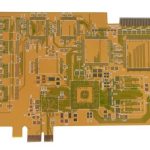
Selective plating lets one board carry both. The gold fingers are plated with nickel and hard gold, the solderable pads receive immersion silver or another solderable finish, and the two regions are defined in the fabrication drawing with clear boundaries and a stated minimum clearance between them. The process sequence matters, because the electrolytic step must not contaminate the solderable areas and the immersion step must not attack the gold.
Edge connectors made this way are standard practice, and the same approach is used for boards with press fit tails, spring contacts or shielding pads. Our notes on immersion silver finishes, gold plating types and gold finger bevel and chamfer cover the details that decide whether a mixed finish board works first time.
Selecting for the Application
Start from the function of each area. Pads that will be soldered want a flat, solderable, inexpensive coating, and immersion silver answers that well where the environment is controlled. Contacts that will be mated repeatedly want a hard, inert, wear resistant layer over a diffusion barrier, which is hard gold. Signal integrity rarely decides the question on its own, since both finishes conduct adequately at the frequencies involved in connector interfaces.
Then check the environment and the expected life. Sulphur bearing industrial atmospheres argue against bare silver; high humidity argues for a proper barrier layer under any gold; long storage argues for a finish that does not change with time. Where a board must satisfy several of those conditions at once, the answer is usually a mixed finish plus a clear specification, and our notes on exposed copper pad finish explain how the choice interacts with mask openings.
Testing and Incoming Inspection
Both finishes need to be verified against a specification rather than judged by appearance. Immersion silver is checked for thickness by X-ray fluorescence, for coverage over the pad edge and for tarnish after a steam ageing test that simulates storage and reflow. Hard gold is checked for gold and nickel thickness, for porosity and for contact resistance before and after a wear cycle, because a thin gold layer over an incompletely covered nickel barrier will fail long before the deposit thickness suggests.
The incoming inspection plan should also cover the boundary between finishes on a mixed board. Look for gold contamination on solderable pads, silver on contact surfaces, mask openings that encroach on either, and any plating bus that was not fully removed after the electrolytic step. These are the defects that survive a superficial check and then appear as poor wetting or unstable contact resistance during assembly.
FAQ
Is immersion silver better than hard gold? Neither is better in general. Immersion silver suits soldered pads, fine pitch assembly and flatness critical joints, while hard gold suits edge connectors, spring contacts and any interface that will be mated repeatedly.
Can immersion silver replace hard gold on a connector? Not where repeated insertion is expected. Silver is soft and thin, so sliding wear removes it quickly, whereas a nickel barrier under hard gold maintains a stable contact resistance over many cycles.
Is hard gold the same as ENIG? No. ENIG is electroless nickel with a thin immersion gold layer, used on solderable pads. Hard gold is electrolytically plated gold over nickel, used on contact and wear surfaces. The two names are not interchangeable in a fabrication note.