Switch PCB Price Guide: Membrane, Tactile and Mechanical
A switch board looks simple and is priced as if it were simple, until the switch itself changes the manufacturing route. Membrane panels are printed, tactile boards are stamped and placed, and mechanical boards are drilled, plated and often gold finished. This guide explains how a switch PCB price is built in 2025, what separates a fifteen-cent membrane panel from a three-dollar mechanical board, and where tooling and test costs hide in the quote.
What a Switch PCB Does
A switch PCB integrates the electrical switch, its contact geometry and the interface to the rest of the product on a single substrate. The board usually carries the switch footprint, a pull-up or debounce network, the connector to the main controller and often an LED indicator. Because the switch is a mechanical component, the board also has to survive repeated actuation without cracking the solder joint or the laminate.
That mechanical duty is what separates switch boards from ordinary logic boards. A membrane panel may see a million presses, a tactile board a few hundred thousand, and a mechanical keyboard tens of millions. The PCB construction therefore has to match the actuation count, and the actuation count is what the price ultimately tracks.
The Three Price Families
A membrane switch PCB is the cheapest family. The conductors are printed rather than etched, the panel is thin and flexible, and the tooling is a screen or a set of print screens rather than a drilling programme. Unit prices in volume are measured in cents, which is why membrane panels dominate appliances, medical keypads and flat control surfaces.
Tactile boards sit in the middle. They use a standard FR-4 substrate with a stamped dome or a small tactile switch, so they combine a normal fabrication flow with an assembly step. Mechanical boards are the most expensive family: they need tight hole tolerances, plate-through switches, often a metal plate for rigidity, and gold or hard-gold contact surfaces that survive millions of insertions or actuations.
Layer Count, Substrate and Finish
Layer count is the first lever. Most switch boards run one or two layers because the routing is simple and the current is small, and moving to four layers adds little functional value unless the board also carries a controller, a display driver or a radio. Where four layers do pay off is a panel with a large matrix, because the extra plane simplifies the row and column routing.
Substrate and finish follow the application. Flexible polyimide is used when the panel must bend, and an aluminum substrate PCB is used when the switch also has to dissipate heat, as in a power tool trigger. For the finish, HASL is adequate for a membrane or tactile board, while a mechanical keyboard PCB that is inserted repeatedly usually needs hard gold on the contact fingers.
Through-Hole or Surface Mount Switches
Through-hole switches are the traditional choice because the pins carry the actuation force into the board rather than into the solder joint. That mechanical advantage costs money: every pin needs a drilled and plated hole, and a keyboard with a hundred switches has several hundred holes, which shows up as a distinct line in the fabrication quote.
Surface-mount tactile switches remove the drilling but transfer the actuation load to the pads. They suit automated assembly and high volume, and they are cheaper per placement, but the pad area and the solder fillet have to be sized for the force. Mixed designs are common, and they usually require selective soldering or a second assembly pass.
Outline, Panel Utilisation and Mechanical Fit
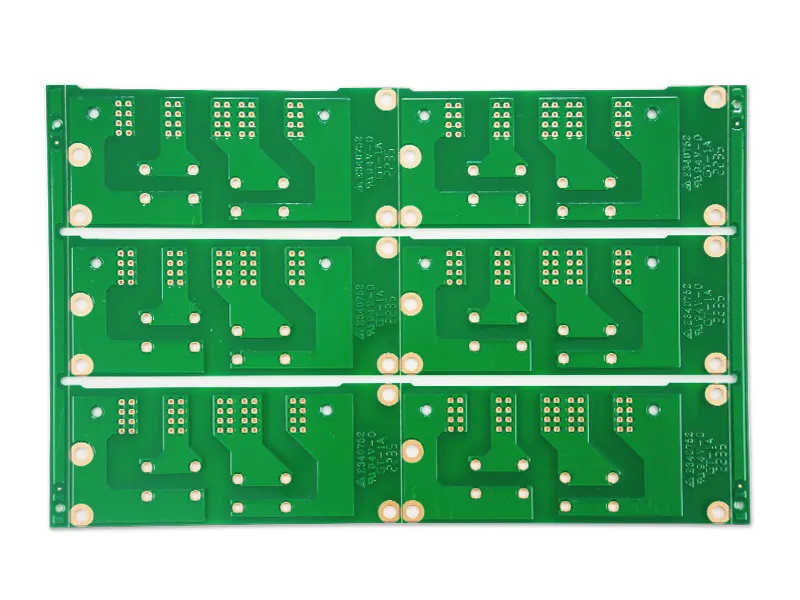
Panel utilisation deserves attention before the outline is released. A fabricator fills a standard panel with as many identical circuits as will fit, and the border that remains is paid for by the buyer. Rotating a long narrow board, adding a tab-route breakaway and keeping consistent spacing to the panel edge are routine requests that cost nothing to implement and can move the unit price by five to ten percent on a high-volume order.
Outline complexity is quietly expensive. A rectangular board nests efficiently on a standard panel, while a curved or cut-out outline needs extra routing time and leaves scrap material around every part. That scrap is paid for by the buyer, so a design that looks elegant on the drawing can add a meaningful percentage to the unit price.
Mechanical fit deserves attention at the same stage. Switch height, plate thickness, connector position and screw holes all interact, and applying board outline and mounting design rules early avoids a revision that would cost more than the panel saving. Keeping at least one dimension standard lets the fabricator reuse a known panel layout.
Prototyping, Tooling and Setup Cost
A first prototype carries a pcb prototype cost that has little to do with the board itself. Engineering time, a stencil, a programming file and a test method are all billed once, so a five-piece run can look expensive per unit even when the board is trivial. The practical approach is to accept that cost, validate the switch feel and the routing, and move to volume quickly.
Tooling for membrane panels is different again, because the artwork becomes the tool. A change in legend, a moved key or a different dome force means new screens, so membrane projects should freeze the layout before tooling is ordered. On rigid boards the equivalent decision is the panelisation, which is cheap to change before the first order and expensive afterwards.
Application Requirements That Raise the Price
Consumer remote controls and small appliances sit at the bottom of the range and rarely need more than a 2-layer FR-4 board with HASL. Industrial control panels move up because they need wider creepage, better thermal stability and usually a protective coating, so the same circuit can cost several times more when it is specified for a factory floor.
Automotive and mechanical input devices sit at the top. Automotive panels have to meet the applicable qualification standard, work over a wide temperature range and resist vibration, while a mechanical keyboard PCB needs controlled plating thickness, tight hole tolerance and often a stiffening plate. Each of those requirements adds a process step, and each process step adds cost.
Regional Pricing and Hidden Costs
Regional pricing still follows labour and compliance cost rather than capability. High-volume fabrication is concentrated where panel handling and plating capacity are cheap, and the gap between regions is largest on simple boards and narrowest on heavily plated and inspected ones. Freight, duty and clearance time then decide whether the lower unit price actually wins.
Hidden costs are the usual culprit in a budget overrun. Setup and tooling charges, electrical test, automated optical inspection, custom packaging and the cost of a design change all appear outside the headline price. Asking for a fully itemised quotation, including prototype requirements and test coverage, is the fastest way to compare two suppliers honestly, and it makes later scope changes visible, which is where most of the unplanned cost appears.
FAQ
Why is a mechanical keyboard board so much more expensive than a membrane panel? The mechanical board carries hundreds of drilled and plated holes, tight tolerances and usually gold contact surfaces, while the membrane panel is printed and laminated. Different process families, different price levels.
Do I need gold on the switch contacts? Only when the contact is inserted repeatedly or when contact resistance has to stay stable for years. A solder-mask-defined pad with HASL or ENIG is enough for a switch that is soldered once and never removed.
Can a flexible switch panel use the same size as a rigid one? It can share the outline, but the flexible version needs a stiffener behind the switch area and a different connector strategy. Those two additions are usually what changes the price, not the flex material itself.