FR-2 PCB: Where Phenolic Laminate Still Makes Sense
Most discussions of laminate assume a glass fibre substrate, and for good reason: it covers the overwhelming majority of boards built today. There is still a large category of products, though, where a paper-based phenolic material is the right answer and a glass fibre board would simply be more expensive than the product can bear. That material is FR-2 PCB laminate.
What FR-2 Is
The designation comes from the flame retardancy rating, and the number identifies the material class within the standard. FR-2 is a paper core impregnated with phenolic resin, which is a fundamentally different construction from the woven glass and epoxy of FR-4.
The difference is not cosmetic. Phenolic paper is cheaper, easier to shear and punch, and adequate for simple low-frequency circuits, but it is mechanically weaker, absorbs more moisture and tolerates far less heat. Those properties define both the applications where it belongs and the ones where it must not be used.
Material Properties
The dielectric strength is moderate and the dielectric constant is higher than glass-based laminates, which is acceptable for low-frequency analogue and simple digital circuits but not for controlled-impedance work. The material is also more sensitive to humidity, which raises leakage and further degrades the electrical performance in a damp environment.
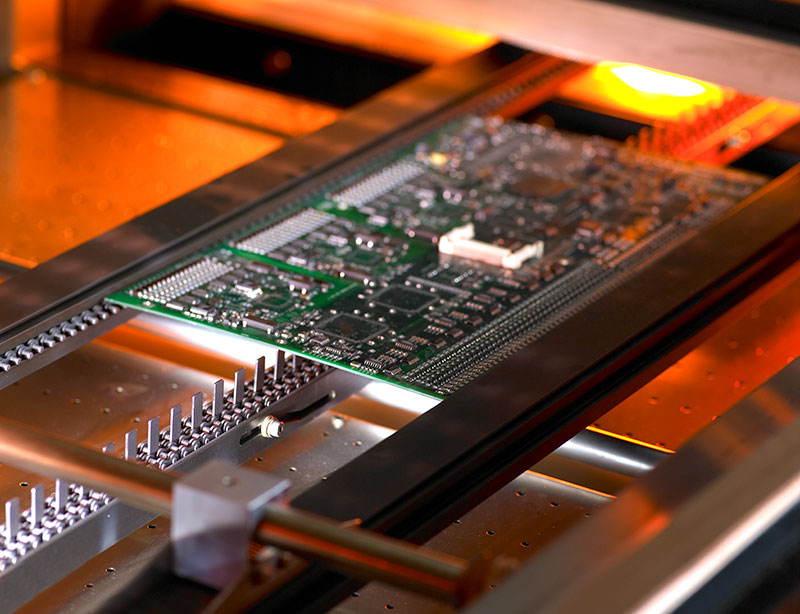
Thermal performance is the tightest constraint. The useable temperature range is roughly 105 to 130 degrees Celsius, well below a standard FR-4 laminate, and soldering has to be done at a temperature and duration that does not blister the resin. Where the assembly is reflow soldered, that limit becomes a real process constraint rather than a theoretical one.
Where It Wins
Cost is the primary advantage and the reason the material persists. It is among the cheapest substrates available, and the saving is largest exactly where it matters most, in high-volume products with little margin per unit.
Then comes the manufacturing advantage. Phenolic paper laminate can be punched rather than drilled and routed, which means a single stroke of a tool produces every hole and the outline at once. For a board with a few hundred holes, that converts a slow sequential operation into one that takes a second, and it is the reason FR-2 boards are common in products where the board is cheap and the volume is enormous.
Where It Fails
The mechanical limits are the first constraint. The material is brittle, it can crack at a mounting hole or a connector if the assembly is stressed, and it flexes under a heavy component. A large transformer or a stiff connector on a thin phenolic board is a reliability problem waiting to happen.
Moisture and heat are the second. Absorbed water increases leakage current and lowers the breakdown voltage, and the resin softens well below the temperatures that a modern lead-free assembly process reaches. Combining those two facts, the material is unsuitable for anything that must operate warm, damp or for a long service life. Where protection is essential, a conformal coating helps, but it treats the symptom rather than the material weakness.
FR-2 Versus FR-4
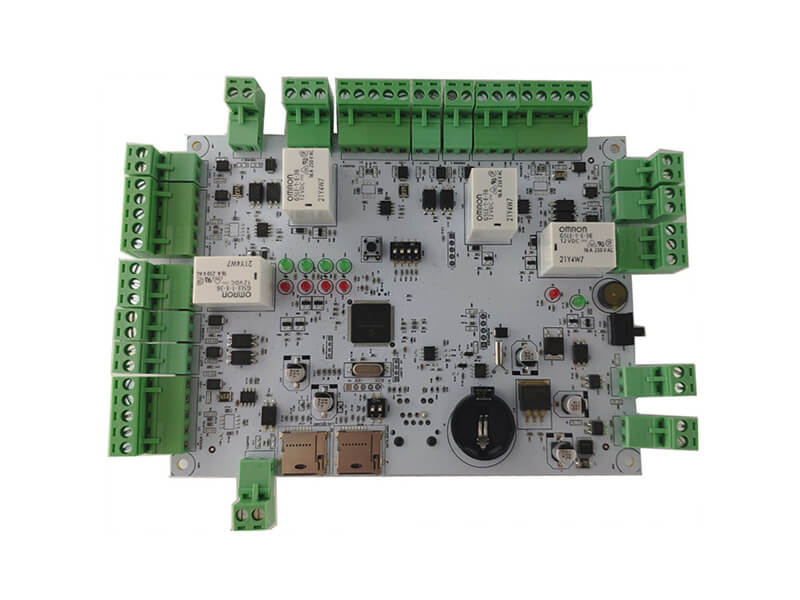
The comparison is straightforward. FR-4 uses woven glass in an epoxy matrix, which gives it greater mechanical strength, a higher temperature capability of roughly 150 to 180 degrees and above, much lower moisture absorption, and the dimensional stability needed for double-sided and multilayer construction. It costs more, and it is far more capable.
FR-2 is limited in practice to a single-sided board construction. Double-sided and multilayer designs are the province of glass-based laminates, because registration through the material and the electrical requirements of a second copper layer both favour a dimensionally stable substrate. Choosing between the two is therefore usually a choice between a single-sided low-cost board and everything else.
The Manufacturing Flow
Production of an FR-2 board is a shortened version of the standard process. A single copper foil is laminated to the phenolic core, the pattern is imaged and etched, the holes and outline are punched or drilled, and the surface is finished and the legend printed. Because the circuit is usually simple and low density, the etching tolerance is generous and the process window is wide.
The finish is chosen for cost. A hot air solder levelled finish or an organic solderability preservative covers most applications, and the choice between them depends on the storage life and the assembly process rather than on electrical performance. The soldering limit of the substrate, not the finish, is what governs the assembly profile; the trade-offs involved are described in the comparison of lead-free and leaded soldering.
Punching and Why It Matters
Punching deserves separate attention because it changes the economics of the whole product. A punch tool is a one-time cost, and once it exists the marginal cost of forming each board is nearly zero, which is why the technique is applied to high-volume products with a stable design.
The tool has consequences for the design as well. Holes need a minimum diameter relative to the material thickness, the distance from a hole to the board edge has to be sufficient that the material does not tear, and the outline needs generous radii rather than sharp internal corners. Designing within those constraints is what makes the low unit cost achievable.
Typical Applications
The uses follow directly from the properties. Remote controls, calculators and clocks, simple toys, low-power LED lighting strips and inexpensive audio devices all use phenolic paper boards, because each of them is a single-sided, low-frequency, low-heat product built in volume.
What they have in common is that the circuit is simple and the environment is benign. Where either of those assumptions breaks, the material is no longer a cost saving but a reliability risk, and the correct decision is to move to a glass-based laminate.
Deciding Whether It Fits
Four questions settle the decision. Is the circuit single-sided? Is the operating temperature low and the environment dry? Is the mechanical load light? Is the volume high enough to justify a punch tool? Four affirmative answers point to FR-2 as the economical choice.
Any negative answer moves the design towards a glass-based laminate. The extra cost per board is usually small in absolute terms, and it buys temperature capability, mechanical strength and dimensional stability that no amount of process control can add to a paper-based substrate.
Additional Considerations for This Build
Practical attention to phenolic laminate pays for itself here, because it is one of the items that decides whether the finished board behaves as the drawing intended. Where the requirement is not stated on the fabrication drawing or in the assembly notes, the shop has to assume a default, and the default is rarely the value the design was simulated with. Stating phenolic laminate explicitly, together with the tolerance that applies, removes that assumption and keeps the result predictable across batches.
Deliberate attention to punching process pays for itself here, because it is one of the items that decides whether the finished board behaves as the drawing intended. Where the requirement is not stated on the fabrication drawing or in the assembly notes, the shop has to assume a default, and the default is rarely the value the design was simulated with. Stating punching process explicitly, together with the tolerance that applies, removes that assumption and keeps the result predictable across batches.
FAQ
Can an FR-2 board be double-sided? Not in practice. The material is a single-sided construction, and the dimensional stability it lacks is precisely what a second copper layer requires.
Is FR-2 suitable for mains-powered products? Only with great care. The reduced dielectric strength, higher moisture absorption and lower temperature rating all conflict with the isolation requirements of mains circuits, so glass-based laminate is the safer choice.
Does FR-2 meet environmental requirements? The substrate is not biodegradable and must be disposed of properly, but a board built with lead-free solder and compliant surface finish can meet the restricted substance requirements that apply to electronics.