
Conductive Foam That Survives Reflow: What To Specify
Shielding a board used to mean a metal finger strip or a die cut gasket fitted by hand, with a conductive adhesive to bond it. As products have become smaller and production has become automated, that approach has run into two limits at once: the parts are difficult to place by machine, and the manual operations do not scale. The answer that has emerged is a compressible conductive foam supplied in tape and reel, placed by the pick and place machine and soldered in the same reflow pass as everything else.
This article sets out what such a part has to survive, and which figures should be requested before one is designed in.
The concept is simple and the engineering is not. A foam gasket that has to be soldered has to survive the oven, stay compressed afterwards, and keep its electrical properties for the life of the product.
What Changed To Make It Possible
The part is a foam core wrapped in a conductive layer, with solderable terminations at the base. It is supplied on tape so that the placement machine can handle it like any other component, and it is reflowed with the rest of the board. That removes the manual operation and gives the assembly the same repeatability as the rest of the surface mount process.
It also solves a packaging problem. A metal finger strip needs a defined mechanical gap and a screw or a clip to hold it, and a die cut gasket needs a housing that presses it. A soldered foam part holds its own position, which frees space on a board where space is the scarcest resource. With the board itself acting as one side of the enclosure, the foam provides both the path for suppressing emissions and the ground connection between the two.
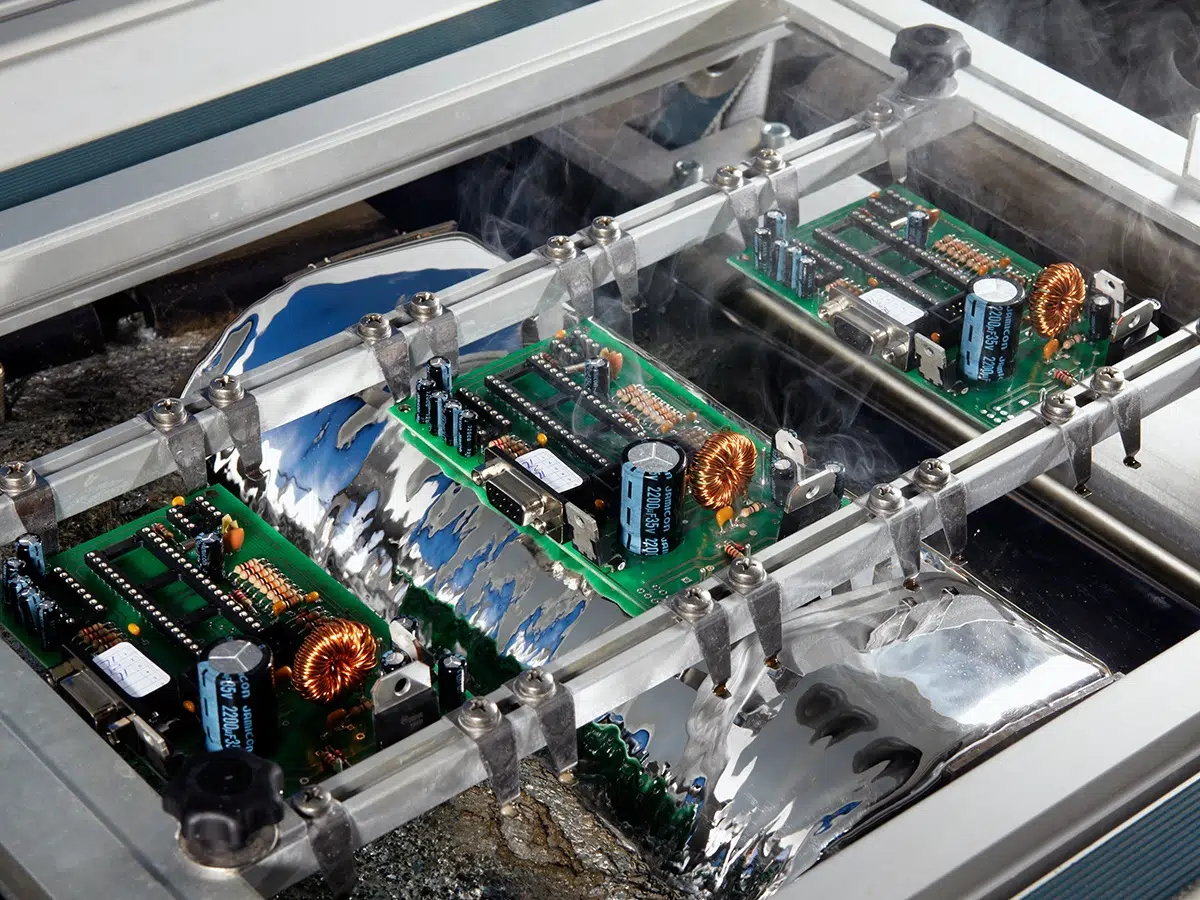
Temperature And The Reflow Window
The first requirement is the reflow profile. A lead free process peaks at about two hundred and forty five degrees, with an upper limit that can reach two hundred and sixty, and the foam assembly has to pass through that without the core collapsing or the conductive layer separating. In service the same part has to operate from minus forty degrees up to a hundred and twenty five at the point where a nearby device heats the enclosure.
The temperature range is worth stating as two separate numbers, because a part that survives the oven may not survive the service life, and one rated for high temperature service may not be stable enough to place. The thermal requirement is also a reason to check the profile rather than the peak: time above liquidus and the number of reflow passes both matter, and a part that tolerates one pass may not tolerate three.
Compression Set And Rebound
The second requirement is mechanical. The foam is compressed between the board and the enclosure, and it has to keep pushing for years. Placement subjects it to a downward force during pick and place, and the assembly is then held at a defined compression, typically between fifteen and thirty percent of its height, which is what generates the contact pressure.
The property that describes how it behaves over time is the compression set: the fraction of the original height that does not recover after the load is removed. A low figure means the foam springs back; a high one means it stays flattened and the contact pressure falls. Rebound is the complement of that, and a part expected to hold a ground connection should be able to return to most of its height after compression. Those two figures are the ones that decide whether the shield still works after a few years of thermal cycling.

Electrical Performance To Ask For
Electrically, a conductive foam part is a ground connection and a shield at the same time, and both functions have to be specified. The shielding effectiveness describes how much of an incident field the part attenuates, and it is frequency dependent, so it should be quoted over the band the product actually uses rather than at a single point. Values in the range of eighty five to a hundred decibels across the lower part of the spectrum, and above seventy in the low gigahertz region, are typical of a good part.
The grounding function is described by contact resistance and surface resistance, and by how they change with compression. A vertical resistance that stays low while the part is compressed, and a surface resistance low enough to carry a return current, are what make the connection effective. The joint that holds the part to the board also has to be sound, and a minimum push off force on the solder joint is a sensible acceptance criterion. The quality characteristics recorded for the assembly should include those measurements rather than only the placement.
Environment, Cycles And Salt Spray
A shield that lives inside a product sees flux residue from assembly, cleaning chemicals, humidity and, in automotive or outdoor products, salt spray. Each of those attacks the metallic layer, and the resistance can climb over time in a way that does not show up in a bench measurement. A salt spray test giving the change in contact resistance after exposure is a more useful figure than a claim that the part is corrosion resistant.
Dynamic products add another requirement. A folding phone hinge or a connector in a vehicle may be compressed and released hundreds of thousands of times, and the interface between the conductive layer and the foam core must not delaminate under that. Asking for a cycle figure with the test conditions attached separates a part that has been tested from one that has been described.
Why A Sample Is Not Enough
The last point is about supplier selection rather than the part itself. A foam gasket is a composite, and its performance depends on the bonding between the layers, the distribution of the conductive coating and the consistency of the core. Those are process properties rather than design properties, and they can vary between batches in ways that a datasheet does not capture.
The practical protection is to require the test data behind the claims, to ask for the batch traceability, to verify the parts at goods inwards, and to test the finished assembly rather than the component. Where a board is being assembled in volume, it is worth building one panel with the foam and running the shielding measurement on that assembly, because that is the configuration the product will be in. gopcb assembles boards with reflow compatible shielding components and can review the placement, the compression and the protection applied to the finished assembly as one design.
FAQ
Can a conductive foam part replace a metal shield can? For grounding and for local suppression, often yes. Where a full enclosure is needed for isolation, a can or a coated housing is still the answer.
Does the foam have to be compressed to work? Yes. The contact pressure comes from the compression, so the mechanical gap in the design has to be defined so that the part sits in its working range.
Why does contact resistance rise after salt spray? Because the metallic coating is attacked, and the oxide that forms is less conductive. The change after exposure is the figure worth specifying.