Placement Nozzle: Design Rules and Process Limits
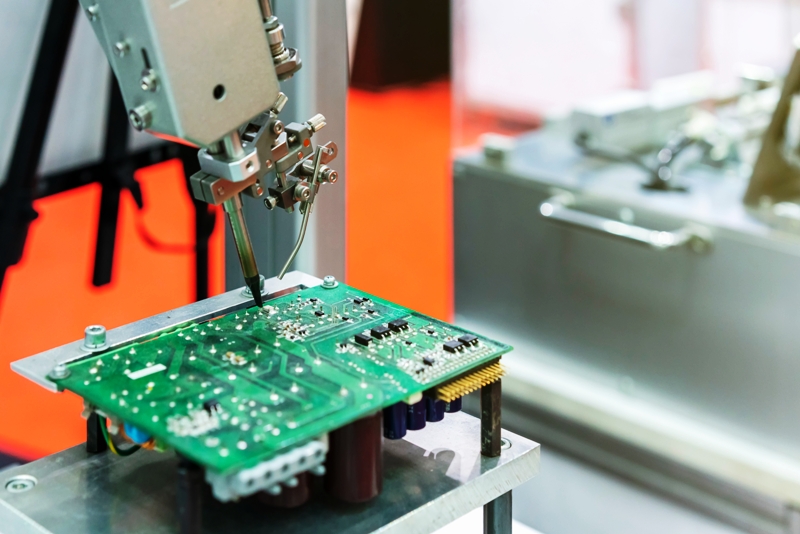
The only part of a placement machine that touches the component is the nozzle, and the entire accuracy of the machine passes through it. A nozzle that is the wrong size for the part produces a pick up that is off centre, a placement that is rotated, or a part that is dropped between the feeder and the board. The selection of the nozzle set is therefore a production decision with a direct effect on yield.
This article covers how a nozzle is matched to a component, what the vacuum system contributes, and how wear changes the result over time.
What The Nozzle Has To Do
The nozzle has to pick a component from its pocket with a force that is enough to hold it during the acceleration of the head, place it on the paste with a force that is low enough not to damage it or the paste deposit, and release it without leaving it attached. It also has to be centred on the part, because the machine measures the position of the component relative to the nozzle and corrects for the offset.
The bore at the tip is therefore the primary dimension. A bore that is larger than the component allows the part to be picked off centre and the vision system has to correct a larger error, while a bore that is smaller than the part either fails to pick it up or picks it up with the part hanging over the edge of the tip.
The relationship between the part and the tip also changes with the placement speed. A faster head accelerates harder, so a heavier part needs more holding force to stay on the nozzle, and the same nozzle that works at a moderate speed can drop parts when the programme is optimised for throughput. The speed and the nozzle are therefore tuned together, and a change to one usually requires a check of the other.
Matching The Bore To The Component
The usual guideline is that the bore should be a substantial fraction of the component dimension, large enough to hold the part flat against the tip and small enough that the part does not overhang. For a chip component the nozzle is often selected by the component size, with a separate nozzle for each package class, and the manufacturer’s selection table is the starting point.
The shape of the tip matters as much as the bore for parts that are not flat. A connector or a module with an irregular top surface needs a nozzle that contacts it at defined points, and a nozzle with a flat tip may pick it up at an angle. For a very small part the tip has to be soft enough to conform slightly, because a hard tip on a hard part does not seal well and the vacuum leaks.
Vacuum And The Sensing Of A Pick Up
The vacuum system generates a pressure difference across the component, and the holding force is the product of that difference and the area of the tip. A larger bore gives more force for the same vacuum, which is why a heavy component needs a larger nozzle. A leak at the tip reduces the difference and the holding force falls, which is why a worn or clogged tip drops parts.
The machine detects a successful pick up by measuring the vacuum level or the airflow at the tip. A part that is present seals the tip and the vacuum rises, while an empty tip leaks and the vacuum stays low. The threshold has to be set for each nozzle, because a large bore produces a different vacuum from a small one, and a threshold that is too tight produces false alarms while one that is too loose misses a part that is present but poorly seated.
Placement Force And Component Damage
The placement force is applied by the head as the nozzle descends to the board, and it has two functions: to seat the component into the paste and to ensure contact. Too little force leaves the part sitting on top of the paste without contact, and too much force spreads the paste, which can cause bridging between adjacent pads.
The force is set by the machine in the placement programme, and it should be tuned for the component rather than for the board as a whole. A ceramic capacitor tolerates very little force, while a large connector needs more to seat. Where a part has a fragile body, a nozzle with a compliant tip and a reduced force is the standard arrangement, and the effect of the force on the paste deposit is visible in the print after placement.
Wear And Maintenance
The tip wears from contact with the components and from the cleaning that the machine performs. A worn tip loses its seal, so the holding force falls and the pick up becomes unreliable, and the parts are more often placed off centre. The wear is gradual, which is why it appears as a slow decline in yield rather than as a failure.
Contamination is the other maintenance item. Paste and flux accumulate on the tip and change both the seal and the contact surface, and a tip that is cleaned on a schedule performs more consistently than one that is cleaned when a problem appears. The nozzle set for a machine should include spares of the sizes used most, because a single worn nozzle in a large set can account for a disproportionate share of the defects.
Building A Nozzle Set For A Product
The set is built from the component list. The parts are grouped by package and by mass, and a nozzle is assigned to each group, with the quantity of each nozzle determined by how many heads the machine has and by the wear rate. The parts that are difficult to pick, which are usually the very small and the very large, are given their own nozzle rather than being grouped.
The assignment should be verified on the first production run by checking the pick up rate and the placement accuracy for each nozzle, because a nozzle that is correct on paper may not perform with a particular component surface. The position and the orientation of the parts are part of the same setup, and the relevant rules are described for placement order and pad positioning. The defects that a poor pick up produces are covered under component shift, and the way the setup affects the line is described in layout decisions that affect production.
FAQ
Can one nozzle handle all the chip components on a board? It can handle the parts it fits, but the pick up is less reliable for parts that are much smaller than the bore. A nozzle per package class is the usual practice.
Why does the machine report a pick up error for a part that is present? Usually because the part is not seated flat on the tip, so the tip leaks. The bore size, the tip condition and the component surface are the things to check.
How often should a nozzle be replaced? Base it on the pick up rate and the placement accuracy rather than on a fixed interval. A slow decline in either is the sign that the tip has worn.