Moisture Absorption: Design Rules and Process Limits
Every organic laminate absorbs a small amount of water from the air. The amount is measured as a percentage by weight and it looks trivial, yet the absorbed water changes the electrical and mechanical properties of the material and creates the internal pressure that drives the delamination failures seen after soldering.
Moisture absorption is therefore a material property that has to be matched to the process and to the environment. A board that is perfectly adequate in a dry application may need a different laminate if it will be soldered at high temperature or operated in a humid climate.
Why Laminate Absorbs Water
An epoxy laminate is a cross linked polymer with polar groups that attract water molecules, and it also contains voids and fibre interfaces where water can collect. The equilibrium moisture content depends on the ambient humidity and temperature, and it is reached slowly over hours or days.
Typical values are 0.1 to 0.3 percent by weight for a standard FR-4 and below 0.1 percent for a high performance laminate. The difference looks small, but the absolute quantity of water in a panel is enough to generate significant internal pressure when it turns to steam.
The Effect On Electrical Properties
Water has a dielectric constant of about 80, compared with roughly 4 for the resin. Absorbed moisture therefore raises the effective dielectric constant of the laminate, which lowers the impedance of a controlled impedance trace and increases the propagation delay.
For a high speed design in a humid environment the shift can be enough to matter, and it is one reason why impedance is specified with a tolerance rather than as a single value. Surface insulation resistance also falls as moisture content rises, which links moisture to the growth of conductive filaments. The way a high speed trace reacts is described under high frequency traces and data bus routing.
Glass Transition Temperature And Softening
The glass transition temperature is the point at which the resin changes from a glassy to a rubbery state, and absorbed moisture lowers it. A laminate rated at 140 C may show a transition more than 15 degrees lower when it is saturated, which brings the transition uncomfortably close to the soldering temperature.
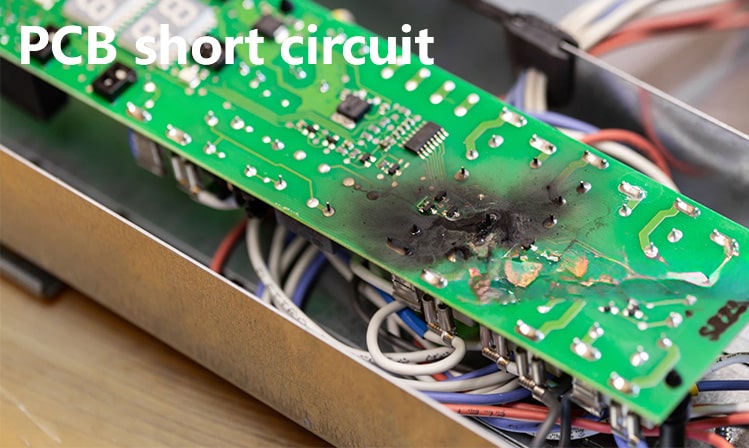
Above the transition the material expands much faster with temperature, and the coefficient of thermal expansion in the Z direction rises sharply. That expansion, combined with the pressure of vaporising water, is what pulls a plated barrel away from the laminate or separates two layers.
Delamination During Soldering
Delamination is the separation of layers within the laminate, and it appears as a blister or a white area after reflow. The mechanism is straightforward: trapped moisture turns to steam at soldering temperature, the pressure exceeds the bond strength, and the material splits.
Popcorning is the same mechanism inside a component package, and it is the reason moisture sensitivity levels are assigned and baking is required. On a bare board the equivalent control is lamination quality and the moisture content at the moment of soldering. The material behaviour behind this is described under PCB dimensional stability and expansion.
Baking Before Assembly
Baking drives the absorbed water out before the board sees soldering temperature. A typical schedule for a bare board is 120 C for four to six hours, or the schedule recommended by the laminate supplier, and the boards should be baked in a ventilated oven with free air circulation between them.
The baking time has to be counted from the moment the board reaches temperature, not from when it enters the oven, and the boards should be used within the floor life defined for the process. Baking a board more than the recommended number of times can oxidise the surface finish and reduce solderability.
Choosing And Storing Materials
Material choice should follow the peak temperature the board will see and the humidity of the operating environment. A laminate with a high glass transition temperature and lower moisture absorption is the standard answer for a board that must survive lead free reflow after long storage.
Storage in a sealed bag with desiccant keeps the moisture content at the as-received level, and the humidity indicator shows whether the bag held. How material selection fits into the qualification of a build is described under PCBA development process.
Process Control and Verification
Where the requirement is not written down, the shop supplies its own default, and the default is chosen for the process rather than for the design. The measurements that matter are the repeatable ones: conductor width and spacing, annular ring, finished hole size, plating thickness and surface finish are all verifiable on a coupon that travels with the panel.
Running a first article through the same checks as the production panel confirms that the two agree, and that comparison is the cheapest form of process control available at prototype stage. Keeping a sample from the panel turns a dispute into a measurement, because the same coupon can be re-examined by both parties without rebuilding the batch.
Checks Before Release
The checks that matter are the ones performed on the product rather than on a sample kept for the purpose, because a coupon that travels with the panel is the only evidence about that panel. Where a requirement can be measured, it should be measured at the point of manufacture and recorded against the board or the lot it applies to.
A parameter that is set once and never re verified drifts, and the drift is usually discovered by a defect rather than by the record.
FAQ
How long does it take a bare board to absorb moisture? It depends on thickness and humidity, but a thin board can reach equilibrium in a few days and a thick one takes weeks. Storage in a sealed bag prevents the change entirely.
Does baking damage the board? It can. Repeated baking oxidises the surface finish and can reduce solderability, and excessive temperature degrades the resin. The supplier schedule and a bake count should both be followed.
Does a higher glass transition temperature solve the problem? It raises the margin, but it does not eliminate moisture absorption. A high transition material still needs to be dry when it is soldered, particularly on a thick board.