Via Tenting Versus Plugging On PCB Assemblies
A via is a hole through the board, and leaving it open creates problems: solder can wick down the barrel during reflow, flux can be trapped inside, and contamination can enter the hole over the life of the product. Tenting and plugging are the two ways of closing it, and they exist for different reasons.
Tenting covers the via with solder mask, while plugging fills the barrel with a material. They sound similar and are often confused, but they solve different problems and they are specified and priced quite differently.
What Via Tenting Does
Via tenting is simply extending the solder mask over the via annulus and across the hole. It is done with the normal mask printing process, so it adds no cost, and it protects the via from contamination and from solder bridging during assembly.
Tenting works well for small vias, up to about 0.3 mm in diameter. Above that the mask tends to sag into the hole or crack across it during thermal cycling, and the protection it was meant to provide is lost.
What Plugging Does
Via plugging fills the barrel with a dielectric or conductive material before the mask is applied. It is used where the via is inside a pad, where a via must be planar for a ball grid array, or where the hole must be protected from moisture over a long product life.
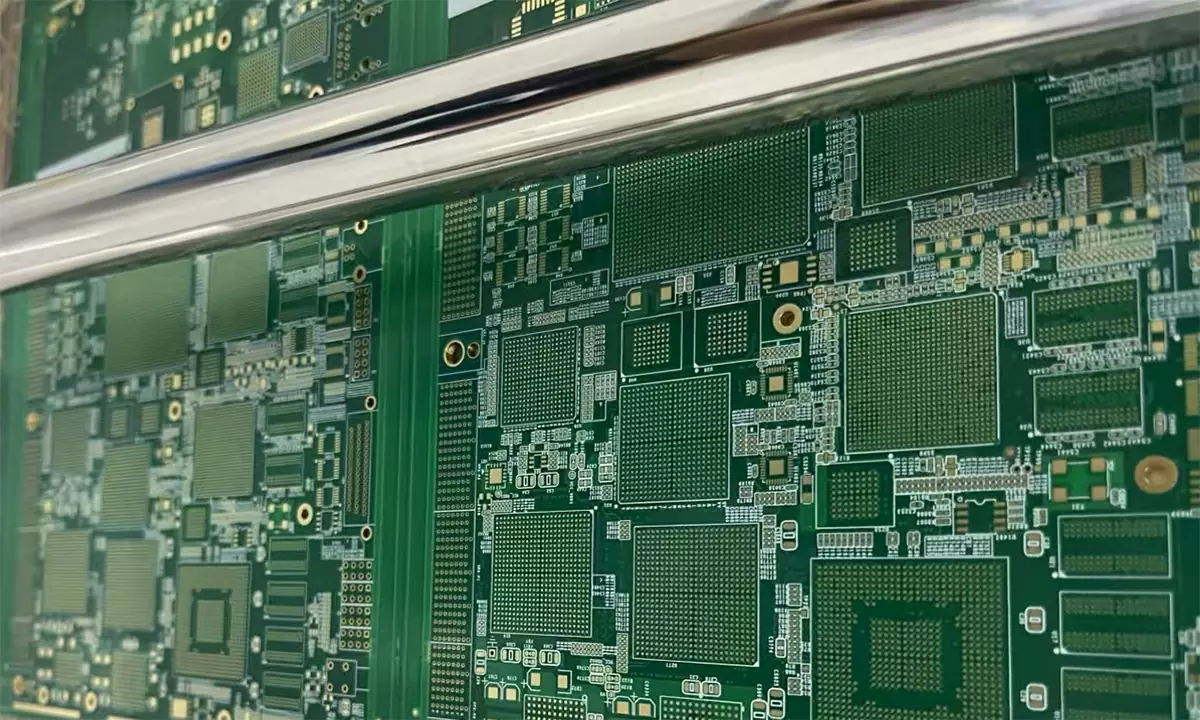
Plugging requires a separate process step and a curing cycle, so it costs more than tenting. The material has to be compatible with the plating, with the mask and with the assembly temperatures, which makes the choice of material important rather than incidental.
Materials Used For Filling
Non-conductive epoxy is the common choice for a via inside a pad, because it can be planarised and then over-plated. A resin plug of this type is filled, cured, ground flat and then plated over, giving a pad that behaves like solid copper.
Conductive pastes are used where the fill itself must carry current, but they have a different coefficient of expansion from the copper and can crack under thermal cycling. The choice should follow the current requirement and the reliability target. The plating defects that can accompany a poor fill are described under electroplating and via filling in HDI.
Outgassing And Assembly Problems
An open via can trap flux and moisture, and during reflow the material inside expands and is ejected as a small bubble. This outgassing throws solder away from the joint and produces a defect that looks like a random splash of solder on the board.
A plugged via removes the cavity and therefore removes the source of the gas. Tented vias reduce but do not eliminate the risk, because the barrel is still open at one end underneath the mask that bridges over it.
Choosing Between Them
Tenting is the default for a standard board with small vias away from pads. Plugging is required for a via inside a pad, for a via under a ball grid array, and for any via that must be flat or fully sealed against moisture.
The choice also depends on the assembly process. A board that will be wave soldered, or that will see a second reflow cycle, benefits from plugging even when the vias are small, because the protection is more reliable. How these choices are specified for a build is described under via in pad or plated through.
Specification And Inspection
The requirement should be stated by via class rather than as one general rule. A typical specification is: tent all vias below 0.3 mm, plug all vias inside pads, and leave test point vias open.
Inspection of a tented via looks for a complete, uncracked mask cover, while inspection of a plugged via looks for a filled barrel with no voids visible in cross section. Incomplete filling is the most common defect, and it appears as a dimple in the surface. The mask requirements that apply are described under PCB design and fabrication.
Vias Under Ball Grid Arrays
A via placed inside a ball grid array pad must be flat, because a dimple or an open barrel changes the volume of the paste deposit and therefore the shape of the ball. Plugging and planarising is the standard solution, and the surface after grinding should be flush with the pad to within a few microns.
Vias placed between the balls rather than inside them are treated differently. They can be tented if they are small, and they should be positioned so that the mask dam between adjacent pads is not weakened, since a narrow dam is a common cause of bridging in a fine pitch array.
The same rule applies to any component with a large thermal pad, where a via in the pad is used to move heat into the plane below. Those vias must be plugged and over-plated so that the paste deposit sits on a flat surface rather than over a cavity.
Effect On Electrical Performance
Filling a via changes its electrical behaviour. A plugged barrel has a different capacitance to the surrounding planes than an open one, because the fill material has a different dielectric constant from air. For most digital designs the difference is small enough to ignore.
For a microwave or a very high speed design the effect should be modelled, and in some cases an unfilled via is deliberately retained in a critical net. The requirement should therefore be defined per via class rather than applied uniformly across the whole board.
Documentation And Cost
Tenting is included in the normal fabrication price, since it is part of the mask artwork. Plugging normally carries a separate charge and often a minimum quantity, because it requires an additional process step and a curing cycle on top of the standard flow.
Marking the requirement clearly on the fabrication drawing avoids the most common commercial dispute, which is a board supplied tented when the designer expected a plugged via. A short note keyed to via size and location removes the ambiguity entirely.
When An Open Via Is Correct
Some vias are deliberately left open. A via used as a test point must stay exposed so that a probe can reach it, and a via used as a vent on a sealed assembly may be left open so that trapped gas can escape during the reflow cycle instead of building pressure below a component.
A via placed on a ground plane for thermal reasons is another case where an open barrel helps, because it adds surface area for heat transfer without interrupting the plane. The specification should list these exceptions explicitly so that a general closing rule applied at the CAM stage does not quietly remove them.
FAQ
Does tenting work on a large via? Beyond about 0.3 mm the mask tends to crack or sag, so the via should be plugged instead. The exact limit depends on the mask thickness and on the thermal cycle the board will see.
Is a plugged via always conductive? No. Most plugging is done with a non-conductive epoxy, and the electrical connection is made by the plating on the barrel. Conductive paste is used only when the fill itself must carry current.
Can a via be plugged after assembly? No. Plugging is a fabrication step performed before the surface finish, and it cannot be added to a completed board.