V Cut Scoring Guide for PCB Panels
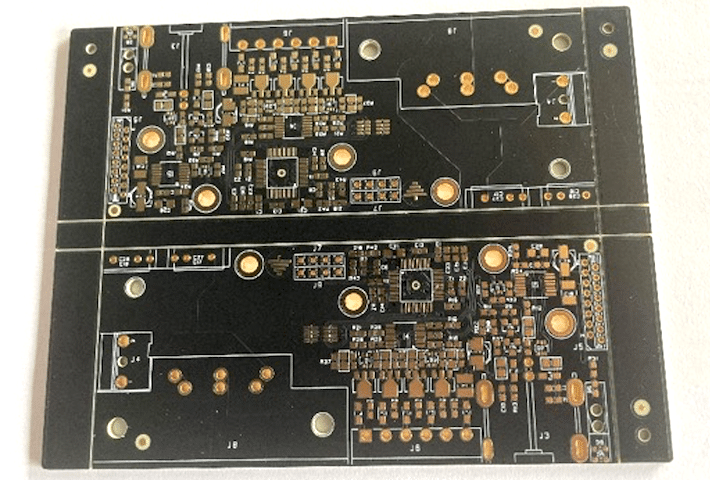
V cut scoring cuts a groove along both faces of a panel so that the boards can be snapped apart later. It is fast, it leaves a clean straight edge and it costs less than routing, and it works only where the boards are rectangular, where they are arranged in straight lines and where the edge does not have to be free of a taper. Those restrictions decide whether the method can be used at all.
How the Cut Is Made
A rotating blade with a V shaped profile is drawn along the line where the boards will separate. A cut is made on the top surface and another on the bottom, and the two grooves are aligned so that the remaining material forms a web.
The blade angle is usually around thirty or forty five degrees included, and the angle sets the width of the groove at the surface. A steeper angle gives a wider groove, which removes more material and leaves a more visible taper on the finished edge.
The depth of each cut is controlled so that the web that remains is a defined fraction of the board thickness. The two cuts are made in separate passes, and the alignment between them is what decides whether the separation is clean.
The Web and the Separation
The web is the material left between the two grooves. It holds the boards in the panel during assembly and it is what breaks when the board is separated.
A web that is too thick requires a large force and the break tears rather than snaps, taking laminate and copper with it. A web that is too thin leaves the boards loose in the panel, which is worse because a loose board produces a poor paste deposit during printing.
The usual target is a web between a quarter and a third of the board thickness. The optimum depends on the material, and a brittle laminate needs a thinner web than a tough one for the same separation force.
Blade Condition and Alignment
The blade has to be sharp and its profile has to be consistent. A worn blade produces a groove that is wider at the surface and shallower than intended, which leaves a thicker web and a rougher edge.
The top and bottom grooves must be aligned. A misalignment of even a small amount means the web is not straight, and the break follows a path that is offset from the intended line, which shows as a step on the edge.
The scoring machine should be set from the actual panel thickness rather than from the nominal figure. A panel that is at the top of its thickness tolerance with a setting calculated from the nominal value will have a web that is too thick.
Where Scoring Cannot Be Used
The method needs a straight line that crosses the entire panel. A board with a curved outline, a cut out or a connector that overhangs the edge cannot be scored on that edge.
It leaves a taper on the finished edge, because the groove is V shaped. A board that has to fit a connector with a tight edge clearance or that has to sit in a housing with a defined gap may not accept that taper.
It also applies a bending moment to the board at the moment of separation. A joint or a component near the score line sees that moment, which is why the method is avoided on a board with a brittle component close to the edge.
Panel Design for Scoring
The boards should be placed so that the score lines form a continuous grid. A gap between the boards is not required, because the boards touch, and the score line runs along the boundary between them.
The material utilisation is therefore high, since the only loss is the groove itself and the small taper on each edge. That is the main economic argument for the method.
The border of the panel should be designed with the same method in mind. A border that is separated by scoring needs its own score line, and the tooling holes must be placed so that the scoring blade does not pass through them.

Separation in Production
The separation can be done by hand, with a fixture or in an automated machine. A hand separation applies an uncontrolled bend, while a fixture that supports the board on both sides of the line applies a controlled one.
The support matters. A board that is held only at one end and pressed at the other bends more than the web requires, and the extra bend is what cracks a joint.
The separated edge should be inspected for a burr of copper or laminate. A burr on the edge of a board that will be inserted into a connector can prevent the board from seating, and the inspection should be part of the separation operation.
Quality of the Finished Edge
The edge carries a taper from the groove and a small ridge where the web broke. The taper is a property of the method and cannot be removed without routing, while the ridge depends on the web thickness and on the material.
A clean break leaves a slightly rough line along the centre of the edge. A tear leaves a jagged edge with material missing, which is a sign that the web was too thick or the material too brittle.
The edge should be inspected against a sample rather than by eye, because the difference between an acceptable and a marginal edge is small and the judgement changes between operators.
Comparison With Routing
Routing removes the material between the boards with a rotating bit and it can follow any outline. It leaves a clean edge with no taper and it applies a much smaller bending moment to the board.
It is slower, it consumes the material in the gap and it produces a dust that has to be extracted. The cost per board is higher than scoring in most cases.
The choice between the two is usually made from the board outline and the edge requirement. A rectangular board with a tolerant edge is scored, while a shaped board or one with a critical edge is routed.
Practical Rules
Set the groove depth from the actual panel thickness, keep the web between a quarter and a third of the thickness and check the blade alignment. Support the board on both sides during separation and inspect the edge against a sample.
Record the scoring parameters with the build records and the depaneling methods, and review the breakaway tab design and the panelization design when the panel is arranged.
FAQ
How thick should the web be? Usually between a quarter and a third of the board thickness. A thicker web tears rather than snaps, and a thinner one leaves the boards loose during assembly.
When can v cut scoring not be used? When the outline is not a straight line, when the edge has to be free of a taper or when a brittle component sits close to the score line.
Why does the edge show a taper? The groove is V shaped by design, so the material removed at the surface is wider than at the web. The taper is a property of the method.