
Solder Mask Registration and Mask Dam Control
The solder mask decides where the solder can go, so its registration is as functional as it is cosmetic. A dam that is too thin breaks down during assembly and a clearance that is too small exposes copper that should have been covered.
Dam Width Between Pads
The dam is what separates two adjacent pads, and its width is the pad spacing minus the two clearances. On a fine pitch part the dam becomes the limiting feature of the whole mask process.
Below a certain width the dam cannot be imaged reliably. Our mask design notes describe the limits.
Clearance to the Pad
The clearance is the distance the mask opening keeps from the copper it exposes. A large clearance exposes laminate and can allow solder to bridge; too small a clearance risks mask on the pad.
The figure has to accommodate the registration tolerance. Our registration notes describe the tolerance that applies.
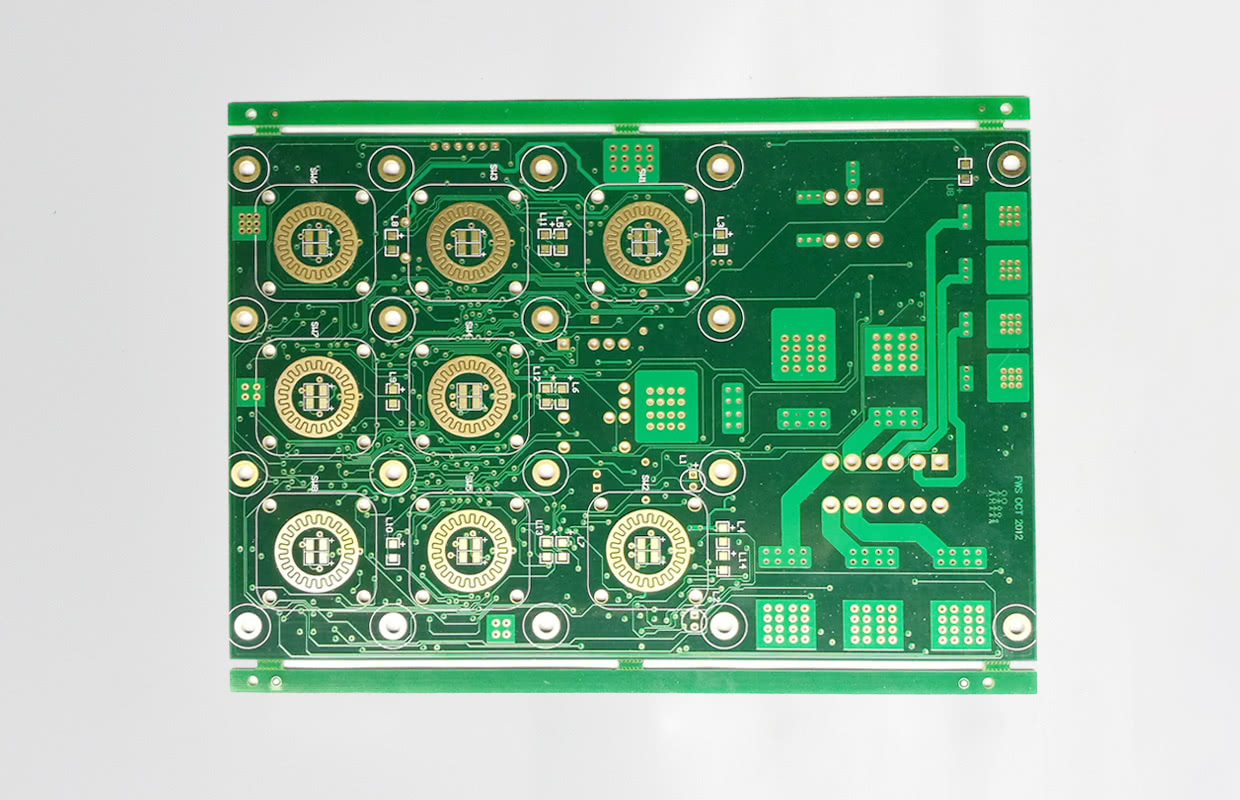
Why Registration Drifts
The mask is imaged and developed, then the panel passes through cure and finishing. Each step moves the image slightly relative to the copper, and the movement differs across the panel.
The drift is why the tolerance is a panel figure rather than a board figure. Our etching notes describe the step that contributes most.
Tenting and Via Coverage
A tented via is covered by mask on both sides. It protects the via from flux and from shorts, and it requires the mask to bridge the hole without cracking.
A via that is too large to tent should be plugged instead. Our via plugging notes describe the alternative.
Mask and Fine Pitch Assembly
On a fine pitch part the mask dam and the stencil aperture are decided together, because the paste has to sit inside the opening. A mask that is registered poorly reduces the effective aperture.
The two should be reviewed as a pair. Our paste volume notes describe the measurement that confirms the result.
Inspection and Its Limits
Registration is inspected optically by comparing the mask edge with the copper edge, which shows a shift clearly. It does not show a dam that has been weakened without being broken.
The dam integrity is confirmed by the assembly result rather than by inspection. Our defect notes describe the failure that appears when it is not.
Verification
The verification is a measured clearance on a sample from the panel, a dam width measured at the finest pitch on the board, and a registration figure recorded for the lot.
Our fabrication notes list the points to confirm.
Process Control and Verification
On a design of this kind, clearance is the item that decides how the rest of the board is arranged. Documenting the assumption is part of the design work, and a short note on the drawing prevents a question that would otherwise arrive a day later and cost a day of schedule. The process window is set by the narrowest step in the flow, so an improvement anywhere else shows up as margin rather than as yield until that step is addressed.
A short note on the drawing about handling, storage or packaging is often worth more than an extra decimal place on a tolerance. Where a value sits close to a process limit, the drawing should say so, since the shop can then open the process window rather than working to a nominal figure that carries no tolerance.
A stack-up that is drawn rather than described removes most of the ambiguity from a quotation, and it lets the fabricator price the board against the dielectric and copper weights that will actually be used. Where the requirement is not written down, the shop supplies its own default, and the default is chosen for the process rather than for the design.
The measurements that matter are the repeatable ones: conductor width and spacing, annular ring, finished hole size, plating thickness and surface finish are all verifiable on a coupon that travels with the panel. Running a first article through the same checks as the production panel confirms that the two agree, and that comparison is the cheapest form of process control available at prototype stage.
Keeping a sample from the panel turns a dispute into a measurement, because the same coupon can be re-examined by both parties without rebuilding the batch.
Process Control and Verification
On a design of this kind, clearance is the item that decides how the rest of the board is arranged. Documenting the assumption is part of the design work, and a short note on the drawing prevents a question that would otherwise arrive a day later and cost a day of schedule. The process window is set by the narrowest step in the flow, so an improvement anywhere else shows up as margin rather than as yield until that step is addressed.
A short note on the drawing about handling, storage or packaging is often worth more than an extra decimal place on a tolerance. Where a value sits close to a process limit, the drawing should say so, since the shop can then open the process window rather than working to a nominal figure that carries no tolerance.
A stack-up that is drawn rather than described removes most of the ambiguity from a quotation, and it lets the fabricator price the board against the dielectric and copper weights that will actually be used. Where the requirement is not written down, the shop supplies its own default, and the default is chosen for the process rather than for the design.
Process Control and Verification
On a design of this kind, clearance is the item that decides how the rest of the board is arranged. Documenting the assumption is part of the design work, and a short note on the drawing prevents a question that would otherwise arrive a day later and cost a day of schedule. The process window is set by the narrowest step in the flow, so an improvement anywhere else shows up as margin rather than as yield until that step is addressed.
A short note on the drawing about handling, storage or packaging is often worth more than an extra decimal place on a tolerance.
Process Control and Verification
On a design of this kind, clearance is the item that decides how the rest of the board is arranged. Documenting the assumption is part of the design work, and a short note on the drawing prevents a question that would otherwise arrive a day later and cost a day of schedule. The process window is set by the narrowest step in the flow, so an improvement anywhere else shows up as margin rather than as yield until that step is addressed.
A first article check confirms that the process and the drawing agree on the points listed above, and that the coupon data supports the values used in the design.

Where a measurement falls outside the expected window, the sample is retained so that the cause can be established before the balance of the batch is released.
FAQ
Is a larger clearance always safer? No. A large clearance exposes laminate and can let solder bridge between pads, so the figure is a compromise.
Can the mask dam be omitted on a fine pitch part? Sometimes the dam is removed deliberately so that the pads share one opening, which is a design choice with its own bridging risk.
What does gopcb provide for solder mask control? We provide a dam width chosen against the finest pitch on the board, a clearance that accounts for the registration tolerance, a measured clearance and dam width on a sample from the panel, a registration figure recorded per lot, and a decision on tenting or plugging for every via.