Nitrogen Reflow: When It Pays
An inert atmosphere during reflow is one of the most commonly specified process upgrades and one of the least carefully evaluated. Nitrogen does change the physics of wetting, but it changes some joints far more than others, and on many boards the benefit is small enough that the gas consumption cannot be justified. This article sets out what the atmosphere actually does and how to decide with measurements rather than with a supplier brochure.
What Nitrogen Changes
Replacing air with nitrogen reduces the oxygen available at the joint, which slows the growth of oxide on the molten alloy and on the surfaces being joined. Less oxide means lower surface tension and a wider window in which the alloy can spread, so wetting improves and the fillet forms more readily on finishes that are marginal.
The effect is not a change in the alloy or in the flux chemistry, and it does not compensate for a paste that is unsuitable or a profile that is wrong. It removes one obstacle to wetting, and its value depends on how large that obstacle was in the first place.
Oxygen Concentration and Measurement
The concentration is expressed in parts per million of oxygen remaining in the tunnel. Ambient air is around 209,000 ppm, a typical nitrogen supply setup runs between 500 and 1,000 ppm, and demanding applications go below 100 ppm. Each step down costs more gas and needs better sealing at the tunnel entries.
Measurement matters because a poorly sealed oven may not achieve the concentration it claims. The sensor should be calibrated, placed near the zones that matter, and logged so that a drift is visible. A reading taken once at commissioning proves nothing about the following month.

Wetting and Surface Tension
Reduced oxidation lowers the contact angle between the alloy and the pad, which shows up as a wider, more complete fillet and fewer non-wetting areas. The improvement is largest on finishes that oxidise readily and on boards that have been stored, because those are the surfaces where oxide was limiting the process.
Copper with an organic solderability preservative and freshly plated finishes benefit more than gold or palladium finishes, which resist oxidation well on their own. That difference is the reason two similar boards can respond very differently to the same gas setting, and it is covered in the comparison of surface finishes in our surface finish guide.
Where It Helps Most
The clearest gains appear on fine pitch assemblies, on boards with a high density of small pads and on processes that cannot afford any non-wetting. Miniature components with small deposits have little flux available and a large exposed surface, so they are the first to benefit.
It also helps where the paste has been on the stencil for a while, or where the print to reflow interval is long. In those conditions the deposit surface has already begun to oxidise before the oven, and the inert atmosphere recovers part of the lost performance. Our notes on solderability testing describe how to quantify the starting condition.
Where It Does Not Help
On a coarse pitch board with generous deposits, fresh material and a well tuned profile, the difference is often invisible. The joints are already fully wetted and the defect rate is at the noise floor, so the gas adds cost without changing the outcome.
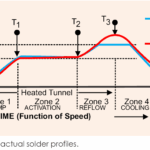
It also cannot fix a poor profile. If the peak is too low or the time above liquidus is too short, the joints will be defective in nitrogen just as they are in air. Buying an atmosphere to compensate for an unverified profile is a common and expensive mistake.
Solder Beading and Spatter
Beading and spatter are reduced in an inert atmosphere because the paste reflows more evenly and the flux volatilises in a more controlled way. Where the defect has been traced to oxidation of the powder surface rather than to a printing problem, this is a genuine benefit.
The distinction matters, because spatter caused by a contaminated stencil or an excessive ramp will not be cured by gas. The general sequence in our reflow defect troubleshooting guide puts the process causes ahead of the atmosphere for exactly this reason.
Cost and Consumption
Cost has two parts: the gas itself and the equipment to contain it. Consumption scales with tunnel volume, conveyor openings and the concentration target, and the largest single loss is usually air entrained at the entry and exit. Curtains, baffles and a well maintained exhaust control that loss more than any reduction in the purity of the supply.
A justified case normally rests on a measured defect reduction that pays back the running cost. Where the defect rate is already low, that calculation rarely closes, which is why the decision should follow a trial rather than precede it.
Deciding with Data
The practical route is a controlled trial. Run the same board, paste and profile in air and then in nitrogen, and compare the wetting, the defect rate and the resulting yield across a statistically meaningful number of panels. Everything else stays fixed so that the atmosphere is the only variable.
Decide on the result of that trial, not on a specification. Then record the concentration that was used alongside the profile, because a change in gas settings can alter the appearance of every joint on the board and make a later comparison meaningless.
Process Control and Verification
Keeping a sample from the panel turns a dispute into a measurement, because the same coupon can be re-examined by both parties without rebuilding the batch. Reviewing the design before the data is released is cheaper than correcting it after the panel is in the tank, because every step downstream inherits the decision made at the front end.
FAQ
Is nitrogen required for lead-free assembly? No. Many lead-free lines run in air with a suitable paste and a verified profile. The atmosphere improves the margin, but it is not a prerequisite.
What concentration should be used? Between 500 and 1,000 ppm suits most production. Lower values help on the most demanding boards, but they cost more gas and demand better tunnel sealing.
Does nitrogen affect solder joint strength? Indirectly, by producing a more complete fillet. The alloy and the intermetallic layer are unchanged, so the benefit is in the geometry rather than in the metallurgy.