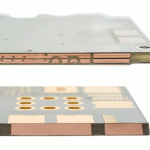
Panel Cleaning After Routing: Burrs, Dust and Handling
Routing is a dusty, abrasive operation, and the panel that comes off the router carries burrs at every cut edge and dust in every hole. Panel cleaning after routing is what removes both before the board goes any further. The cleaning step is short, and the defects it prevents appear much later in the process.
The step is often treated as a quick brush off, which is why the defects it should prevent appear later. Burrs interfere with assembly, dust causes solder defects, and both are cheaper to remove now than to explain afterwards. It is judged by what the next operation sees on the panel, not by the appearance of the flat surface.

Why Panel Cleaning Follows Routing
Routing cuts with a rotating bit that leaves a burr on the exit side and a trail of resin dust. The burr is sharp, and the dust is fine enough to travel into holes and onto pads. It is part of the routing operation rather than a separate housekeeping activity. A router that leaves a burr on every panel is telling you about the bit, not about the brush.
Both are process residues rather than dirt, which means they have to be removed deliberately. A panel that is merely shaken will still carry dust in the plated holes and burrs along the edges. A panel cleaned before the burr is removed has simply been dusted. It is judged by whether the burr is gone, not by whether the panel looks clean.
Burrs and Their Removal
Burrs are removed by mechanical means, and the method has to suit the edge. Brushing removes the small burrs on a straight edge, while a chamfer or a controlled edge break is used where the customer requires a defined profile. The method should be chosen from the edge profile the customer requires rather than from convenience.
The machine settings matter more than the brush, because a brush that is pressed too hard rounds the edge and removes copper. The practice described in deburring and brushing PCB panels work covers the balance between the two. A brush that is worn will polish the edge rather than cut the burr away. The brush should be changed on a schedule rather than when the operator notices it is worn.
Dust and Debris Extraction
Dust should be captured at the cutting point rather than collected later, and the extraction should be checked as part of the router maintenance. A dull bit produces more dust and more heat, which makes the extraction problem worse. Extraction should be checked at the same interval as the bit, since the two problems travel together.
The condition of the bit is therefore part of the cleaning result. The wear patterns described in depaneling router bit wear work explain why a worn bit and a dust problem usually appear together. A router that is cutting hot will deposit resin on the panel that no brush will remove.
Static and Ionised Air
Routing generates static on a dry panel, and static holds the dust against the surface instead of letting it fall away. Ionised air at the exit of the router releases that dust so that it can be extracted. The ioniser should be tested on a schedule, because an emitter that has fouled will stop working quietly. Ionised air that has stopped working is invisible, which is why the test belongs on a schedule.
Grounding alone does not solve it, because the panel is an insulator. The ioniser has to be positioned where the dust is still airborne rather than after it has settled. A panel that leaves the router charged will attract dust all the way to the next process.
Cleaning Methods Compared
Dry brushing, high pressure air, water based washing and ultrasonic cleaning are all used, and each removes a different fraction of the residue. Air removes loose dust but leaves the fine material that is held by static. The method should be written down with its parameters, so that two shifts produce the same result.
Aqueous cleaning removes both but adds a drying step, and the drying has to be complete. The methods and their verification are compared in PCB board drying after cleaning work. A change of cleaning method is a change to the process and should be qualified rather than adopted. A change of cleaning method should be verified on the next process rather than on the cleaned panel.
Drying and Residue
Where water is used, the panel has to be dried before it is packed or processed further. Water left in a hole or under a component will cause corrosion and will show up as a defect much later. Drying should be verified with a moisture check on the first panel rather than by a timer.
The drying method should be matched to the panel, since a thin panel with many small holes will dry differently from a thick one. Drying should be verified rather than timed. A panel with many small holes takes longer to dry than a plain one of the same thickness. Removing water from a hole is harder than removing it from a flat surface.
Handling Into Assembly
Clean panels have to stay clean, and that means handling by the edges and stacking with separators. A panel that is cleaned and then stacked bare has simply moved the contamination around. Separators should be clean, because a dirty separator contaminates the panel it is protecting. A dirty separator is a contamination source that travels with the panel.
The stacking and racking rules used elsewhere in the plant apply here as well. Where the panel is packed for shipping rather than for assembly, the packing has to protect the edges as well as the surface. Panels should be handled by the edges even when gloves are worn, since gloves carry residue too.
Records and Checks
The record should carry the bit condition, the cleaning method, the drying result and the inspection outcome. Where the shop works to a published standard, such as the assembly documents from IPC, the acceptance criteria should come from that source. The inspection should be recorded with the panel so that a later defect can be traced to the operation. The inspection result should be attached to the panel so that a later fault can be traced.
The check that matters is the one the next process sees, so the inspection should look at holes and edges rather than at the flat surface. A panel that looks clean can still fail at the first solder operation. Where the same defect appears on every panel, the cause is in the process rather than in the handling. Where a defect appears once, the handling is the likely cause and the process is not.

FAQ
Why is a brush off not enough after routing? Because static holds fine dust against the panel and a brush cannot reach into plated holes. The residue comes back as solder defects at assembly.
Does brush pressure matter? It does. Excessive pressure rounds the edge and removes copper, so the aim is to remove the burr without changing the profile the drawing requires.
Why is drying a cleaning issue? Because water left in a hole or under a component causes corrosion that appears long after the panel has been packed and shipped.