Print Volume Verification for Solder Paste Deposits
The print volume of each solder paste deposit is the single number that predicts most assembly defects, because it carries both the flux and the alloy that form the joint. A deposit that is 30 percent low produces an open joint or a weak fillet, and a deposit that is 30 percent high produces bridging or solder balling beside the pad.
Verifying that volume means measuring deposits rather than inspecting the stencil, and it means understanding which parameters move the number. Volume is set at the printer, but it is decided by the aperture geometry, the paste rheology and the separation step.
What Print Volume Tells You
Print volume is expressed in cubic micrometres or as a percentage of the nominal aperture volume, and the second form is the one that production uses. A deposit of 4 000 000 cubic micrometres printed through an aperture of the same nominal volume gives a transfer efficiency of 100 percent.
Transfer efficiency is a property of the aperture and the paste rather than of the printer alone. Values above 90 percent are expected on apertures with an area ratio better than 0.7, while small apertures on thick stencils can sit at 50 percent no matter how the printer is set. Each deposition is a small volume of paste whose dimensions come from the aperture, the stencil thickness and the separation step, so the measurement describes the printer rather than the component.
Measuring Deposits with SPI
Solder paste inspection builds a height map of each deposit with a structured light or a laser triangulation sensor and integrates it into a volume. The measurement of a single deposit takes milliseconds, so a full board can be mapped without slowing the line.
Accuracy depends on calibration. A gauge block or a certified artefact should be measured at each maintenance interval, and the reference tile that ships with the machine is only valid for the axis it was made on. Where two machines share the same product, they should be correlated before the data is used for process control. Repeatability matters as much as accuracy, because a machine that reads consistently can still control a process whose true volume is 5 percent away from the report.
Aperture Area Ratio and Release
The area ratio of an aperture is the area of the opening divided by the area of its walls, and it governs how much paste the walls hold back. Below an area ratio of 0.6 the release becomes unreliable and the spread between deposits on the same board widens quickly.
Aperture design is therefore the first lever on volume, and the second is the stencil thickness. Reducing thickness improves the area ratio and often recovers an aperture that would otherwise be marginal, as set out in the notes on aperture area ratio. Aperture walls that are rough from laser cutting hold more paste back than walls that are smooth, which is one reason two stencils of identical geometry can print differently.
Paste Rheology and Transfer Efficiency
Paste is a thixotropic material, so its viscosity falls while it is being sheared by the squeegee and recovers after the stroke. The recovery time decides how much of the deposit stays in the aperture wall and how much rises with the stencil during separation.
Temperature, humidity and age all move that behaviour. A paste that has warmed on the printer for several hours prints differently from one fresh out of the jar, and print volume is usually the first measurement to show the change. Paste left on the stencil through a break also loses solvent, and the deposits printed after the break are usually smaller than those printed before it.
Sampling and Data Handling
Measuring every deposit on every board produces more data than the line can use. A practical approach measures a defined set of apertures on each panel, chosen to include the smallest and the largest openings and the corners of the print area.
Data should be kept against the printer, the stencil and the paste lot, because a volume shift has different causes in each case. Trending the average and the spread together separates a setup problem from a material problem, and the feedback loop is covered in the SPI feedback notes. Sampling should be stable between runs, because changing the measured apertures in the middle of a product makes the trend line meaningless.
Limits That Predict Defects
Limits belong on volume rather than on height, because a deposit can be flat and short or tall and narrow with the same height reading. A common window is 80 to 120 percent of nominal volume with an additional cap on the deposit area.
The window should be tied to the defect it prevents. Below 70 percent the joint may not form, and above 130 percent the risk of bridging on fine pitch parts rises sharply, so a single window can serve for all apertures only when the pad geometries are similar. The limits should be reviewed whenever the stencil thickness or the surface finish changes, since both move the volume a given aperture will release.
Printing Parameters That Move Volume
Squeegee pressure, print speed, separation speed and the under-stencil wipe all move the number. Pressure that is too low leaves paste on the stencil, and pressure that is too high scoops the deposit out of the aperture and drives paste under the stencil.
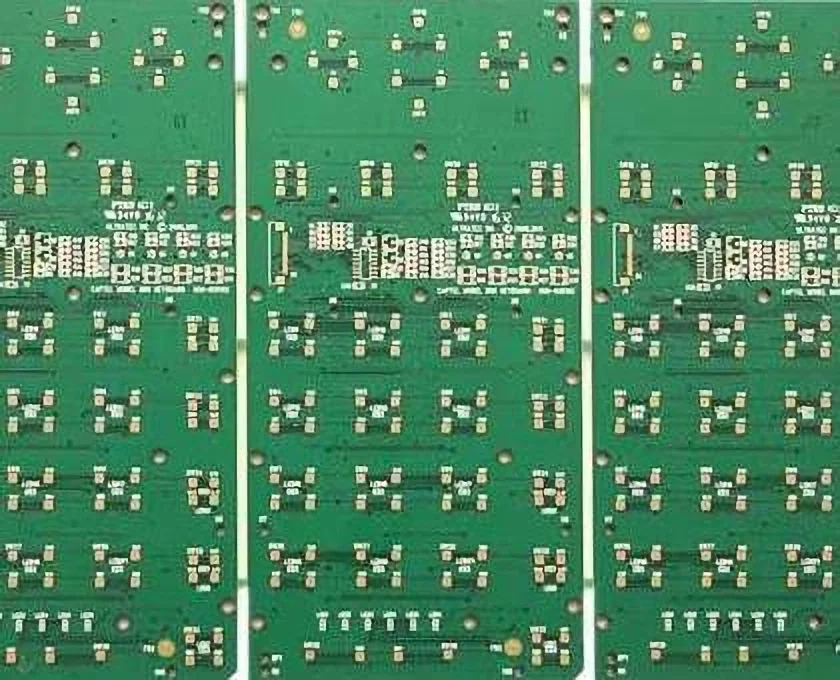
Separation speed is the parameter that is most often left at a default. A slow, controlled separation with a small snap-off gap releases the paste more completely, while a fast separation tears the deposit and leaves a peak in the middle of the pad. Snap-off gap and squeegee durometer also matter, but they usually shift the spread rather than the average, which is why both statistics belong in the record.
Correlation Between SPI and AOI or X-Ray
Volume data becomes useful for the rest of the line when it is correlated with the inspection results downstream. A deposit of 60 percent that passes AOI is a latent defect, and a deposit of 60 percent that fails at X-ray confirms that the volume limit is set where it should be.
Running that correlation once per product gives a defensible limit and a faster response to drift. Where the correlation is missing, every volume alarm becomes a discussion rather than a decision.
Records and Process Control
Records should carry the printer settings, the stencil identification, the paste lot and the volume statistics for the panel. gopcb keeps those values with the lot so that a change in transfer efficiency can be traced to a stencil or a paste batch.
Control charts belong on the average and on the standard deviation of the sampled apertures, because a stable average with a growing spread predicts defects long before the average itself moves.
FAQ
What print volume should a solder paste deposit have? Between 80 and 120 percent of the nominal aperture volume for most designs, tightened where fine pitch parts sit close to the limit of the process.
Is height enough to judge a deposit? No. Height ignores area, and a small, tall deposit can read correctly on height while carrying far less paste than the joint needs.
How often should the printer be verified with SPI? At the start of each shift, after a stencil change or a paste change, and whenever a defect appears that a volume shortage would explain.