FR4 PCB: PCB Design, PCB Manufacturing, Materials, Properties & Applications
A printed circuit board (PCB) provides the foundation for mounting and electrically interconnecting electronic components within a compact space. By separating conductive copper layers with dielectric materials, PCBs can achieve high circuit density while maintaining electrical insulation between different layers.
Among the many dielectric materials available today, FR4 PCB material remains one of the most widely used choices for rigid PCB applications. Its popularity comes from a practical combination of mechanical strength, electrical insulation, flame resistance, manufacturability, availability, and relatively low cost.
However, FR-4 is not a single material with identical characteristics. It represents a broad family of glass-reinforced epoxy laminate systems, and different FR-4 grades can have substantially different Tg, Dk, Df, CTE, thermal performance, and processing characteristics.
This article explains what FR-4 is, how FR-4 PCB materials are classified, their key properties, advantages and limitations, applications, and how to select the appropriate FR-4 grade for PCB Design and PCB Manufacturing.
What Is an FR4 PCB?
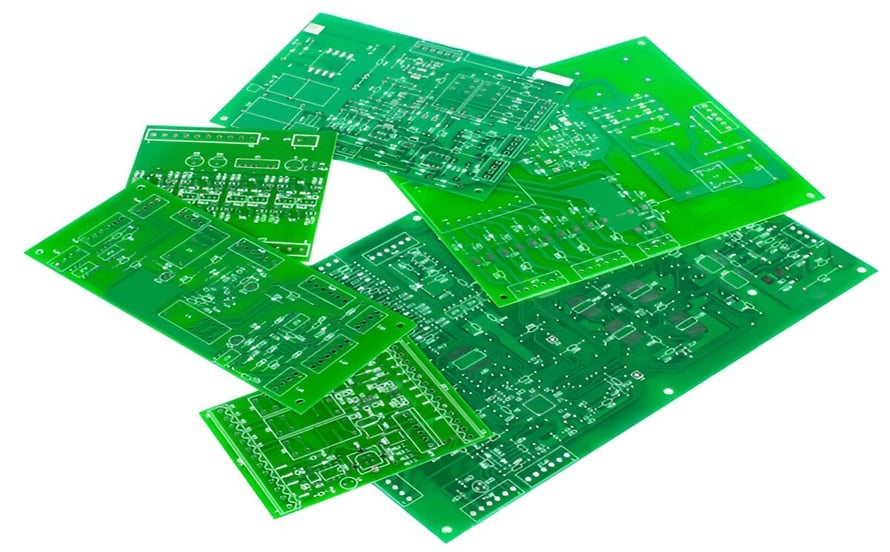
An FR4 PCB is a printed circuit board manufactured using FR
FR-4 typically consists of woven glass-fiber reinforcement impregnated with an epoxy resin system. The glass reinforcement provides mechanical strength and dimensional stability, while the resin provides electrical insulation and contributes to the laminate’s thermal and flame-retardant characteristics.
FR-4 is most commonly used in rigid PCBs, including:
- Single-sided PCBs
- Double-sided PCBs
- Multilayer PCBs
- High-Tg PCBs
- HDI PCB structures using compatible FR-4 grades
- Rigid-flex and semi-flex constructions in specialized configurations
It is important to distinguish between conventional rigid FR-4 and specialized flexible or semi-flex constructions. Standard FR-4 is not a flexible material. Certain specialized constructions can use thin FR-4 sections in controlled bending or flexing regions, but these should be designed according to the specific laminate, bend-radius, copper, and reliability requirements.
What Is FR4 PCB Material?
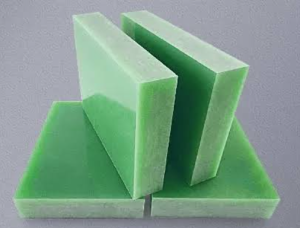
FR-4 is a material designation commonly associated with flame-retardant glass-reinforced epoxy laminate used for PCBs and other electrical insulation applications.
The term FR stands for Flame Retardant, while the number identifies a material classification rather than a single proprietary formulation.
FR-4 became widely adopted as an alternative to older phenolic paper-based laminates and other lower-performance materials because it provides a strong balance of:
- Mechanical strength
- Electrical insulation
- Dimensional stability
- Thermal resistance
- Flame resistance
- Chemical resistance
- Manufacturability
- Cost efficiency
The exact performance of an FR-4 PCB depends on the specific laminate manufacturer and grade. Therefore, simply specifying “FR-4” may not be sufficient for demanding applications.
Types of FR4 PCB Materials
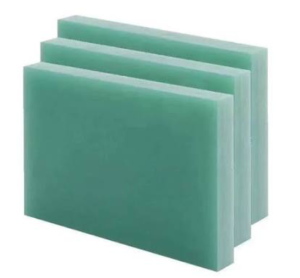
FR-4 is better understood as a material family rather than one standardized formulation with identical performance.
Different laminate manufacturers offer multiple FR-4 grades optimized for different requirements. Examples include materials designed for:
- General-purpose PCB manufacturing
- High-Tg applications
- Low-loss applications
- Lead-free assembly
- High-reliability multilayer PCBs
- Improved CAF resistance
- Low-Z-axis expansion
- High-speed digital applications
- HDI structures
- Halogen-free applications
One of the most commonly discussed differences between FR-4 grades is the glass transition temperature (Tg).
What Does Tg Mean in FR4 PCB Material?
The glass transition temperature (Tg) is the temperature range over which the epoxy resin system undergoes a significant change in mechanical behavior, transitioning from a relatively rigid glassy state toward a softer, rubber-like state.
Tg should not be interpreted as the absolute maximum operating temperature of a PCB. PCB reliability depends on several thermal properties, including Tg, decomposition temperature (Td), coefficient of thermal expansion (CTE), thermal cycling, and the actual operating temperature.
FR-4 materials are often broadly grouped according to Tg:
Standard-Tg FR-4
Typical Tg values are around 130–140°C, although the exact value depends on the laminate grade and test method.
Standard-Tg FR-4 is widely used for general-purpose electronics where operating temperatures and reliability requirements are moderate.
Mid-Tg FR-4
Mid-Tg materials generally fall in the approximate 140–160°C range.
These materials can provide additional thermal margin and may be suitable for applications involving higher assembly temperatures or more demanding thermal conditions.
High-Tg FR-4
High-Tg FR-4 commonly has a Tg of approximately 170°C or higher, depending on the material specification.
High-Tg materials are often selected for:
- Automotive electronics
- Industrial equipment
- Power electronics
- High-reliability multilayer PCBs
- Aerospace and defense applications
- Applications exposed to repeated thermal cycling
The appropriate Tg should always be selected according to the complete application requirements rather than simply choosing the highest available value.
Key Properties of FR4 PCB Materials
FR-4 provides a combination of electrical, mechanical, and thermal properties that make it suitable for a wide range of PCB applications.
Typical properties can vary considerably between different grades. Representative ranges may include:
| Property | Typical Range / Characteristic |
|---|---|
| Dielectric Constant (Dk) | Approximately 3.8–4.7, depending on grade and frequency |
| Dissipation Factor (Df) | Approximately 0.02–0.03 for many conventional grades |
| Volume Resistivity | Typically >10¹³ Ω·cm |
| Dielectric Strength | Approximately 20–50 kV/mm, material-dependent |
| Tensile Strength | Approximately 350–500 MPa |
| Flexural Strength | Approximately 400–600 MPa |
| Tg | Approximately 130–180°C, depending on grade |
| Thermal Conductivity | Approximately 0.3–0.4 W/m·K for many conventional FR-4 systems |
| Flame Resistance | Available in UL 94 V-0 compliant grades |
| RoHS/REACH | Available in compliant grades |
| HDI Compatibility | Dependent on the specific laminate and construction |
These values are representative rather than universal specifications. Engineers should always use the manufacturer’s current datasheet for actual PCB Design calculations.
Electrical Performance
FR-4 provides adequate dielectric insulation for a large percentage of conventional digital, analog, and mixed-signal PCB applications.
However, its Dk and Df vary with resin content, glass weave, frequency, temperature, and measurement method. For high-speed or RF designs, these variations can become important.
Therefore, FR-4 should not be considered a universal high-frequency material.
Mechanical Strength
The woven glass reinforcement gives FR-4 excellent mechanical strength and dimensional stability.
This makes it particularly suitable for rigid PCBs that must withstand:
- Mechanical vibration
- Component insertion
- Handling
- Thermal cycling
- Assembly processes
- Mechanical shock
Thermal Performance
FR-4 provides adequate thermal stability for many general-purpose applications.
However, conventional FR-4 has relatively low thermal conductivity. When a PCB must dissipate substantial heat, engineers may need to use thermal vias, copper planes, heat sinks, thermal interface materials, or alternative substrate technologies.
Flame Resistance
The “FR” designation refers to flame-retardant characteristics. Many FR-4 PCB laminates are available with UL 94 V-0 ratings.
However, not every material marketed simply as FR-4 should be assumed to have identical flame-retardant certification. The actual certification should be confirmed from the manufacturer’s documentation.
Advantages of Using FR4 PCB Material
FR-4 remains popular because it provides a strong balance between performance and cost.
1. Cost-Effective
One of the biggest advantages of FR-4 is its relatively low cost compared with many specialty PCB laminates.
This makes it attractive for:
- Consumer electronics
- Industrial controls
- General-purpose electronics
- Communication equipment
- Computer peripherals
- Prototypes
- Large-volume PCB production
High-performance FR-4 grades cost more than standard grades, but they can still be more economical than specialized RF, ceramic, or other advanced substrates.
2. Excellent Availability
FR-4 materials are widely available through PCB manufacturers and laminate suppliers around the world.
This broad availability helps simplify:
- Material sourcing
- Prototype production
- Mass production
- Replacement sourcing
- Supply-chain management
3. High Mechanical Strength
The combination of woven glass fiber and epoxy resin provides excellent rigidity and mechanical stability.
FR-4 can maintain PCB structural integrity during manufacturing, assembly, transportation, and normal operation.
4. Good Thermal and Flame Resistance
FR-4 is suitable for many applications where the PCB must withstand elevated processing temperatures and moderate operating temperatures.
High-Tg FR-4 grades can provide additional thermal margin for more demanding applications.
5. Good Electrical Insulation
The epoxy/glass structure provides effective electrical isolation between conductive copper layers.
This is particularly important in multilayer PCB construction, where dielectric layers separate signal, power, and ground planes.
6. Chemical and Moisture Resistance
FR-4 generally provides good resistance to many chemicals and relatively low moisture absorption compared with some alternative substrate materials.
However, actual moisture performance varies by laminate grade, resin system, glass content, and environmental exposure.
7. Wide Range of Applications
Because many FR-4 grades are available, engineers can select materials with different thermal, electrical, and mechanical characteristics.
This allows FR-4 to be used in both basic electronics and relatively demanding PCB applications.
FR4 PCB Applications
FR-4 is used across virtually every major electronics sector.
1. General Electronics
General-purpose electronics with moderate signal speeds and thermal requirements commonly use standard FR-4.
Examples include:
- Control boards
- Consumer electronics
- Home appliances
- Industrial controllers
- Interface boards
- Power-control circuits
2. Networking Equipment
FR-4 is widely used in networking hardware, particularly where the electrical performance requirements remain within the capabilities of the selected laminate grade.
For higher-speed communication systems, however, engineers may select low-loss or high-speed FR-4 variants or combine FR-4 with specialty laminates.
3. Consumer Electronics
Consumer electronics represent one of the largest application areas for FR-4 PCBs.
Products such as:
- Computers
- Monitors
- Home appliances
- Smart devices
- Industrial peripherals
- Consumer control systems
may use FR-4 PCB constructions.
For advanced smartphones, laptops, servers, and other high-density products, specialized low-loss, high-Tg, HDI-compatible, or hybrid material systems may also be used.
4. Medical Electronics
FR-4 is used in many medical electronic systems, including certain diagnostic equipment, monitoring systems, control boards, and portable devices.
For regulated medical equipment, material selection must be combined with the appropriate quality, reliability, cleanliness, and regulatory requirements.
5. LED Displays and Signage
High-Tg FR-4 may be used for LED control boards, driver boards, and display electronics when the thermal requirements exceed the capabilities of standard FR-4.
However, high-power LED applications may benefit from aluminum or other thermally optimized PCB technologies when heat dissipation is the primary concern.
FR4 vs. Rogers vs. Polyimide
FR-4 is highly versatile, but it is not the ideal material for every application.
Different substrate technologies are selected according to electrical, thermal, mechanical, and environmental requirements.
| Property | FR-4 | Rogers-Type RF Laminates | Polyimide |
|---|---|---|---|
| Primary Strength | Cost-effective mechanical and electrical performance | Low-loss and stable RF performance | Flexibility and high-temperature capability |
| Mechanical Rigidity | High | Material-dependent | Lower in flexible constructions |
| RF Performance | Moderate; grade-dependent | Excellent for many RF/microwave applications | Application-dependent |
| Flexibility | Generally rigid | Generally rigid | Excellent in flexible circuits |
| Thermal Performance | Moderate to high depending on grade | Material-dependent | Generally strong thermal capability |
| Cost | Low to moderate | Higher | Moderate to high |
| Typical Applications | General electronics, rigid multilayer PCBs | RF, microwave, high-speed communications | Flexible PCB, rigid-flex, aerospace, wearables |
The comparison should not be interpreted as meaning that one material is universally superior. Material selection should follow the actual electrical, mechanical, thermal, and manufacturing requirements.
Limitations of FR4 PCB Material
Despite its versatility, FR-4 has limitations that should be considered during PCB Design.
1. Limited Thermal Conductivity
Conventional FR-4 has relatively low thermal conductivity.
For high-power applications, simply increasing the FR-4 Tg does not solve the fundamental heat-transfer problem.
Engineers may instead use:
- Thermal vias
- Large copper planes
- Heavy copper
- Heat sinks
- Thermal interface materials
- Metal-core PCBs
- Aluminum PCBs
- Hybrid PCB constructions
2. Higher Signal Loss at High Frequencies
Conventional FR-4 generally has higher dielectric loss than specialized RF and low-loss laminates.
At high frequencies and high data rates, insertion loss, dielectric dispersion, glass-weave effects, and impedance variation can become important.
For demanding RF or microwave designs, materials from specialty RF laminate families may be more appropriate.
3. Material Variation
One of the most important considerations is that “FR-4” does not describe one fixed set of electrical properties.
Different grades can have significantly different:
- Dk
- Df
- Tg
- Td
- CTE
- Moisture absorption
- Resin content
- Thermal performance
Therefore, engineers should specify the actual laminate grade rather than simply writing “FR-4” when the application is performance-sensitive.
4. Not Ideal for Flexible PCB Applications
Standard FR-4 is rigid and is not a substitute for polyimide flexible PCB material.
Although specialized semi-flex constructions can incorporate thin FR-4 sections, repeated dynamic flexing normally requires a purpose-designed flexible circuit material and construction.
5. Thermal Expansion
FR-4 has different CTE values in the X/Y and Z directions.
Z-axis expansion becomes particularly important during repeated high-temperature cycles because it can place stress on plated through-holes and vias.
For high-reliability multilayer PCBs, engineers should therefore consider Tg, Z-axis CTE, copper thickness, via geometry, and thermal cycling together.
When Should You Not Use FR4 PCB?
FR-4 may not be the most suitable choice when an application requires:
- Very low dielectric loss
- Extremely stable RF performance
- Microwave-frequency operation
- Very high thermal conductivity
- Continuous dynamic flexing
- Extreme-temperature performance beyond the selected FR-4 grade
- Specialized low-loss high-speed performance
In these cases, engineers may consider:
- Rogers-type RF laminates
- Polyimide
- PTFE-based materials
- Aluminum PCB
- Metal-core PCB
- Ceramic PCB
- Hybrid laminate constructions
However, a specialty material should not be selected simply because it has higher performance specifications. If the application does not require those capabilities, the additional cost and manufacturing complexity may not provide a practical benefit.
How to Choose the Right FR4 Grade
Selecting the correct FR-4 material is an important part of both PCB Design and PCB Manufacturing.
1. Evaluate Electrical Requirements
Check:
- Dk
- Df
- Operating frequency
- Signal rise time
- Controlled impedance
- Transmission-line geometry
- Maximum data rate
For high-speed designs, use material data measured at relevant frequencies whenever possible.
2. Check Tg and Thermal Requirements
Determine the expected:
- Operating temperature
- Reflow temperature
- Number of reflow cycles
- Thermal cycling range
- Localized hot-spot temperature
- Required reliability margin
Then select an appropriate Tg and thermal-performance grade.
3. Evaluate CTE and PTH Reliability
For multilayer and high-reliability PCBs, consider the Z-axis CTE and its relationship to copper plating.
This is particularly important for:
- High-layer-count PCBs
- Thick PCBs
- HDI structures
- Automotive electronics
- Industrial electronics
- Aerospace electronics
4. Consider Thermal Management
If the board generates substantial heat, evaluate the entire thermal path rather than relying solely on a high-Tg laminate.
5. Confirm Manufacturing Compatibility
Make sure the selected material is compatible with:
- PCB stackup
- Prepreg
- Copper foil
- Lamination process
- Drilling
- Plating
- Surface finish
- SMT assembly
- Reflow profile
6. Verify Industry Requirements
Depending on the application, designers may need to consider applicable IPC specifications, UL requirements, RoHS/REACH requirements, automotive requirements, medical requirements, or other market-specific standards.
Compliance should always be verified against the actual material and product documentation.
FR4 PCB Manufacturing Considerations
FR-4 is relatively easy to manufacture compared with many specialty PCB materials, which is one reason for its widespread adoption.
A typical PCB Manufacturing process includes:
- Engineering and DFM review
- Material and stackup selection
- Inner-layer imaging
- Etching
- Layer alignment
- Lamination
- Mechanical or laser drilling
- Hole-wall preparation
- Copper plating
- Outer-layer imaging and etching
- Solder mask application
- Surface finishing
- Electrical testing
- AOI and dimensional inspection
- Final quality inspection
- PCB assembly when required
For High-Tg or high-reliability FR-4, process parameters may need to be adjusted to match the selected laminate system.
This is especially important during lamination, drilling, plating, and thermal processing.
How Kingda Can Support FR4 PCB Projects
Kingda can support customized FR4 PCB Manufacturing projects according to different electrical, mechanical, thermal, and production requirements.
Depending on the project, the manufacturing process can be configured around requirements such as:
- Standard or High-Tg FR-4
- Multilayer PCB
- HDI PCB
- Controlled impedance PCB
- Heavy copper PCB
- Lead-free assembly
- Different surface finishes
- Prototype and volume production
- PCB Assembly
- DFM engineering review
- Electrical and visual inspection
For performance-sensitive designs, the selected FR-4 grade should be confirmed before production so that material characteristics match the PCB’s electrical, thermal, and reliability requirements.
Frequently Asked Questions
Is FR-4 the same as a PCB?
No.
FR-4 is a PCB laminate material, while a PCB is the complete manufactured circuit board.
A PCB may contain copper conductors, FR-4 dielectric layers, solder mask, silkscreen, surface finish, vias, and electronic components.
Is FR-4 suitable for high-frequency PCBs?
It depends on the frequency, loss budget, signal speed, and specific FR-4 grade.
Conventional FR-4 can work well for many moderate-speed designs, but demanding RF, microwave, and very high-speed applications may require low-loss specialty laminates.
What is the difference between standard FR-4 and High-Tg FR-4?
The primary difference is the thermal behavior of the resin system.
Standard FR-4 commonly has a Tg around 130–140°C, while High-Tg FR-4 grades commonly have Tg values around 170°C or higher.
Actual values vary by manufacturer and product grade.
Is FR-4 waterproof?
No.
FR-4 is relatively moisture-resistant compared with many alternative materials, but it is not waterproof.
PCB enclosure design, conformal coating, sealing, surface protection, and environmental protection may be required for products exposed to water or high humidity.
Can FR-4 be used for multilayer PCBs?
Yes.
FR-4 is one of the most widely used dielectric materials for multilayer PCB manufacturing.
Depending on the application, standard, mid-Tg, High-Tg, low-loss, or other specialized FR-4 grades may be selected.
Is FR-4 suitable for HDI PCB manufacturing?
Yes, but not every FR-4 grade is suitable for every HDI structure.
HDI PCB manufacturing requires appropriate dielectric properties, resin systems, laser-drilling performance, dimensional stability, sequential lamination capability, and via reliability.
The laminate should therefore be selected together with the complete HDI stackup.
Conclusion
FR-4 remains one of the most important materials in modern PCB Manufacturing because it provides an effective balance of cost, mechanical strength, electrical insulation, thermal performance, flame resistance, availability, and manufacturability.
Its versatility allows FR-4 to be used in everything from simple consumer electronics to sophisticated multilayer, automotive, industrial, networking, and medical electronics.
However, FR-4 should not be treated as a single material with fixed performance characteristics. Different grades can vary substantially in Tg, Dk, Df, CTE, thermal performance, moisture resistance, and high-speed electrical behavior.
For this reason, successful PCB Design requires selecting the specific FR-4 grade according to the actual operating environment, signal requirements, thermal conditions, reliability targets, and manufacturing process.
When conventional FR-4 is not sufficient, High-Tg FR-4, low-loss FR-4, RF laminates, polyimide, metal-core, aluminum, ceramic, or hybrid PCB constructions may provide more appropriate solutions.
The best material is therefore not necessarily the most expensive one. It is the material that provides the required electrical, thermal, mechanical, and reliability performance while maintaining practical manufacturing cost and supply availability.