Project Overview: Energy Storage Inverter Control PCBA Manufacturing
In modern renewable energy infrastructure, the Energy Storage Inverter Control PCBA plays a critical role in ensuring stable power conversion, grid interaction, and intelligent energy management.
As global demand for photovoltaic storage systems, industrial microgrids, and hybrid energy platforms continues to increase, manufacturers require high-precision, high-reliability PCBA manufacturing solutions that can support long-term stable operation under harsh electrical conditions.
This case study presents a manufacturing and process optimization solution for Energy Storage Inverter Control PCBA, focusing on production engineering, SMT capability, thermal reliability, and system-level stability.
Project Overview
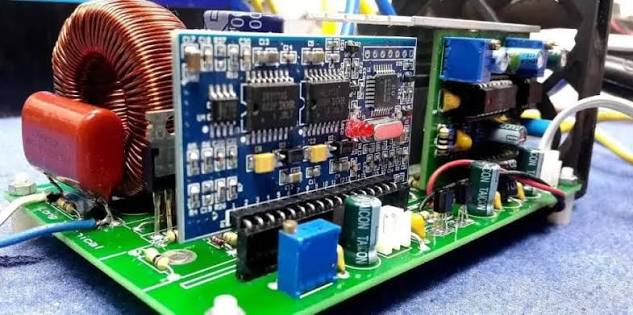
This solution is based on a 3kW continuous-mode totem-pole PFC architecture, designed for next-generation high-efficiency energy conversion systems.
Key Electrical Parameters:
- Input Voltage: 176Vac ~ 264Vac
- Rated Output: 400Vdc / 7.5A
- Rated Power: 3kW Continuous Mode
- Topology: Totem-Pole PFC (Continuous Conduction Mode)
- Control MCU: Single ARM Cortex-M4 MCU
- Wide Bandgap Devices: SiC / GaN power semiconductors
Unlike traditional PFC structures, this solution eliminates the bridge rectifier and diode stage, significantly reducing conduction losses and improving system efficiency.
Key Performance Features
1. High-Efficiency Totem-Pole PFC Architecture
- Continuous mode operation with advanced digital control
- Eliminates reverse recovery losses of traditional MOSFET body diodes
- Replaces silicon devices with SiC / GaN high-speed switching devices
- Peak system efficiency reaches 99.1%+
2. Advanced Digital Control System (Single MCU Architecture)
- ARM Cortex-M4 based control platform
- Integrated digital control loop execution
- Supports:
- Current loop control
- Voltage loop regulation
- Harmonic compensation
- Repetitive control algorithms
Result: Faster execution speed + higher control precision + improved dynamic response
3. Optimized EMI and Switching Stability
- Fixed switching frequency design
- Optimized EMI filter architecture
- Reduced high-frequency noise during high-speed switching
- Improved electromagnetic compatibility (EMC) stability for industrial deployment
4. High Power Density Compact Design
- PCB mechanical dimension: 130 × 240 × 44 mm
- Power density: 25 W/in³
- Compact layout optimized for thermal and EMI balance
- Suitable for high-density energy storage inverter systems
5. Integrated Protection System (MCU-Level Safety Control)
The MCU integrates multiple protection comparators enabling real-time hardware-level safety response:
- Input Under Voltage Lockout (UVLO)
- Input Over Voltage Protection (OVP)
- Output Over Current Protection (OCP)
- DC Bus Over Voltage Protection (BUS OVP)
- Short Circuit Protection
This ensures fast fault response and system-level safety shutdown capability.
Manufacturing Focus: High-Reliability PCBA Production Requirements
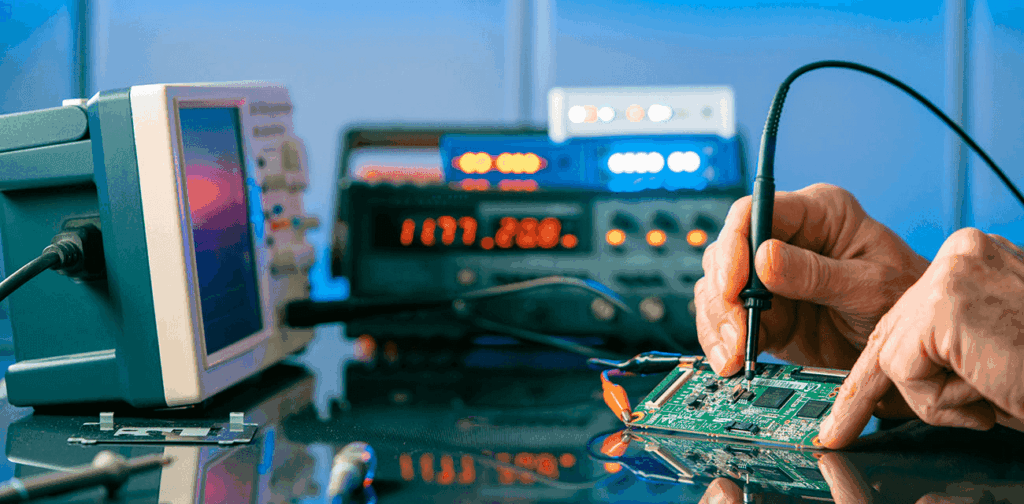
Unlike general consumer electronics PCBA, inverter control boards require industrial-grade manufacturing standards due to high voltage, high current, and continuous operation environments.
Key Manufacturing Challenges:
1. High-Power Thermal Stress
Energy storage inverters operate under sustained load, generating significant heat:
- Requires optimized thermal via structures
- Controlled copper thickness (1–3 oz copper)
- Precision heat dissipation layout during PCB fabrication
- Advanced thermal profiling during SMT reflow process
2. High-Voltage Isolation & Safety Compliance
Manufacturing must ensure:
- Reinforced insulation distance (creepage & clearance control)
- Multi-layer high-voltage separation design execution
- Strict PCB solder mask control for leakage prevention
- Compliance with IEC/UL safety manufacturing standards
3. High-Frequency Noise & EMC Stability
IGBT and MOSFET switching in inverters generates strong electromagnetic interference.
Manufacturing optimization includes:
- Controlled impedance PCB fabrication
- Clean ground plane execution during lamination
- Precision SMT placement to minimize parasitic effects
- EMI shielding assembly integration
SMT & PCBA Assembly Capabilities
To ensure long-term system reliability, manufacturing optimization focuses on:
1. Thermal Reliability Optimization
- Optimized reflow temperature curve for high-mass components
- Controlled solder joint integrity under thermal cycling
- Reinforced pad design for power devices
2. Power Integrity Optimization
- Stable current distribution across multi-layer PCB
- Reduced IR drop in high-current paths
- Optimized copper pour balancing for load stability
3. Long-Term Stability Validation
Each batch undergoes:
- High-temperature aging test
- Thermal shock cycling test
- High-voltage insulation test
- Load endurance simulation
Process Optimization for Energy Storage Applications
Problem:
- Multi-loop control (voltage/current/harmonics) is difficult
- MCU resource limitations affect performance
Our Solution:
✔ ARM Cortex-M4 MCU with integrated IIR modules
✔ Supports:
- Loop control
- Harmonic compensation
- Repetitive control
Result:Faster execution + higher control precision
System-Level Integration Value for Customers
A professionally manufactured Energy Storage Inverter Control PCBA enables OEM/ODM customers to achieve:
1. Higher Energy Conversion Efficiency
Improved switching stability and reduced power loss in DC–AC conversion.
2. Stronger System Reliability
Reduced failure rate under continuous 24/7 operation in grid-connected environments.
3. Intelligent Energy Control Capability
Supports integration with:
- Battery Management Systems (BMS)
- Energy Management Systems (EMS)
- Smart grid communication protocols (CAN / RS485 / Modbus)
4. Lower Maintenance Cost
Stable manufacturing quality reduces field failure and warranty risk.
Application Scenarios
This Energy Storage Inverter Control PCBA is widely used in:
- Solar + Battery Home Energy Storage Systems
- Industrial Peak Shaving Systems
- Smart Microgrid Infrastructure
- EV Charging Station Energy Storage Units
- UPS and Backup Power Systems
Manufacturing Value Proposition
From a production engineering perspective, the key value lies in:
- Stable high-voltage manufacturing capability
- High-density SMT precision assembly
- Strong thermal and EMI process control
- Scalable mass production capability for OEM customers
- Consistent quality control across multi-batch production
The Energy Storage Inverter Control PCBA is not just an electronic assembly—it is a mission-critical industrial power control platform.
Through advanced SMT manufacturing, thermal optimization processes, and strict high-voltage production control, this solution ensures stable operation in next-generation smart energy systems.
As global energy infrastructure moves toward AI-driven smart grids and hybrid storage ecosystems, high-reliability PCBA manufacturing becomes the foundation of system performance and safety.