AOI Programming and False Call Control
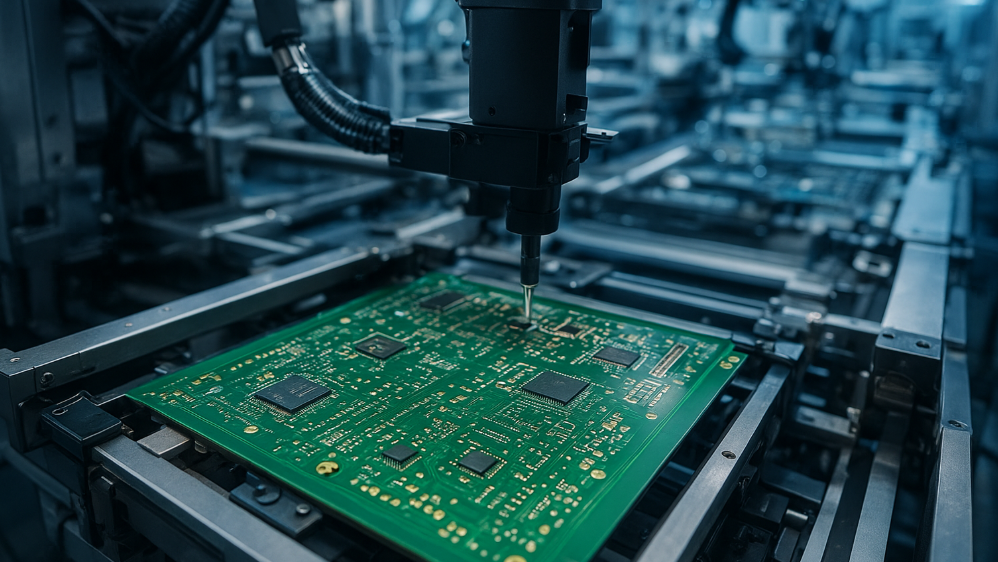
An automated optical inspection station compares what it sees with what it expects, and its value depends entirely on how well the expectation was built. A program with loose thresholds misses defects and one with tight thresholds buries the line in false calls.
Building the Component Library
The library holds a reference image and a tolerance for each package type, including the window for presence, polarity, offset and solder fillet. It should be built from boards that the process has already produced rather than from a drawing.
A library built from one vendor’s parts fails on another’s. Our AOI notes describe the programming steps.
Thresholds and Their Effect
Each detection has a threshold that trades missed defects against false calls. The trade is not symmetrical: a missed defect reaches the field, and a false call costs an inspection minute.
The threshold should be justified per detection rather than set globally. Our yield analysis notes describe how the data is used to set it.
Why False Calls Rise
A change of paste, of mask colour, of component vendor or of lighting will move the image and produce calls that are not defects. The library has to be re taught when any of those changes.
Blocking a call without re teaching the library hides the change. Our defect notes describe the changes that matter most.
What AOI Can and Cannot See
AOI sees the surface: presence, position, polarity, the visible part of the fillet and the silkscreen. It does not see under a package, inside a barrel or into a via.
The coverage should be stated so that the other techniques fill the gap. Our inspection notes describe the boundary.
Inline and Offline Placement
An inline station inspects every board and has to keep pace with the line, which pushes toward fewer and coarser detections. An offline station inspects a sample and can afford more.
The choice follows the product volume rather than the technology. Our floor control notes describe the line balance.
Review and Disposition
Every call is either confirmed, rejected or reworked, and the disposition should be recorded. A station whose calls are mostly rejected is telling the programmer something.
The record of confirmed defects is what justifies the program. Our defect notes describe the classification.
Verification
The verification is a library built from production samples, a documented threshold per detection, and a sample of boards inspected both optically and by another method to confirm that the calls match the defects.
Our quality notes describe how the records are kept.
Additional Considerations for This Build
Practical attention to AOI programming pays for itself here, because it decides whether the finished board behaves as the drawing intended. Where the requirement is not stated on the fabrication drawing or in the assembly notes, the shop has to assume a default, and that default is rarely the value the design was simulated with. Stating AOI programming explicitly, together with the tolerance that applies, removes the assumption and keeps the result predictable from batch to batch.
Deliberate attention to inspection threshold pays for itself here, because it decides whether the finished board behaves as the drawing intended. Where the requirement is not stated on the fabrication drawing or in the assembly notes, the shop has to assume a default, and that default is rarely the value the design was simulated with. Stating inspection threshold explicitly, together with the tolerance that applies, removes the assumption and keeps the result predictable from batch to batch.
Careful attention to pass criteria pays for itself here, because it decides whether the finished board behaves as the drawing intended. Where the requirement is not stated on the fabrication drawing or in the assembly notes, the shop has to assume a default, and that default is rarely the value the design was simulated with. Stating pass criteria explicitly, together with the tolerance that applies, removes the assumption and keeps the result predictable from batch to batch.
Process Control and Verification
On a design of this kind, inspection threshold is the item that decides how the rest of the board is arranged. Keeping a sample from the panel turns a dispute into a measurement, because the same coupon can be re-examined by both parties without rebuilding the batch. Reviewing the design before the data is released is cheaper than correcting it after the panel is in the tank, because every step downstream inherits the decision made at the front end.
Documenting the assumption is part of the design work, and a short note on the drawing prevents a question that would otherwise arrive a day later and cost a day of schedule. The process window is set by the narrowest step in the flow, so an improvement anywhere else shows up as margin rather than as yield until that step is addressed.
A short note on the drawing about handling, storage or packaging is often worth more than an extra decimal place on a tolerance. Where a value sits close to a process limit, the drawing should say so, since the shop can then open the process window rather than working to a nominal figure that carries no tolerance.
A stack-up that is drawn rather than described removes most of the ambiguity from a quotation, and it lets the fabricator price the board against the dielectric and copper weights that will actually be used. Where the requirement is not written down, the shop supplies its own default, and the default is chosen for the process rather than for the design.
The measurements that matter are the repeatable ones: conductor width and spacing, annular ring, finished hole size, plating thickness and surface finish are all verifiable on a coupon that travels with the panel. Running a first article through the same checks as the production panel confirms that the two agree, and that comparison is the cheapest form of process control available at prototype stage.
Process Control and Verification
On a design of this kind, inspection threshold is the item that decides how the rest of the board is arranged. Keeping a sample from the panel turns a dispute into a measurement, because the same coupon can be re-examined by both parties without rebuilding the batch. Reviewing the design before the data is released is cheaper than correcting it after the panel is in the tank, because every step downstream inherits the decision made at the front end.
Process Control and Verification
On a design of this kind, inspection threshold is the item that decides how the rest of the board is arranged. Keeping a sample from the panel turns a dispute into a measurement, because the same coupon can be re-examined by both parties without rebuilding the batch. Reviewing the design before the data is released is cheaper than correcting it after the panel is in the tank, because every step downstream inherits the decision made at the front end.
A first article check confirms that the process and the drawing agree on the points listed above, and that the coupon data supports the values used in the design.
Where a measurement falls outside the expected window, the sample is retained so that the cause can be established before the balance of the batch is released.
FAQ
Is a lower false call rate always better? Only if the escape rate does not rise with it. The two move together and the balance is the programming decision.
Can AOI replace visual inspection? It replaces the routine part of it. The judgement cases still go to a person, with the AOI image as the record.
What does gopcb provide for AOI? We provide a library built from production samples, a threshold justified per detection, re teaching after any change of paste, mask or vendor, a stated coverage against X-ray and visual inspection, and a recorded disposition for every call.