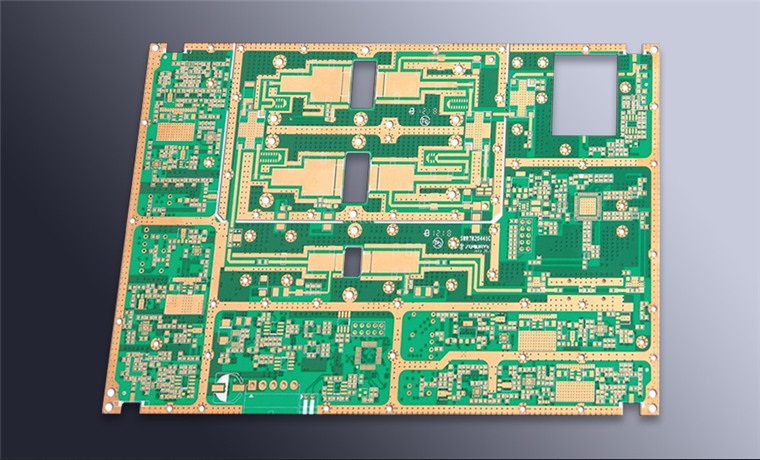
High Speed PCB Design: What Actually Changes Engineers often ask at what clock frequency a board becomes high speed, and the honest answer is that the frequency is not the deciding factor. What matters is whether the interconnections behave as transmission lines, and that depends on how fast the signal…
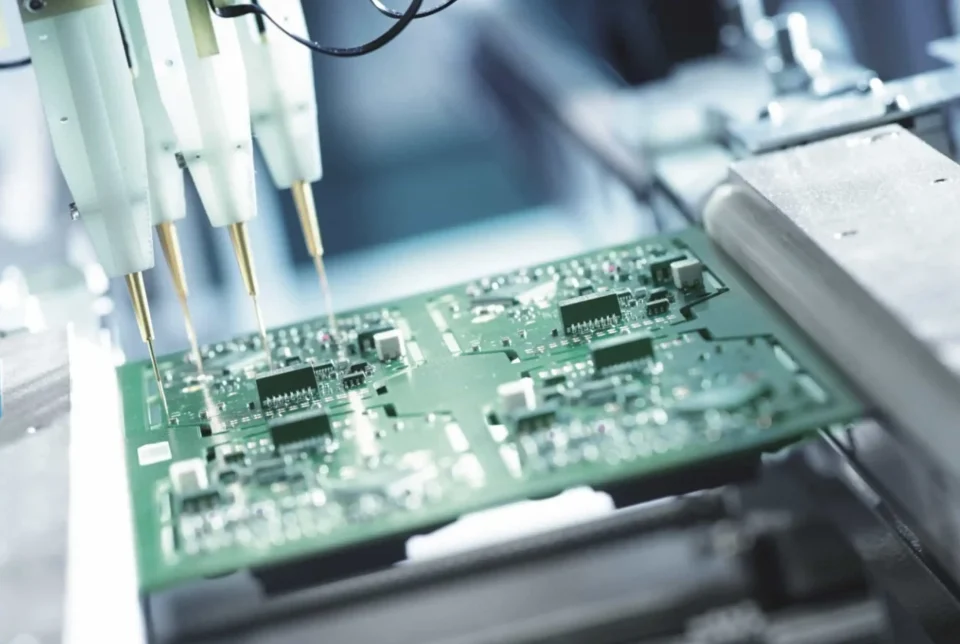
Microsection Analysis of a PCB: What a Cross Section Proves When a board fails and the cause is not on the surface, the cross section is what settles the argument. A microsection takes several hours to prepare and destroys the sample, which is why it is often deferred, and why…
High Speed ADC Clock Design: Jitter and Sampling Stability In a high speed data conversion system the clock is not a support function, it is part of the measurement. An adc samples the input at the instant the clock edge arrives, so any uncertainty in that instant becomes uncertainty in…
Impedance Mismatch In High Speed Routing: What Causes It A high speed link is designed as a transmission line, and a transmission line only behaves as designed when its impedance is the same from end to end. Every place where that uniformity breaks becomes a source of signal reflection, and…
Statistical Process Control on SMT Assembly Lines An SMT line produces thousands of joints an hour, and inspecting them all is neither possible nor economic. Statistical process control takes the opposite approach: measure a small sample often, compare it with what the process normally does, and act when the pattern…
Registration Budget: Keeping PCB Layers Aligned in Production Every layer in a multilayer board has to line up with the layers above and below it, and the permitted error is set by the smallest feature in the design. Registration is the budget that covers film stretch, drill shift, laminate movement…
RTD Sensor Measurement Circuit Design An RTD sensor is the reference choice when a temperature measurement has to be accurate over a wide range, because its resistance changes with temperature in a way that is stable, repeatable and well characterised. The sensor itself is rarely the limiting factor. What limits…
Copper Clad Laminate: The Base of Every PCB Every rigid printed circuit board starts as a sheet of copper clad laminate: a woven glass cloth impregnated with resin, cured, and bonded to copper foil on one or both faces. The laminate is the dielectric, the mechanical structure and the thermal…
Solder Mask for Microwave Assemblies and Soft Soldering A microwave assembly is soldered with the same tools as any other board, but the requirements are different in one important respect: the solder mask is no longer only a protective coating, it is part of the electrical environment. At frequencies above…
Incoming Inspection of Bare Boards: What to Measure and Record A batch of bare boards arrives, the box is opened, one board is held up to the light and the lot is accepted. That single glance is the whole of the receiving inspection process in many programs, and it is…