Footprint Creation and Verification The Footprint Is the Interface A footprint is the board’s interface to a component, and it decides where the paste is printed, where the part is placed and how the joint forms. It is usually drawn once, early, and reused for years, which is why an…

Teardrops and Trace Entry Design What a Teardrop Is A teardrop is a small taper of copper that blends the trace into the pad, so that the junction is a smooth transition rather than a right angle. The taper adds copper at the point where the trace meets the pad,…
Annular Ring and Pad Design Rules What the Annular Ring Is The annular ring is the width of copper that surrounds a drilled hole on the pad. It is what remains after the hole has been drilled through the pad, and it has to absorb the drilling’s position tolerance, the…
Thermal Relief Design for Soldering Why a Plane Makes Soldering Harder A copper plane conducts heat better than the laminate, so a pad that is connected directly to a plane draws heat away from the joint during soldering. The result is a joint that reaches a lower peak temperature, that…
Board Level Shielding and RF Cans When a Shield Is Needed A board level shield, often called a can, is a metal cover over a section of the circuit that confines the field of an emitter or protects a sensitive receiver. It is used when the layout, the filtering and…
Microvia Reliability in HDI Boards What a Microvia Is A microvia is a small laser drilled via, usually with a diameter below about a tenth of a millimetre, that connects an outer layer to the layer immediately beneath it. It is the element that makes a high density interconnect possible,…
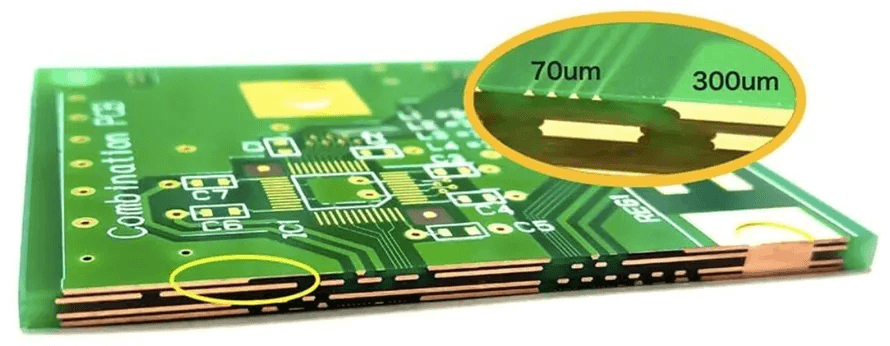
Blind and Buried Vias in Multilayer Boards What the Two Terms Mean A blind via starts at an outer layer and ends at an inner layer, so it is visible from one side only. A buried via connects two inner layers and is not visible from either surface. Both exist…
Backdrilling and Stub Removal The Stub Problem A plated through hole connects every layer it passes through, so a via that is used to connect an inner layer still has a length of barrel below the connection. That unused length is a stub, and at high frequency it behaves as…
Packaging and Shipping Electronics Assemblies The Pack Is Part of the Product A board that is perfect when it leaves the line and damaged when it arrives has failed, and the pack is what stands between the two. The damage can be mechanical, from a drop, a vibration or a…
Burn-In and Stress Screening What Burn-In Is For Burn-in subjects every unit to a period of operation at an elevated stress, usually temperature, in order to precipitate the defects that would otherwise appear in the first weeks of the customer’s use. It works on the premise that a population has…