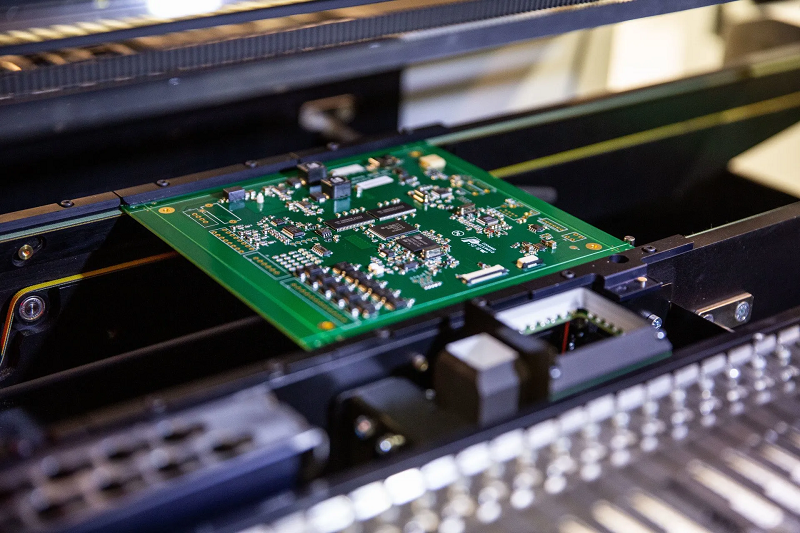
Serialization: Design Rules and Process Limits Traceability is often treated as a labeling task, and it is really a data task. A board that carries a barcode but has no record of which paste lot, which profile or which operator produced it is not traceable; it simply has a number.…
Intermetallic Growth: How Solder Joints Age Every solder joint contains a layer of intermetallic compound where the alloy meets the copper, and that layer is the reason the joint bonds at all. It is also the reason joints fail late, because the layer continues to thicken with time and temperature,…
Stencil Tension and Frame: Why Tension Sets Print Quality Stencil tension is the least visible variable in a printing process and one of the most influential. A slack foil does not peel away from the paste, it sags into the board, and the aperture that was laser cut to a…
Conformal Coating Masking and Keep-Out Control Conformal coating protects a board only where it is allowed to stay, and the parts of the assembly that must remain clear of it are the ones that cause the most trouble. Masking defines the boundary, and a keep-out zone that is too small,…
Solder Preforms for Large Joints: Selection and Placement A solder preform exists for the joints that paste cannot fill: a heavy copper slug, a shield frame, a connector shell where the large joint volume is measured in cubic millimetres rather than in nanolitres. In those places the preform supplies the…
XRF: Preparation, Placement and Process Control XRF is the standard way to check coating thickness on a finished board, and it is also easy to use badly. The instrument reports a number to three decimal places whether or not the calibration, the spot size and the substrate behind the coating…
QFN Thermal Pad Voiding: Causes and Control A QFN thermal pad is a large, flat joint with no leads to carry heat away, and it is the part of the assembly most likely to trap gas. The void that results does not always show up as a defect, which is…
Print Offset Correction: Stencil Alignment and Paste Registration A print offset of a tenth of a millimetre is invisible on a coarse board and fatal on a 0.4 mm pitch device, because the same displacement that leaves a comfortable deposit on one pad spills onto the mask beside the next.…
ESD Damage Investigation: Finding Latent Failures ESD damage is difficult to investigate because the most damaging events are the ones that do not destroy a part. A discharge that passes through a gate oxide leaves a weakened device that passes test, ships, and fails months later. That outcome is called…
BGA Rework: Preheat, Nozzle Size and Thermal Profile BGA rework concentrates a reflow process into a few square centimetres, and everything that is gentle in an oven becomes aggressive at that scale. The board is heated from below, the package from above, and the nozzle decides where the heat lands,…