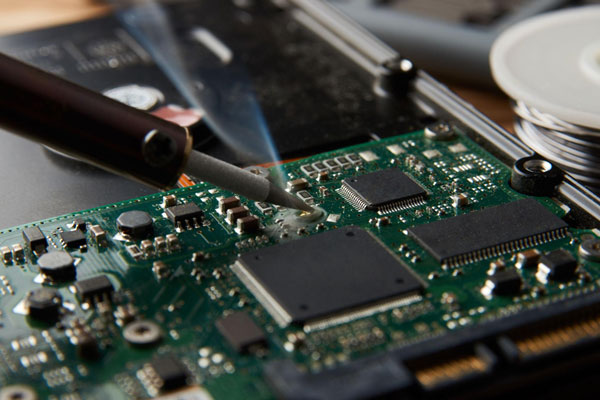
PCB Cross Section Lab Practice: Cutting to See Inside Modern electronics depend on boards that are assembled correctly the first time. Every product – a phone, a charger, a medical instrument or an industrial controller – relies on thousands of solder joints that must conduct current for years. This article…

ENIG Surface Finish: Process, Thickness and Performance Electroless nickel immersion gold is the surface finish that most engineers specify when they want a flat, long lasting, solderable pad and are prepared to pay for it. It is the finish of choice for fine pitch components, for ball grid arrays and…
Controlled Impedance PCB: Principles and Stack-Up Design Controlled impedance means that a trace has a defined characteristic impedance and that the board is built to keep it there. It is one of the few requirements in printed circuit design that cannot be satisfied by the layout alone, because it depends…
Copper Core PCB: Thermal and Electrical Advantages Explained A copper core PCB uses a solid copper base instead of aluminium under the dielectric. The construction looks like an ordinary metal core board, but the difference in thermal conductivity is large enough to change what the board can do. Copper conducts…
Data Acquisition PCB Design for Industrial Systems A data acquisition PCB in an industrial setting has to measure signals that arrive from sensors tens or hundreds of metres away, in an environment full of motors, contactors and variable-frequency drives. The measurement chain has to survive that environment and still resolve…
Resin Plugging vs Via Tenting: Choosing the Right Via Treatment A via can be left open, covered with solder mask, filled with mask ink or filled with resin and capped. The choice looks like a detail on the fabrication drawing, but it decides whether solder balls form during assembly, whether…
ACF vs FPC: Anisotropic Conductive Film in Flex Assembly An anisotropic conductive film is a bonding material, not a circuit board. It is a thin adhesive loaded with conductive particles that conducts in one direction only, so a row of fine pitch pads on a flex circuit can be joined…
Ferrite Bead Selection for EMI Suppression on PCBs A ferrite bead looks like an inductor and is often drawn like one on a schematic, but it behaves differently. It is specified in ohms rather than henries because the important figure is the impedance it presents at a given frequency, not…
LED Aluminum Substrate Thermal Conductivity Explained An LED aluminium substrate is judged on three numbers: thermal conductivity, thermal resistance and dielectric strength. The aluminium plate is not the limiting factor, because aluminium conducts heat well. The thin insulating layer between the copper circuit and the metal base decides almost everything,…
PCB Selective Solder Nozzle Cleaning: Keeping the Fountain Open Electronics manufacturing has become a discipline of small details. Solder paste volumes, placement accuracy, temperature profiles and inspection limits all add up to the final result. This guide looks at PCB selective solder nozzle cleaning from the perspective of a PCBA…