Bow and Twist Measurement in PCB Fabrication
A board that is not flat is difficult to print, difficult to place components on, and difficult to fit into an enclosure. Bow and twist are the two numbers that describe how far the board departs from a plane, and they are measured on every panel that leaves a fabrication shop. Understanding how they are defined makes it easier to specify a realistic limit and to identify the process step that is causing a problem.
Defining Bow and Twist
Bow is a curvature along one axis, so that the board forms a shallow cylinder and the corners opposite the highest point lift off a flat surface. Twist is a rotation about the diagonal, so that one corner is high and the opposite corner is low while the other two sit near the surface. A real board usually shows a combination of both, and the measured value is the maximum departure from the reference plane expressed as a percentage of the diagonal length.
The reference is a flat surface, usually a granite plate or a precision table, with the board resting on it under its own weight. The measurement is taken at the point of maximum lift, and the figure is divided by the diagonal to give a percentage. Because the definition depends on how the board is supported, the standard used to measure it should be stated with any result.
What Causes a Board to Leave Flatness
Laminate stress is the most common cause. Each layer of prepreg shrinks as it cures, and a stackup with unequal copper distribution or asymmetric construction shrinks more on one side than the other, which bends the finished board. The thicker the board, the more force the imbalance generates, so a heavy copper design is more prone to bow than a thin signal board.
Drilling and routing contribute as well, particularly when a large area of copper is removed on one side only. Thermal history matters during assembly: the board is heated above the glass transition temperature, where the resin softens and stress can relax, and the way it is supported during that excursion determines how flat it stays afterwards. A board that leaves the factory flat can therefore bow after the first reflow if the support and the profile are not appropriate.
How the Measurement Is Taken
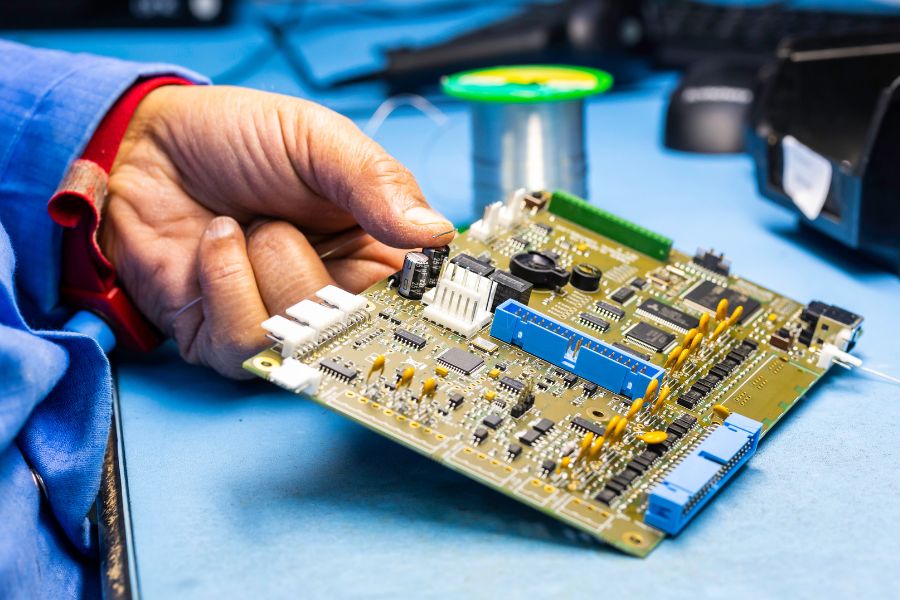
The board is placed on the reference surface and the lift is measured with a height gauge, a dial indicator on a stand, or increasingly with a vision or laser system that scans the surface. Manual measurement is quick but depends on finding the true maximum, which is why several points along each diagonal are checked rather than one. Automated systems map the whole surface and report the maximum, which is more repeatable but requires calibration.
Temperature and humidity affect the result. A laminate absorbs moisture and swells, and the amount of bow changes as the moisture content changes. Measurements taken immediately after a wet process differ from those taken after the board has equilibrated, so the conditioning before measurement should be defined. This is one reason that a specification often refers to a measurement made after a specified bake.
Limits and Classes
Common acceptance criteria are expressed as a percentage of the diagonal, with 0.75 percent used for surface mount boards and 0.5 percent for boards with fine pitch parts, while some general purpose products allow up to 1.5 percent. The tighter figure exists because the printing and placement processes assume that the board lies flat against the machine tooling, and a board that bows beyond that cannot be held down reliably.
The class of product should drive the limit rather than the fabricator’s default. A design with a large ball grid array needs a flatter board than one with only through-hole parts, because the ball array cannot tolerate a gap. Where the assembly uses a pallet or a vacuum fixture, a slightly less flat board may still be workable, and the limit should be set with that process in mind.

Copper Balance and Layer Symmetry
The most effective design measure is symmetry. Keep the copper distribution similar on both sides of the neutral plane, and avoid a stackup in which one side carries a large plane while the other carries only traces. Where a heavy copper layer is required, balance it with copper on the opposite side, even if that copper is not electrically needed, and connect it appropriately.
Symmetry also applies to the construction. The same prepreg type and thickness on each side of the core produces a more stable result than a stackup that mixes materials. Where different materials must be used, the imbalance should be evaluated rather than accepted, because a board that is marginal on flatness will worsen after the thermal excursions of assembly.
Effects on Assembly
A bowed board behaves differently at every process step. In printing, the stencil does not sit flat and the paste deposit varies; in placement, the machine’s height reference is wrong and components are pressed or dropped; in reflow, the warped board can shift components and produce solder defects. Twist is particularly damaging for a board that must fit into a housing, because the mounting holes no longer align with the bosses.
The effect is amplified by a two sided assembly. The first reflow heats the board and relaxes some stress, and the second reflow changes the shape again. Where the resulting bow exceeds the machine’s tolerance, the process becomes marginal and the yield drops without an obvious cause. Measuring the board flatness before and after assembly is a useful diagnostic when a line suddenly develops placement defects.
Corrective Measures in Fabrication
A fabricator has several levers. The lamination cycle can be adjusted to reduce residual stress, with a slower cool-down under pressure giving a flatter result. The stackup can be rebalanced, which may require a change in the layer construction that the designer must approve. Panels can be pressed flat after lamination, and the drilling and routing parameters can be adjusted to reduce mechanical stress.
Where the board must be very flat, a thicker core and thinner prepreg generally help, and a material with a lower coefficient of thermal expansion reduces the movement during assembly. The intended use should be stated on the drawing, because a board specified for fine pitch assembly needs a different process from one specified for general use, and the difference is in the process time and cost. The ‘+L(‘pcb-dimensional-stability-expansion’,’dimensional stability’)+’ discussion and the ‘+L(‘multilayer-pcb-prototype-requirements’,’prototype requirements’)+’ cover the related parameters.
FAQ
What is an acceptable bow and twist? Around 0.75 percent of the diagonal for surface mount boards and 0.5 percent for fine pitch work is common, with the figure quoted from the applicable standard and the measurement conditions stated.
Can a bowed board be flattened after assembly? Not reliably. The flatness has to come from the stackup and the lamination process, because assembly introduces its own thermal history and any correction applied afterwards will not be stable.
Does moisture affect the measurement? Yes. A laminate swells as it absorbs moisture, so the measured value depends on conditioning. The specification should state whether the board is measured as received or after a bake.